Repair vs Replace HVAC: A Practical Guide for Homeowners
A data-driven comparison of repairing versus replacing your HVAC system, focusing on age, reliability, energy efficiency, and long-term costs. Home Repair Guide analyzes when to fix versus upgrade for comfort and value in 2026.


When facing a malfunction, the repair vs replace hvac decision hinges on age, reliability, and energy goals. A repair may be sensible for a relatively new, dependable system, while replacement often delivers greater efficiency and fewer interruptions in the long run. Use a structured cost-benefit check to decide today, then plan for future upgrades as needed.
HVAC aging and the repair vs replace decision
Navigating the repair vs replace hvac question starts with understanding that most homes rely on a single heating and cooling system for year-round comfort. As components wear, reliability shifts and energy efficiency declines. The Home Repair Guide team has found that the best choice is rarely a one-size-fits-all answer; instead, it depends on the unit’s age, service history, and how a repair would influence comfort over the next several seasons. In this section, we unpack the core concepts—age-related performance, common failure modes, and how small fixes can delay a full upgrade while a full replacement promises modern efficiency and quieter operation.
Throughout this guide, you’ll see practical criteria you can apply to your own situation, from fuel type and system type to maintenance history and expected future energy costs. The aim is to give you a defensible framework for deciding between repair vs replace hvac that keeps your home comfortable without overspending.
When a repair is the smarter move: signals and scenarios
Repairing makes sense when the system remains relatively young or mid-life (typically under a decade or so, depending on usage and climate), a component failure is isolated, parts are readily available, and the total repair cost is reasonable compared with a potential upgrade. If you find that the issue is a single compressor capacitor, a fan motor, or a blown fuse, and the rest of the unit is performing reliably, a targeted repair can restore comfort quickly. Additionally, when the system cools or heats adequately but exhibits intermittent issues, repairing is often the lowest-risk path. Consider also the cost trajectory: a modest repair now can extend the life of the existing equipment and defer the need for replacement until you can justify a modern, energy-efficient upgrade.
This section emphasizes a practical mindset: quantify the repair’s impact on reliability, comfort, and energy use over the next 3–5 years before making a decision. The goal is to avoid knee-jerk replacements while recognizing when the current system is no longer cost-effective to maintain.
When replacement is warranted: signals and scenarios
Replacement becomes attractive when the system is older, has a history of recurring failures, or delivers poor energy performance that raises monthly bills. A notably inefficient unit may require frequent repairs that don’t meaningfully restore comfort, or it may lack support for newer refrigerants and smart controls. In such cases, a new system typically yields better long-term energy savings, improved humidity control, and enhanced indoor air quality. If you notice rising repair frequency, diminished cooling or heating, unusual noises, refrigerant odors, or uneven room temperatures, it is time to compare upgrade options.
Another key factor is warranty coverage. A new installation often comes with extended warranties, which can lower long-term maintenance risk and provide peace of mind. When evaluating replacement, consider not only the upfront cost but also the anticipated energy savings, improved comfort, and potential tax incentives or rebates that can offset the investment over time.
Overall, replacement is usually the stronger choice when the existing system cannot reliably meet your climate needs, or its efficiency has fallen well below modern standards.
Lifecycle costs and break-even concepts: a framework you can use
Understanding lifecycle costs is essential to decide between repair and replacement. The trade-off isn’t only the immediate expense; it’s the total cost of ownership over the unit’s remaining life. A newer unit typically delivers higher efficiency, which translates into lower energy bills and reduced maintenance over time. If you own an older system, the incremental savings from a replacement may offset the larger upfront price sooner than you expect.
A practical approach is to approximate three financial factors: (1) upfront costs, (2) predictable maintenance over the next 5–10 years, and (3) energy savings from improved efficiency. Even without exact numbers, you can compare scenarios in qualitative terms: a repaired system with ongoing maintenance versus a newer model with better efficiency and a longer warranty. Home Repair Guide’s analysis shows that most households reach a break-even point where replacement pays for itself through energy savings within a reasonable horizon, especially in hot or cold climates where HVAC use is heavy.
Keep in mind that local climate, insulation, and thermostat usage influence these dynamics, so tailor the analysis to your home.
How to estimate repair costs and replacement investments: a practical checklist
To make a defensible repair vs replace hvac decision, start with transparent pricing and clear expectations. Gather at least three written quotes from licensed HVAC professionals. Ask for a breakdown: parts, labor, and any additional costs for refrigerant or refrigerant recharging, ductwork adjustments, or electrical work. Request a list of potential repairs with estimated timelines and the expected impact on efficiency and comfort.
When evaluating replacement, obtain bids for multiple reputable units with similar SEER ratings and warranties. Have the contractor explain the expected energy savings, noise levels, and maintenance needs. Ask about refrigerant compatibility, compatibility with smart thermostats, and the availability of service in your area for the chosen model. Keep a comparison sheet to weigh upfront costs against long-term value, factoring in potential rebates or financing options.
Finally, get a second opinion if a single estimate heavily skews high or low. A balanced approach reduces the risk of overspending or underestimating future maintenance.
Practical steps to maximize ROI in either path: maintenance, upgrades, and habits
Whether you repair or replace, ongoing maintenance is the most reliable route to sustained comfort and efficiency. Schedule seasonal inspections, replace air filters monthly during peak usage, and seal leaks in ducts and around penetrations. Consider upgrading to a programmable or smart thermostat to optimize energy use, and ensure proper insulation in attic spaces and around ductwork to minimize heat gain or loss.
If you choose replacement, select a model with a high SEER rating, a reliable compressor, and compatibility with variable-speed operation for steady temperatures. For repairs, prioritize components with the highest return on investment, such as capacitor replacements, fan motor repairs, or refrigerant leak fixes. In any case, align maintenance with a formal maintenance schedule so you don’t overlook critical tasks.
Financial incentives, financing, rebates, and planning: offsets to consider
Governments and utilities offer incentives that can reduce the net cost of a replacement or energy-saving improvements. Rebates, tax credits, and low-interest financing programs may be available depending on your location and the equipment selected. Your contractor can usually help identify eligible programs and assist with documentation. Even when incentives are modest, they can tip the decision in favor of a more efficient system when the long-term energy savings are substantial. If you’re repairing, you may still qualify for maintenance rebates or incentives related to efficiency upgrades, such as ducts or insulation improvements, which can improve overall system performance.
Planning ahead with a budget and a 3–5 year improvement plan makes it easier to balance immediate needs against future energy savings. Home Repair Guide recommends documenting your decision with a written plan that includes maintenance milestones, replacement triggers, and expected energy performance goals.
Common myths about repair vs replace hvac: separating fact from fiction
Several myths persist around repair vs replace decisions. A common belief is that repairs always cost less and are enough to keep a system running for many years. In reality, frequent repairs can indicate an aging system that will never reach the reliability of a newer installation. Another myth is that replacement is always disruptive and expensive; times have changed, and professional installations are faster, quieter, and more energy-efficient than ever. A final myth is that older units are always compatible with modern thermostats; some older refrigerants and components require replacement to meet current efficiency and environmental standards. By debunking these myths, you can approach the decision with clear expectations and avoid costly missteps.
How to talk to contractors and evaluate bids: a practical talk track
Effective communication with HVAC contractors is essential for an apples-to-apples comparison. Start with a written scope of work that specifies unit type, SEER rating, warranty terms, and expected timelines. Request itemized bids with separate line items for installation, refrigerant handling, duct sealing, and disposal. Ask for references and photos of similar installations, and verify licenses and insurance. During conversations, ask how the contractor would measure post-installation performance and what guarantees or maintenance plans are included. Finally, compare energy-saving claims against independent standards (such as SEER/HSPF benchmarks) to ensure realistic expectations.
Real-world case studies: scenarios homeowners often encounter
Consider a 12–15 year-old central A/C system that has shown intermittent cooling issues and rising energy bills. Repairing the most likely causes (compressor controls or condensate drainage) may restore comfort for a season or two, but each repair adds to the risk of future failures. In this scenario, replacement with a modern high-efficiency system could yield improved comfort, quieter operation, and energy savings that justify the upfront investment. In another case, a home with excellent insulation and a smaller system could see long-term payoff from repair if the unit remains reliable and energy use stays within reasonable bounds. These examples illustrate how the decision depends on age, reliability, and energy goals rather than the repair vs replace hvac question alone.
Energy efficiency, indoor air quality, and long-term value: a broader perspective
Energy efficiency improvements go beyond SEER and HSPF ratings. A newer system often provides better humidity control, improved filtration, and reduced duct leakage, contributing to healthier indoor air quality. Even modest improvements in insulation and air sealing can magnify the benefits of a new HVAC installation, making a replacement worthwhile when paired with home efficiency upgrades. If IAQ concerns are a priority—for example, allergies or sensitivities—upgrading to a system that supports advanced filtration or media air cleaners can deliver tangible health and comfort benefits.
Decision framework: a quick-reference checklist for repair vs replace hvac
Use this concise framework to guide your choice:
- Age and reliability: Is the system near or past its expected life and frequently failing?
- Repair history: Are recent repairs becoming routine rather than exceptional?
- Energy costs: Are bills rising despite proper maintenance?
- Availability and cost of parts: Are critical components still supported and affordable?
- Comfort and IAQ: Do you notice humidity issues or poor filtration that a new unit would address?
- Warranty and incentives: Are you eligible for a warranty or rebates that improve the cost-benefit balance?
- Contractor guidance: Do multiple qualified bids converge on a clear recommendation?
If most factors favor efficiency, reliability, and improved comfort, a replacement with a high-efficiency model may be the best long-term investment. If a repair addresses a minor issue in a system with solid remaining life, maintenance-focused planning can deliver value without premature replacement.
Comparison
| Feature | Repair | Replace |
|---|---|---|
| Upfront cost | Lower upfront expense for targeted fixes | Higher upfront investment for a new system with installation |
| Long-term costs | Depends on maintenance and part availability; can be moderate | Often lower operating costs due to improved efficiency and warranties |
| Reliability and downtime | Short outages for fixes; reliability depends on current components | Long-term reliability with modern components and service support |
| Energy efficiency | Efficiency limited by aging components | Significant potential gains with high-efficiency models |
| Warranty and support | Limited or no warranty after many years of use | New equipment includes warranties and ongoing service options |
| Disruption and installation time | Minimal disruption for repairs | Installation requires scheduling, removal, and rebalancing of systems |
| Incentives and rebates | Less likely to qualify for incentives | Often eligible for rebates, financing options, and tax credits |
Upsides
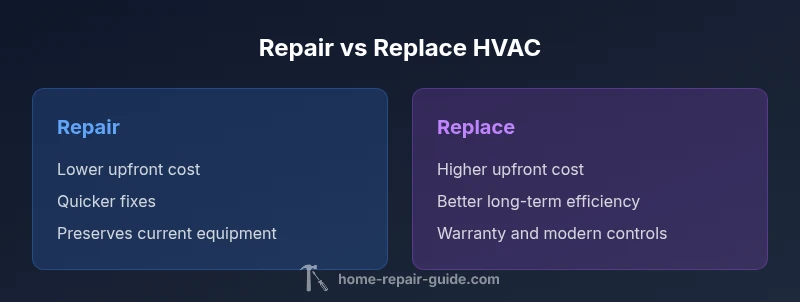
- Lower upfront costs for repairs
- Faster turnaround for minor fixes
- Preserves current system if components are compatible
- Less waste when repairs suffice
Disadvantages
- Frequent repairs can add up over time
- Older units may remain inefficient and cost more to operate
- Repair parts may become scarce as units age
Replacement is often the better long-term value when the system is old or inefficient.
If the HVAC shows frequent failures or energy bills rise, a modern replacement typically saves more over time. Repair is reasonable when the unit remains reliable and within budgeted maintenance plans.
FAQ
What is the typical lifespan of an HVAC system?
Most HVAC systems last about 10–15 years with regular maintenance. After that, performance and reliability tend to decline, and replacement becomes more attractive. This is a common inflection point in the repair vs replace hvac decision.
Most HVAC systems last around a decade or more with proper care.
Should I repair if only one major component fails?
If the failed component is affordable and the rest of the system is in good shape, repair makes sense; otherwise replacement may prevent recurring issues and ensure reliability.
Repair when a single component fails and the rest of the unit is solid.
How do energy costs affect the decision?
Older units are typically less energy-efficient, which raises operating costs. Replacing with a high-efficiency model can reduce energy use and improve comfort, especially in extreme climates.
Energy savings from a newer unit can be substantial in hot or cold weather.
Are rebates available for replacement?
Rebates and financing options are commonly available for efficient replacements, depending on location and programs. A contractor can help identify eligible incentives and assist with paperwork.
Check for rebates when upgrading to a high-efficiency unit.
How do I evaluate bids from contractors?
Request itemized bids with scope, equipment specs, warranties, and timelines. Check references, licenses, and insurance, and compare energy performance data to ensure apples-to-apples comparisons.
Get written, detailed bids and verify credentials.
Key Takeaways
- Assess system age and repair history before deciding
- Weigh immediate repair costs against projected energy savings
- Consider energy efficiency gains from a new unit
- Obtain multiple bids and verify warranties