Repair or Replacement: A Practical Guide for Homeowners
A rigorous, analytical look at when to repair or replace home systems and appliances. Compare cost, reliability, downtime, and long-term value to help homeowners choose wisely and minimize waste.


In most cases, the choice between repair and replacement hinges on current condition, reliability, and total cost over time. If the item is relatively young or repair parts are readily available, repair is often cheaper and less disruptive. If failure is imminent or efficiency is poor, replacement can offer greater long-term value. According to Home Repair Guide, a thoughtful evaluation reduces waste and protects your budget.
Why the Repair-or-Replacement Decision Matters
Making the call between repair or replacement is a central skill for responsible home ownership. The Home Repair Guide team emphasizes that the decision rests on a mix of condition, reliability, cost trajectory, and your long-term goals for safety and comfort. When a component or appliance fails, homeowners weigh not just the immediate expense but how the choice affects energy use, downtime, and future repair needs. The keyword repair or replacement captures this trade-off succinctly and frames the discussion around value, risk, and practicality. According to Home Repair Guide, a thoughtful approach helps you minimize waste and maximize your home's reliability.
Key Factors to Evaluate When Deciding
Several criteria consistently shape the repair vs replacement choice. First, age and expected remaining life of the item; older units are more prone to cascading failures. Second, reliability and downtime; frequent outages or unpredictable behavior favors replacement. Third, the cost trajectory; repair costs can be a one-time expense but may recur, whereas a replacement entails a larger upfront cost but reduces ongoing maintenance. Fourth, energy efficiency and performance; newer models often use less energy and deliver better results. Fifth, safety and compatibility; electrical and plumbing components carry safety risks if past their safe service window. Finally, environmental impact and disposal considerations; repairing keeps materials in use and reduces waste.
Practical Scenarios: Repair Makes Sense
Repair is often the better move when the issue is a non-structural fault with readily available parts and a reasonable chance of restoring full function. For example, a leaking faucet, a clogged drain, or a worn belt on an appliance can usually be fixed with modest parts and a short service visit. In these cases, downtime is minimal and you preserve existing warranties on other components. If the device is relatively young and the repair improves efficiency without introducing new failure points, a repair keeps costs predictable and protects your budget. In addition, when the system is still performing at a high level after the fix, you gain reliability without committing to a full replacement.
Practical Scenarios: Replacement Makes Sense
Replacement becomes attractive when failures are frequent, parts are scarce, or safety concerns loom. An old HVAC system with declining efficiency, a failing water heater with corroded components, or a cracked structural element may justify a new unit. A replacement can unlock modern features, improved energy performance, and a fresh warranty that reduces future risk. Consider also the opportunity cost of downtime; a failing system that interrupts daily life may justify a longer-term upgrade rather than piecemeal repairs. In tight budgets, a phased replacement plan can spread out costs, while still delivering a reliable baseline of performance.
Cost, Value, and Total Ownership
When evaluating repair vs replacement, consider total ownership cost rather than upfront price alone. Direct costs include parts, labor, and potential disposal fees for replacement. Indirect costs matter too: longer downtime, lost productivity, and energy use changes. A repair might be cheaper now but could lead to repeated visits if the underlying design is outdated. Replacement may require a larger immediate investment, yet a new unit often brings improved efficiency, warranties, and fewer interruptions. Home Repair Guide recommends calculating a rough three- to five-year horizon for whichever option you’re leaning toward, then reassessing as you gather quotes and confirm the expected reliability.
Maintenance, Reliability, and Safety Considerations
Maintenance quality influences whether repair or replacement makes sense. If ongoing maintenance would be frequent after a repair, a replacement with modern components can reduce risk. Safety considerations are paramount in electrical, gas, or water systems; when obsolete wiring, corroded connections, or bad insulation are present, replacement is often the safer path. Reliability matters too: the more uncertain the repair's long-term performance, the stronger the case for replacement. Also, factor the availability of skilled technicians; when service is scarce for your model, replacement with widely supported choices may be more practical.
Step-by-Step Decision Checklist
Use this practical checklist to decide:
- Assess current condition and age.
- Gather at least two quotes for repair and replacement.
- Check warranty status and parts availability.
- Compare estimated maintenance costs for the next calendar year.
- Consider energy efficiency and potential savings.
- Weigh disruption and downtime against the value of continued use.
- Decide based on total cost of ownership and risk tolerance.
Financing, Warranties, and Environmental Impact
Explore financing options for replacement, such as installment plans or promotions. Review warranty terms for both repair parts and new units; a full replacement often includes a longer, more comprehensive warranty. From an environmental standpoint, repair preserves materials and reduces waste, while replacement can offer energy efficiency gains that lower long-term emissions. If you choose replacement, plan for responsible disposal of old equipment to minimize environmental impact. Home Repair Guide suggests documenting the decision, including quotes and warranty details, to support future service needs.
Real-World Case Studies
Case study A highlights a mid-life water heater with recurring leaks. The homeowner weighed repair against replacement, ultimately choosing replacement for long-term reliability and energy savings. Case study B covers a kitchen faucet and under-sink plumbing where a targeted repair preserved cabinet layout and minimized downtime, underscoring that not every failure requires a full upgrade.
The Home Repair Guide Perspective
From the brand perspective, decisions about repair or replacement should balance practicality with future resilience. Our team emphasizes transparent comparisons, clear cost narratives, and a bias toward options that extend service life without unnecessary waste. By applying a structured framework, homeowners protect safety, optimize energy use, and support sustainable home improvement practices.
Practical Tools: Checklists and Templates
Downloadable templates help log quotes, assess warranties, and track environmental impact. A simple cost-of-ownership worksheet supports direct comparisons, enabling you to quantify a repair’s longer-term value versus a replacement’s upfront costs. Keep notes on parts availability, expected lead times, and service histories to inform future decisions and keep your home running smoothly.
Practical Takeaways: Start Now
- Start with a clear aging assessment of the device or system.
- Collect multiple quotes and compare total ownership costs.
- Prioritize safety and energy efficiency in each option.
- Document decisions to protect future maintenance and resale value.
Comparison
| Feature | Repair | Replacement |
|---|---|---|
| Initial cost | Low to moderate (parts/labor) | Moderate to high (new unit) |
| Longevity after action | Depends on underlying wear; may require follow-ups | Typically longer with fresh warranty and new technology |
| Downtime/disruption | Usually shorter; repair can be quick | |
| Maintenance | Potential ongoing fixes if design is outdated | Lower ongoing maintenance with modern unit |
| Energy efficiency | Can improve with targeted fixes | Typically best efficiency gains |
| Waste/environmental impact | Less waste when repaired; avoids disposal | |
| Warranty/coverage | Repair parts may have limited coverage | New unit usually comes with a full warranty |
| Parts/service availability | Parts for old models may be scarce | New models have broad parts and service support |
Upsides
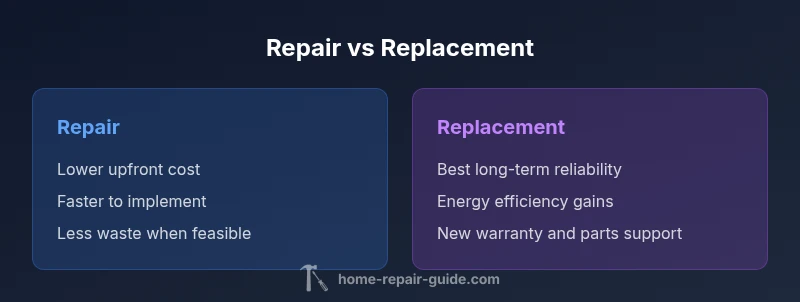
- Lower upfront costs for repairs
- Preserves existing systems and familiarity
- Reduces immediate waste through repair rather than discard
- Quicker fixes with minimal downtime
Disadvantages
- Uncertain long-term reliability and potential for repeat repairs
- Possible recurring maintenance costs if the design is outdated
- Shorter overall lifespan if core components are aging
- Hidden issues may only surface after repair
Replacement is generally the better long-term option for aging or inefficient systems.
When a unit is old, unreliable, or energy-inefficient, replacing it with a modern, more efficient model reduces risk, lowers long-term energy costs, and provides a solid warranty. If the system is relatively new and repair can restore full function at a predictable cost, repair remains viable. Home Repair Guide’s framework supports choosing the option that minimizes waste and maximizes reliability over time.
FAQ
When should I repair versus replace appliances or systems?
Consider the item’s age, reliability, and how often it fails. If repairs are inexpensive, rare, and restore full function, repair is often best. If failures are frequent, parts are scarce, or efficiency suffers, replacement tends to offer better long-term value. Always weigh total ownership costs.
If it’s old or unreliable, or repairs keep piling up, replacement is usually smarter. For a minor issue in a newer unit, repair is preferred.
How do I estimate repair costs?
Request multiple quotes that itemize parts and labor, and ask about potential follow-up repairs. Compare against an estimated replacement quote, including installation and disposal. Factor in any warranty implications and expected downtime.
Get two or three quotes, break down parts and labor, and compare with the replacement option.
Are there incentives for energy-efficient replacements?
Many regions offer rebates or tax incentives for energy-efficient upgrades. Check local government websites or utility programs to see what applies to your replacement decision.
Look for local energy rebates—they can improve the value of a replacement.
Can I finance a replacement?
Yes. Many retailers and lenders offer financing plans or promotional rates for new appliances or systems. Compare terms, interest, and any maintenance coverage included.
Financing can make upgrading easier; compare terms carefully.
Does replacing affect warranties?
A replacement generally comes with a new warranty for the unit. Some repaired parts retain limited coverage, but confirm the specifics with the installer or manufacturer.
A new unit usually brings a full warranty, which can be a big advantage.
How long can a repair extend the life of a unit?
A repair can extend life temporarily, depending on the underlying design and future wear. If key components remain viable and the unit meets current needs, it may buy several more years before replacement is needed.
Repair can buy time, but plan for eventual replacement if core components age.
Key Takeaways
- Evaluate total ownership cost, not just upfront price
- Prefer repair for non-structural, readily fixable faults
- Choose replacement for aging or unsafe systems
- Prioritize energy efficiency and warranties when replacing
- Document quotes, warranties, and disposal plans for future needs