Why Not Repair: A Practical Guide to Fix vs Replace
Learn how to decide when to repair or replace home systems and appliances. This educational guide covers costs, safety, reliability, and budgeting with practical steps for homeowners and renters.


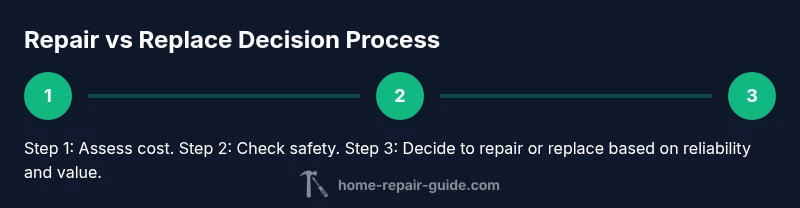
In home projects, deciding whether to repair or replace starts with a quick framework: compare repair costs to replacement price, check for safety risks, assess reliability and energy efficiency, and consider warranty terms. If the repair restores safe operation at a reasonable cost and extends the item’s life, repair is usually the smarter choice. Otherwise, replacement may yield greater long-term value.
Why not repair? Framing the question for homeowners
The phrase “why not repair” isn’t a dismissive dodge; it’s a thoughtful prompt to assess value, risk, and long-term performance. When you start with the right questions, you build a clear path toward a decision that saves money while preserving safety and comfort. According to Home Repair Guide, the decision to repair or replace should weigh the repair cost against the anticipated lifetime of the fix, the reliability of the repaired component, and how the choice affects energy use and overall home value. This approach helps avoid knee-jerk replacements or endless, ineffective fixes. By focusing on practical outcomes rather than ego or habit, you can make a decision that stands up to scrutiny from a safety and budgeting perspective.
Why not repair? Framing the question for homeowners
The phrase “why not repair” isn’t a dismissive dodge; it’s a thoughtful prompt to assess value, risk, and long-term performance. When you start with the right questions, you build a clear path toward a decision that saves money while preserving safety and comfort. According to Home Repair Guide, the decision to repair or replace should weigh the repair cost against the anticipated lifetime of the fix, the reliability of the repaired component, and how the choice affects energy use and overall home value. This approach helps avoid knee-jerk replacements or endless, ineffective fixes. By focusing on practical outcomes rather than ego or habit, you can make a decision that stands up to scrutiny from a safety and budgeting perspective.
This block introduces the core question and sets the stage for a structured evaluation. The goal is to empower homeowners and renters to make informed choices that balance upfront costs with long-term value.
The central theme is that repairs should be prioritized when they deliver meaningful improvements in safety, reliability, and efficiency without compromising future options. If a repair is likely to fail again soon or does not address the root cause, replacement may become the most economical path in the long run.
Tools & Materials
- Safety gear (gloves, safety glasses)(Protect hands and eyes during inspections and fixes)
- Measuring tools (tape measure, ruler)(Assess dimensions for parts and replacements)
- Screwdriver set (Phillips and flathead)(Disassemble and reassemble covers and components)
- Voltage tester or multimeter(Only for electrical work; ensure power is off before testing)
- Sealant, pliers, and small parts organizer(Carry common repair consumables and fasteners)
- Flashlight or headlamp(Inspect dark spaces and interior cabinets)
- Manuals or part catalogs(Have model numbers handy for accurate pricing)
Steps
Estimated time: 2-4 hours
- 1
Identify failure and scope
Describe the problem in concrete terms, check for obvious signs of wear, and list symptoms. Gather model numbers and prior repair history if available. This step defines what “success” looks like and helps avoid guessing.
Tip: Take clear photos before disassembly to reuse in documentation or when ordering parts. - 2
Assess safety and power status
If dealing with electrical or gas systems, turn off the appropriate power or gas supply and verify there is no live energy. Safety first prevents injuries and costly mistakes.
Tip: Use a voltage tester to confirm power is truly off before touching any wires. - 3
Check for common fixables
Look for loose connections, worn seals, clogged filters, or sediment buildup. Many failures are caused by simple wear that can be repaired with a basic part or adjustment.
Tip: Consult part diagrams and manuals to locate the most common failure points. - 4
Estimate repair scope vs replacement
Compute expected parts cost, labor time, and the remaining lifespan after repair. If the total exceeds a reasonable percentage of replacement price, replacement may be wiser.
Tip: Create a quick cost ladder: parts (<) labor (<) downtime (<) replacement price. - 5
Source parts and verify compatibility
Search reputable suppliers or manufacturer catalogs for compatible parts. Check warranty status and return policies before purchasing.
Tip: Record part numbers and keep receipts for warranty validation. - 6
Execute the chosen fix
Follow the repair steps with attention to safety and sequence. Do not improvise wiring or critical connections; if in doubt, pause and seek guidance.
Tip: Work methodically, one fastener or connector at a time to avoid mix-ups. - 7
Test and verify
Restore power or gas, run the system through normal cycles, and observe for abnormal sounds, leaks, or error signals. Confirm safe operation.
Tip: Document test results and any adjustments for future maintenance. - 8
Document outcomes and plan maintenance
Record what was repaired, part numbers, costs, and expected maintenance intervals. Set reminders for routine checks to extend life.
Tip: Create a simple maintenance calendar to avoid future breakdowns.
FAQ
What does the phrase 'why not repair' mean in home maintenance?
It means evaluating whether fixing a component adds value, safety, and reliability before jumping to replacement. It emphasizes cost and long-term outcomes rather than habit.
The phrase asks whether fixing the item provides enough value to justify repair rather than replacing it.
When should I repair instead of replacing?
Repair is sensible when the repair cost is far less than replacement, parts are available, and the item remains safe and reliable after repair. Consider energy use and downtime too.
Repair is best when cost, safety, and reliability after fix favor it compared with replacement.
What factors influence the repair vs replace decision?
Cost, safety, reliability, expected lifespan post-repair, downtime, and energy efficiency all influence the choice. Warranties and service plans also play a role.
Think about cost, safety, reliability, and how long the fix will last.
Are DIY repairs safe for appliances and electrical items?
For simple, non-critical issues, DIY may be appropriate with proper safety precautions. For electrical or gas systems, consult a licensed professional when in doubt.
DIY can be okay for simple fixes, but for electrical work, call a pro.
How can I estimate repair costs realistically?
Gather multiple quotes or price parts, factor in labor, and compare to the replacement price for a like-for-like upgrade. Avoid cheap fixes that don’t last.
Get quotes and compare them to the replacement price.
Do warranties affect the repair decision?
Yes. Some repairs may void existing warranties; read terms carefully. Some service plans may cover repairs, while others emphasize replacement.
Check if repairs affect warranties and what the service plan covers.
Watch Video
Key Takeaways
- Assess costs vs replacement upfront.
- Prioritize safety and power shutdown.
- Evaluate reliability and expected lifespan after repair.
- Check warranties before DIY work.
- Document results for future budgeting.