Repair or Replace Water Heater: A Practical Guide
Learn how to decide between repairing or replacing your water heater with a structured framework, covering costs, lifespans, energy efficiency, and real-world scenarios to protect comfort and value.


Determining whether to repair or replace a water heater hinges on age, failure pattern, repair costs, and energy efficiency. If the unit is relatively new and the problem is minor, repair may be cost-effective; for older models or repeated failures, replacement often saves time and money in the long run. This comparison helps homeowners decide with confidence.
How to approach the repair-or-replace decision
Deciding between repair and replacement starts with a clear checklist of what matters: safety, reliability, cost, and comfort. According to Home Repair Guide, homeowners should treat the decision as a mini-investment analysis rather than a quick fix. Start by documenting the symptoms: first-time heat failures, fluctuating water temperatures, strange noises, or gas smell. Then note the unit’s age; most tank-style heaters are 8–12 years old, while tankless units often last 15–20 with proper maintenance. Use this information to estimate repair costs and compare them against replacement costs for similarly sized units.
From there, estimate energy use and potential savings. A newer unit with high energy efficiency can lower monthly bills, sometimes offsetting a larger upfront expense within a few years. Also consider safety: sediment buildup may corrode tanks, and gas-fired systems carry combustion risks if venting is blocked or damaged. By framing the decision around expected lifespan, return on investment, and personal tolerance for hassle, you’ll avoid the common trap of repairing just because the problem is small. Home Repair Guide emphasizes a practical rule: if repairs accumulate and the unit is past mid-life, replacement tends to deliver more reliability and peace of mind.
Key factors influencing your choice
Several factors influence the repair-or-replace decision. Age and expected remaining life of the unit are primary considerations; if the water heater is nearing the end of its typical lifespan, replacement may be the wiser move. Frequency and severity of failures matter; a single repair that resolves the issue for years is different from recurring problems. Repairability is another concern: some failures affect only an accessory part (thermostat, heating element) while others signal corrosion or a compromised tank—issues that often threaten safety and reliability. Costs should be evaluated as an investment. A small repair cost today can be attractive, but repeated fixes may exceed replacement costs over time. Energy efficiency is increasingly important; newer models generally offer better insulation and higher energy factors, which reduces ongoing utility bills and improves comfort. Finally, we must consider installation complexity, including space, venting, and local codes. For multi-family or older homes with limited space, a compact or tankless system may offer practical advantages. When you collect data across these factors, you’ll be able to quantify the trade-offs between repair and replace water heater more precisely, making the final call far less stressful.
Age and reliability: what the numbers mean
Age is a primary predictor of whether to repair or replace water heater problems. The typical tank-style water heater lasts about 8–12 years with normal maintenance; tankless models often promise longer service life but can be costlier to install. A unit under 8 years with a straightforward issue—such as a faulty thermostat or a leaking valve—might be worth repairing, especially if the problem is isolated and the system otherwise performs well. If the unit sits in the 10–12 year range or shows signs of rust, consistent poor temperature control, or frequent leaks after repairs, replacement becomes more compelling. Reliability also depends on how the system has been used and maintained: regular flushing, an intact anode rod, and proper venting for gas models all extend life. Home Repair Guide suggests a cautious approach: when the estimated remaining life is uncertain or the unit has failed in ways that threaten safety, running the numbers for replacement provides clearer value. The goal is to minimize downtime, protect your family, and avoid chasing endless repairs on aging equipment, which often yields diminishing returns.
Costs: repair vs replacement
Cost considerations anchor the decision. Repair costs vary widely depending on the failed component and labor rates. A minor repair, such as replacing a thermostat or an element, can be relatively affordable; a more involved repair—like a faulty gas valve or a leaking tank—may approach the cost of a basic replacement. Generally, you can expect repair costs in the hundreds of dollars or less for common fixes, while a full replacement runs into the thousand-dollar range, depending on unit type and installation complexity. When you repair vs replace water heater, always account for service call fees and potential additional parts. If the unit is older and repairs accumulate, you might see the total repair bill exceed the price of a new unit within a few years, especially if you factor in disposal or permit fees. In Home Repair Guide analysis, replacement often yields better value when the existing unit requires multiple major repairs, is poorly insulated, or lacks essential safety features. Remember that price is only part of the picture; reliability, energy efficiency, and warranty terms also influence the long-term return on investment.
Energy efficiency and running costs
Energy efficiency matters in the repair-or-replace decision. New water heaters, including tank-style and modern tankless options, typically come with improved insulation and more favorable energy factors. A newer unit can reduce standby heat loss and improve overall running costs, which translates into lower monthly bills over the life of the system. The decision to replace should consider the expected energy savings relative to the upfront cost and installation. In some cases, insulating pipes and tanks or upgrading to a higher-efficiency model can yield noticeable savings without a full replacement. Financing incentives or utility rebates may also affect the math, especially when selecting ENERGY STAR-certified models. When you evaluate the energy picture, compare not just the sticker label on the box but the entire system's efficiency, including venting, heat-loss, and potential heat pump integration if applicable. Trying to estimate energy savings requires a baseline: current fuel type, gas vs electric, and climate. In all cases, keep the repair-or-replace water heater decision grounded in tangible efficiency gains rather than assumptions.
Scenarios by system type: tank vs tankless
The decision framework changes based on system type. Tank-style water heaters store hot water, so leaks or corrosion in the tank are more severe and expensive to fix. For older tanks with sediment buildup, a repair can buy time, but a tank with multiple problems or rusting seams often signals that replacement is the smarter option. Tankless water heaters heat water on demand and usually have longer lifespans and smaller footprints, but installation is more complex. For repair-or-replace water heater decisions, a failed heating element or thermostat in a tankless unit is typically simpler to fix, while issues with gas lines, venting, or the control board might suggest replacing the entire unit to avoid ongoing problems. In both cases, the cost and complexity depend on whether the unit was installed as part of a larger system update and how easily the unit is accessible for service. If energy efficiency and space constraints are the priority, upgrading to a more efficient model—particularly a tankless or heat-pump water heater—can offer long-term benefits, but only if the upfront costs and install logistics align with your household needs.
DIY repair options and safety notes
There are some maintenance tasks homeowners can safely perform to extend the life of a water heater, but many repairs require a licensed professional. Simple tasks include flushing the tank to remove sediment, replacing a faulty anode rod, adjusting the thermostat, or tightening connections to stop minor leaks. If the unit is gas-fired, turn off the gas supply, ventilate the area, and ensure proper venting before attempting any work. Electric models require you to switch off the circuit breaker and discharge any stored energy safely. Do not open pressure relief valves or tamper with safety devices unless you are fully trained—the risk of scalding, gas leaks, or electric shock is real. If you notice water around the base of the tank, banging sounds, or a persistent failure pattern, document the symptoms and consult a professional. The repair-or-replace decision should consider not only the immediate fix but whether ongoing repairs will eventually approach or exceed the cost of a new system and its warranty coverage. Home Repair Guide consistently warns against taking on dangerous tasks without proper training.
When to call a professional and how to choose one
Some problems are best handled by licensed technicians. You should contact a professional if you smell gas, detect a water heater leak from the tank, notice rust in the water, or see a repeated failure after a repair. A pro can diagnose venting issues, gas line integrity, electrical connections, and structural corrosion more reliably than a DIY fix. When selecting a contractor, verify licenses, insurance, and warranty terms. Request a written estimate that itemizes parts and labor, and ask about permit requirements in your area. For the repair-or-replace decision, a professional can provide an independent cost-benefit analysis and help you evaluate whether a replacement would deliver long-term value given your household size, peak hot-water usage, and energy bills. In many cases, a pro can also help you select a model that best fits your climate and fuel source, ensuring compatibility with existing space and venting.
Real-world case studies
Case A: A 9-year-old electric storage water heater developed intermittent heating issues and minor leaks. A technician diagnosed a failing heating element plus a corroded anode rod. The repair cost was reasonable, and the unit’s remaining life allowed for a stable few years of service. The homeowner chose to repair, postponing replacement until a future budget cycle. Case B: A 12-year-old gas-fired water heater began leaking at the tank seam and showed rust at the heat exchanger area. Repairs would have been frequent and the risk of a major failure remained high. Replacement was selected, and a modern, high-efficiency model was installed with proper venting. The homeowner reported lower energy bills and improved temperature stability after the upgrade.
Decision checklist you can print
- Check age of water heater and documented failure history
- Compare repair quotes vs replacement quotes for a similar system
- Assess energy efficiency gains from upgrading to ENERGY STAR-certified models
- Confirm venting, gas lines, and electrical connections are up to code
- Consider space constraints and installation complexity
- Evaluate warranties and potential rebates or incentives
- Decide based on reliability needs and long-term cost of ownership
Comparison
| Feature | Repair | Replace |
|---|---|---|
| Typical cost to fix vs replace | $150–$900 (parts/labor for common fixes) | $1,000–$4,500 (tank or tankless installation) |
| Estimated remaining life after action | Depends on remaining life; often 2–6 years after minor repair | 10–15+ years with proper maintenance and warranty |
| Energy efficiency impact | No baseline change if repair only fixes the problem | Potential substantial efficiency gains with newer model |
| Downtime / installation time | Hours to complete repair, depending on access | 1–2 days for installation and setup |
| Best for | Short-term fix or tight budget | Long-term reliability and efficiency; high usage homes |
Upsides
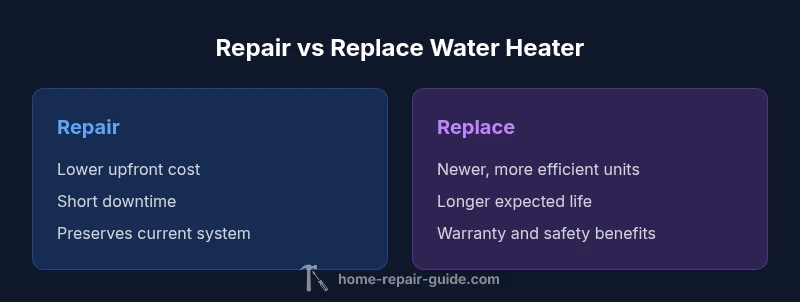
- Lower upfront costs when repair suffices
- Minimal downtime compared to full replacement
- Preserves existing system and setup
Disadvantages
- Risk of recurring issues if the unit is aging
- Possibly diminishing remaining life after multiple repairs
- Older systems may lack modern safety features and warranties
Replacement is usually more cost-effective for old or repeatedly failing units; repair is sensible for newer units with isolated issues.
If the water heater is near end-of-life or shows frequent failures, replacing tends to deliver reliability and efficiency benefits. For younger units with a simple fix, repair can buy time without a large upfront expense.
FAQ
When is it better to repair instead of replace a water heater?
If the unit is relatively new and the issue is isolated (like a faulty thermostat or element), repairing can be cost-effective. If failures recur or the tank shows corrosion, replacement usually offers better reliability and value.
Repairing is best for a young unit with a simple fault; replace when failures become frequent or the unit is near or beyond typical life expectancy.
What is the typical lifespan of a water heater?
Tank-style water heaters commonly last about 8–12 years with routine maintenance. Tankless models may last longer, but installation costs are higher and depend on proper upkeep.
Most tanks last around a decade; tankless can last longer but requires professional maintenance.
How should I budget for repair vs replacement?
Estimate repair costs in the hundreds of dollars for common fixes, and replacement in the low-to-mid thousands depending on system type and installation. Consider lifetime costs, energy savings, and warranties.
Expect repair costs to be much lower upfront than replacement; factor in energy savings and warranties for the long term.
Are tankless water heaters worth it?
Tankless heaters save space and may run more efficiently, but installation can be costly and complex. They suit homes with high hot-water demand or where space is at a premium, provided the installation is feasible.
Tankless can be great for space and efficiency if you’re ready for higher upfront costs.
Can I DIY any part of this work safely?
Some maintenance tasks, like flushing the tank or replacing a simple thermostat, can be DIY-friendly. More complex repairs—gas lines, venting, or electrical work—should be performed by a licensed professional to avoid safety hazards.
Only do safe, basic maintenance yourself; call a pro for major repairs.
What should I consider when replacing a water heater?
Evaluate fuel type, energy efficiency, space, venting (for gas), and warranty. Choose a model with appropriate capacity for your household’s hot-water usage and look for ENERGY STAR-certified options when available.
Think about fuel, space, efficiency, and warranties when replacing.
Key Takeaways
- Assess age and failure pattern before deciding
- Weigh upfront repair costs against replacement costs
- Prioritize energy efficiency gains in the decision
- Involve a licensed professional for safety-critical judgments