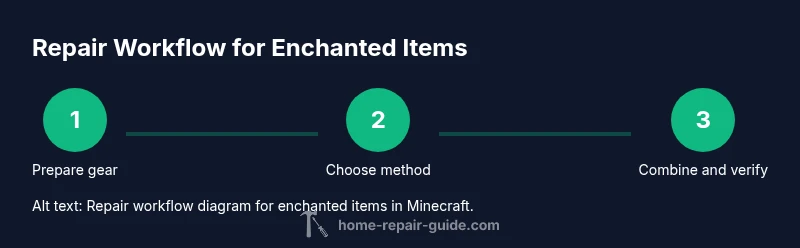
Can You Repair Enchanted Items in Minecraft: A Step-by-Step Guide
Learn how to repair enchanted items in Minecraft using anvils, Mending, and grindstones. This comprehensive guide covers methods for weapons, tools, and armor, plus tips to manage durability and enchantments.


Yes, enchanted items can be repaired in Minecraft, but you repair them using specific methods rather than patching a hole. The main approach is using an anvil to combine two of the same item, which restores durability and preserves enchantments (with an XP cost). You can also enable Mending to auto-repair from experience and use a grindstone to remove enchantments if you want a fresh enchantment setup.
Understanding Enchanted Items and Repair in Minecraft
The question can you repair enchanted items in minecraft often comes up among players who want to keep their gear effective without losing enchantments. In Minecraft, enchanted items gain durability through use, and repairing them is not about patching a hole but about restoring the item’s overall lifespan while preserving or carefully managing enchantments. A solid repair strategy starts with knowing the right tools and methods: anvils for durable repairs, Mending to use XP, and grindstones to strip enchantments when you want to re-enchant later. Keeping this in mind helps you balance effort, cost, and enchantment value over time.
How Anvils Work for Repair
Anvils are the primary repair station in Minecraft. To repair, you place the damaged item in the left slot and a second identical item in the right slot. The interface will show the resulting item and the XP cost. The repaired item combines remaining durability from both items, potentially transferring or stacking enchantments. Each repair action costs experience levels, so players often plan repairs around XP farming or the presence of the Mending enchantment.
The Role of Mending and XP in Repair
Mending uses XP orbs to repair the item automatically when the enchantment is present. This means you don’t need to manually combine items as long as you gain XP from mining, farming, or killing mobs. Without Mending, repairs rely on anvils and potentially repairing materials. Be mindful that repeated repairs increase the XP cost on the anvil, eventually making future repairs impractical without expanding your XP pool.
When to Use a Grindstone vs Anvil
Grindstones remove all enchantments from an item, returning it to its base state, and can also repair some durability in certain versions. Anvils, by contrast, allow you to preserve or merge enchantments while restoring durability. Use grindstones when you want to strip enchantments to reapply better ones, and use anvils when durability needs to be preserved and enchantments retained.
Repair Scenarios: Weapons, Tools, and Armor
Different gear benefits from different repair workflows. For tools and weapons, you typically repair by merging two identical items or using Mending with XP. Armor follows the same pattern, but you may prioritize durability on chestplates and helmets, where durability saves you more battlefield downtime. Always check whether combined enchantments are compatible and whether the XP cost is acceptable for your game phase.
Practical Tips for Managing Durability and Enchantments
- Prioritize items with the Mending enchantment for automatic repair when XP is abundant.
- Carry spare identical items to perform quick repairs without excessive XP costs.
- Use an anvil with care; every operation increases the cost, so plan ahead.
- Keep a log of your enchantments so you don’t lose crucial protections when merging.
- Consider naming items to track their repair history and avoid confusion during enchantment stacking.
Troubleshooting Common Issues with Enchanted Item Repair
If repair costs balloon, pause and reassess: either switch to Mending, seek XP sources, or replace the item rather than paying an ever-increasing price. If enchantments seem to disappear after an exchange, verify that you are using compatible combinations and that you’re not unintentionally stripping enchantments with a grindstone. Always back up critical gear in case of unexpected results.
Enchanting Strategy for Longevity
Plan enchantments with longevity in mind. Prioritize higher-tier protections, Unbreaking levels, and Mending where available. Some rare combinations may be impossible to merge; in such cases, re-enchant on an anvil using an enchantment book or an anvil with a target item. Regular maintenance and XP management keep your enchanted gear useful longer.
Safe Enchanted Item Repair Checklist
- Confirm you have an appropriate repair method (anvil vs grindstone) for the goal.
- Ensure you have enough XP or spare identical items before repairing.
- Check compatibility of enchantments after merging to avoid loss.
- If in doubt, test on a spare item before applying to your main gear.
Next Steps and Additional Resources
Now that you know how to repair enchanted items in Minecraft, explore practical scenarios in your world and refine your approach based on experience. For more ideas and strategies, follow the Minecraft community guides and experiment safely, using XP channels and repair-friendly workflows.
Tools & Materials
- Anvil(Essential for repairing by combining items)
- Grindstone(Removes all enchantments; use when re-enchanting)
- Repair materials (item-specific)(E.g., iron ingots, diamonds, or other items used to repair via anvil; depends on gear type)
- Experience points (XP)(Needed for anvil enchantment costs; accumulate via gameplay)
- Mending enchantment(Allows XP to repair the item automatically)
Steps
Estimated time: 25-40 minutes
- 1
Prepare your repair setup
Gather two identical items you want to repair and ensure you have the necessary materials or XP. Decide whether you will preserve enchantments or strip them later with a grindstone. This preparation prevents wasteful repairs.
Tip: Have spare identical items on hand to keep XP costs manageable. - 2
Open the anvil and place items
Place the damaged item in the left slot and the repair mate in the right slot. The interface will show the resulting item and the XP cost. Confirm that the resulting durability and enchantments align with your goal.
Tip: Double-check that your two items are the same type and material. - 3
Review enchantments and costs
Check which enchantments transfer or merge and how many XP levels you’ll spend. High-cost merges may be better delayed until you accumulate more XP or obtain newer gear.
Tip: If enchantments are not desirable, consider removing them with a grindstone first. - 4
Apply the repair
Withdraw the repaired item from the output slot and place it into your inventory. If the cost is too high, back out and reassess your materials or XP sources.
Tip: If the repair cost is excessive, stop and gather more XP or craft a different gear path. - 5
Consider Mending or grindstone options
If you have Mending, you can rely on XP to repair automatically. If you want to re-enchant after removing enchantments, use a grindstone and re-enchant with care.
Tip: Mending can dramatically reduce the need for manual repairs over time.
FAQ
Can you repair enchanted items with a grindstone?
A grindstone can remove enchantments from an item and sometimes restore durability, but it does not help you preserve all enchantments. Use it when you want to re-enchant or remove enchantments before a new merge.
A grindstone removes enchantments from an item and can repair durability in some versions; use it when you want to re-enchant afterward.
What is the role of Mending in repairs?
Mending repairs an item automatically by consuming XP orbs, provided the item has the enchantment. It is the easiest way to keep gear durable without manual merging.
Mending uses XP to repair automatically if the item has the enchantment.
Do enchantments transfer when merging items?
When you merge two items with compatible enchantments on an anvil, enchantments can transfer or fuse. Some merges may not preserve all enchantments, depending on the items and enchantments involved.
Enchantments can transfer during anvil merges, but not always all of them depending on the setup.
How do XP costs affect repairs?
Anvil repairs cost XP levels, and the cost increases as you perform more merges on the same item. If costs become too high, finish repairs and do new work later when you have more XP.
XP costs rise with each repair; save up XP when planning multiple repairs.
Is there a limit to how many repairs an item can undergo?
There isn't a hard limit, but escalating XP costs and potential damage from combined enchantments make endless repairs impractical. Consider replacement gear when costs are too high.
There's no fixed limit, but costs can become prohibitive over time.
Can I repair enchantment books as well?
Enchanted books themselves are not repaired by the same processes as gear; they are used to apply enchantments via anvil or grindstone workflows. You repair gear, not the books.
Enchanted books aren’t repaired like gear; treat them separately when enchanting.
Watch Video
Key Takeaways
- Use anvils to repair by merging items and preserve enchantments.
- Mending reduces manual repair needs by using XP.
- Grindstone removes enchantments if you want to re-enchant later.
- XP costs rise with each repair; plan repair timing.
- Always verify enchantment compatibility after merges.