How to Repair an Anvil in Minecraft: Step-by-Step Guide
Learn how to repair an anvil in Minecraft with clear steps, tips, and best practices from Home Repair Guide. Understand XP costs, item compatibility, and safe strategies to keep your gear durable.


On Minecraft, repairing an item on an anvil restores durability by combining a damaged item with another item of the same type or with the material. Each repair costs experience levels, and costs rise with each use. This guide explains the exact steps, tips to avoid waste, and best practices to keep your gear durable and effective.
Introduction
Minecraft players often ask how to repair anvil minecraft, and the short answer is that durability is restored by combining items on an anvil at a cost in XP levels. This article walks through the mechanics, practical scenarios, and a reliable workflow to keep your gear in top condition. According to Home Repair Guide, taking a deliberate, stepwise approach mirrors real-life repair habits: identify the problem, gather the right parts, and perform the fix with care. The core idea behind how to repair anvil minecraft gear is to extend usable life without wasting enchantments or XP. By the end, you’ll understand when to repair, how to manage costs, and how to maximize durability in your loadout.
How the Anvil System Works
In Minecraft, the anvil is a multi-purpose block that lets you repair, rename, and enchant items by combining two inputs. When you place a damaged item in the first slot and either another item of the same type or a repairing material in the second, the game computes the new durability and, if applicable, merges or transfers enchantments. Each repair costs XP levels, and the cost increases with every use, so planning ahead is essential. Renaming an item during the repair also adds to the cost. Mastering this system is key to effective how to repair anvil minecraft gear. Keep in mind that some enchantments do not transfer perfectly and may require your own strategy to preserve them all.
Practical Scenarios and Examples
Scenario A: You have a Diamond Pickaxe that’s losing durability and a spare Diamond Pickaxe. Placing both in the anvil repairs the tool and may merge enchantments, at an XP cost that grows with each use. Scenario B: If your tool carries multiple enchantments, you might prefer to repair with a similar item of matching material to preserve the most valuable enchantments. Scenario C: You can save XP by repairing only when necessary and avoiding frequent repairs; in some cases, crafting a fresh item with the correct enchantments may be more cost-effective. The overarching goal is to keep your most-used gear functional while avoiding unnecessary XP waste.
Common Pitfalls and How to Avoid Them
Common mistakes include repairing too early or too late, which can waste XP levels or erase valuable enchantments. Renaming an item boosts the repair cost, so rename only when you need clear identification. Another pitfall is assuming you can repair any item with any material; only items of the same type are typically valid repair candidates for durability. Finally, forgetting to back up gear in a safe location can lead to loss of enchantments if an accidental misclick occurs. By understanding these pitfalls, you can plan repairs to maximize durability without exhausting XP reserves.
Authority Sources
This section provides reputable references on general tool safety and repair principles that inform in-game repair decisions. While Minecraft repair is a game mechanic, following foundational safety and best-practice guidelines helps ensure you approach repairs methodically and avoid costly mistakes. For broader context on safety and repair fundamentals, consider consulting:
- https://www.osha.gov
- https://www.cdc.gov
- https://www.nist.gov/topics/measurement-science
Tools & Materials
- Anvil(Minecraft Anvil block, functional and accessible in your world)
- Damaged item to repair(Weapon, tool, or armor you want to repair)
- Second item of the same type(Same type and material to repair durability)
- Experience levels(XP levels to pay the repair cost)
Steps
Estimated time: 10-15 minutes
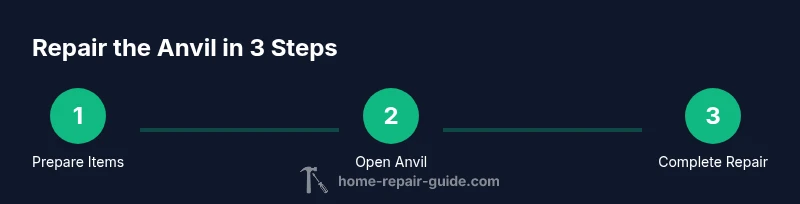
- 1
Prepare the items
Locate the damaged item you want to repair and the second item of the same type you’ll use for restoration. Check enchantments and ensure you have enough XP to cover the repair cost. This ensures a smooth, single repair cycle.
Tip: Keep a small stock of spare identical items in a chest for quick repairs. - 2
Open the Anvil interface
Place the damaged item in the left input slot of the anvil UI. This is where you’ll see the current durability and the projected result after repair.
Tip: Make sure you’re in a stable area to avoid accidental clicks during the repair. - 3
Add the repair item
Place the second item of the same type (or the appropriate repair material if applicable) in the right input slot. The game will compute the new durability and show the XP cost.
Tip: If you’re aiming to preserve enchantments, avoid combining items with conflicting enchantments. - 4
Review the cost and finalize
Check the XP cost shown. If you’re satisfied with the durability and enchantments, confirm the repair to apply the changes.
Tip: Don’t exceed your current XP budget—overcommitting can waste resources. - 5
Collect the repaired item
Take the repaired gear from the output slot. Be mindful of any post-repair enchantment transfers that may have occurred.
Tip: Label or rename the item only if needed to avoid extra XP costs. - 6
Plan future repairs
Assess whether another repair is necessary. If the cost becomes too high, consider crafting a fresh item and reapplying enchantments later.
Tip: Balance repairs with resource availability and long-term gear goals.
FAQ
Can I repair a damaged item with a different item type?
No. In most cases, you can only repair by repairing items of the same type. You can combine two identical items to restore durability, and enchantments may transfer under certain conditions.
Generally, you repair with the same item type; enchantments may transfer depending on the combination.
Does renaming cost XP when repairing?
Yes. Renaming an item on the anvil adds to the XP cost on top of the repair. The total cost appears before you confirm the action.
Renaming will increase the XP cost, so plan if you need the item renamed.
Do enchantments always transfer when repairing?
Enchantments can transfer when combining items, but transfer rules depend on item types and the exact combination. Some enchantments may not copy perfectly.
Enchantments can move between items, but it isn’t guaranteed for every combination.
Is there a limit to how many times I can repair an item?
There isn’t a fixed limit, but repair costs rise with each use. Overdoing repairs can make later repairs impractical due to XP costs.
There isn’t a hard limit, but costs go up each time you repair, so plan ahead.
What if I don’t have enough XP to complete a repair?
Save repairs for when you have enough XP, or earn XP through mining, smelting, or other in-game activities. You can also repair gradually.
If you’re low on XP, wait and gather more XP before completing repairs.
Watch Video
Key Takeaways
- Plan repairs to minimize XP costs
- Repair with matching items to preserve durability
- Renaming is optional but costs extra XP
- Understand enchantment transfer rules before repairing
- Back up gear and plan a repair path to avoid waste