What Size Service Wire for 400 Amp: Practical Sizing Guide
Comprehensive guide to sizing service conductors for a 400-amp service, comparing copper and aluminum, NEC guidance, voltage-drop considerations, and practical installation tips.


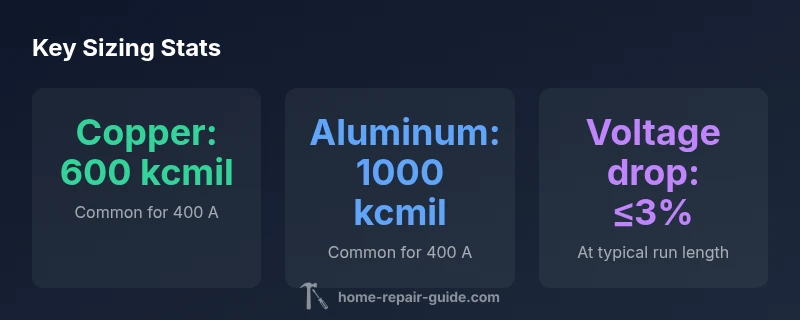
According to Home Repair Guide, for a 400-amp service the typical service conductors are copper around 600 kcmil or aluminum around 1000 kcmil, depending on insulation temperature rating and voltage-drop limits. Verify with NEC Tables 310.16/310.17 and 230.42, and have a licensed electrician confirm final sizing and installation, including grounding and terminations.
Why Correct Wire Sizing Matters
Sizing service conductors correctly is the foundation of a safe, reliable electrical installation. Undersized wires heat up, lose voltage, and can trip breakers or, in worst cases, become fire hazards. Over-sizing wires costs more upfront but reduces long-term maintenance and improves system resilience. The Home Repair Guide team emphasizes that sizing must reflect the actual load, distance, insulation temperature rating, and how the conductors will be terminated at the main service. For a 400-amp service, mis-sizing often appears as choosing a smaller conductor to save materials, only to discover excessive voltage drop or nuisance trips when lighting and appliances run at full load. Local amendments, conduit fill limits, and the method of protection all influence final conductor size. In practice, engineers balance practical constraints with code requirements, using a methodical approach rather than guesswork. The result is a service that remains safe and compliant under all expected operating conditions. This emphasis on correct sizing underpins long-term reliability and safety for both homeowners and renters.
Copper vs Aluminum: Pros, Cons, and Trade-offs
Copper conductors offer superior conductivity, smaller diameters for the same ampacity, and typically easier termination with fewer oxidation concerns. They remain the preferred choice when long-term reliability and maximum fault tolerance are priorities. Aluminum conductors are lighter, often cheaper, and available in very large sizes that make large services economical. However, aluminum requires careful handling of oxidation, proper connector selection, and compatible devices to avoid galvanic corrosion at terminations. For a 400-amp service, aluminum can be a cost-effective option if the run is long or the project budget is tight, provided you use compatible lugs, anti-oxidant compounds where recommended, and trusted installation practices. The material choice also interacts with insulation rating and temperature limits; 75°C and 90°C insulation expand the practical ampacity of both copper and aluminum clips and lugs. In the end, the decision should be based on total installed cost, ease of installation, future expansion, and compatibility with the service equipment.
How to Determine Wire Size: The Key Factors
The process starts with a clear understanding of load and service size. Determine the feeder and service load using code references or a licensed electrician’s assessment. Material is the next variable: copper or aluminum. Then consider insulation temperature ratings (60°C, 75°C, or 90°C), voltage drop limits over the actual run length, and conduit or raceway fill. Distance is crucial: longer runs demand larger conductors to keep voltage drop within acceptable limits. The environment (indoor vs outdoors, damp locations, and chassis grounding) affects conductor choices as well. Finally, ensure the selected wire size is compatible with the main disconnect, meter socket, and distribution equipment, while meeting local amendments. Home Repair Guide’s framework walks you through these decisions with practical checkpoints, so you avoid over-sizing or under-sizing. Keep in mind that exact ampacity varies by insulation and code edition, making professional review essential for a 400-amp service.
NEC Guidelines and Sizing Tables You’ll Use
Sizing service conductors for a 400-amp service relies on NEC guidelines and tables that translate temperature ratings into ampacity. The primary references include 310.16 and 310.17 for conductor ampacity at different temperature ratings, and 230.42 for feeder and service disconnect sizing. In most cases, 75°C or 90°C insulation is assumed for larger sizes, but always confirm the temperature rating of the conductors and terminations on site. Local amendments can alter the required sizes, so consult the latest edition of the National Electrical Code and any jurisdictional supplements. For homeowners, the takeaway is to start with copper 600 kcmil or aluminum 1000 kcmil as a planning anchor, then adjust based on length, method of installation, and overcurrent protection. This process minimizes the risk of heat buildup, voltage drop, and equipment mismatch, ensuring safety and code compliance.
Voltage Drop, Temperature Rating, and Conductor Sizing
Voltage drop is a practical constraint that often drives conductor choice in a 400-amp service. A longer run increases drop, especially with high-current loads. As a rule of thumb, aim for a total drop near or under 3% from the utility source to the main panel, with most of that drop coming from the feeders rather than branch circuits. The temperature rating of the insulation affects ampacity; higher rated insulation (90°C) lets you carry more current in the same size of conductor, but you must ensure terminations and lugs are rated accordingly. The combination of distance, load diversity, and temperature rating means that a 600 kcmil copper or 1000 kcmil aluminum are common starting points, but exact design must be verified by calculations or a professional. Document each assumption so inspectors and future electricians can review the sizing decisions quickly.
Protecting the Service: Overcurrent Protection and Clearances
The OCP device and distance to the service disconnect determine the maximum conductor size that can be installed. A 400 A service requires a main disconnect sized for at least 400 A, with feeders and conductors protected by appropriate overcurrent devices. Ensure the service entrance equipment has appropriately rated lugs and terminals for the selected conductors, and respect torque requirements from the manufacturer. Ensure proper clearances around service equipment for heat dissipation and safe operation. Use listed connectors for aluminum-to-copper transitions and apply anti-oxidant compounds where recommended. This block emphasizes planning for future expansion, ensuring that your main service gear remains compatible with the chosen conductor size and that the installation follows both NEC and local amendments.
Step-by-Step Sizing Example for 400 A
- Establish load and distance. 2) Pick material based on budget and termination compatibility. 3) Check insulation rating and temperature allowance. 4) Refer to NEC tables for ampacity: copper and aluminum options viable at 600 kcmil and 1000 kcmil respectively. 5) Calculate voltage drop for the actual run length and acceptable limit. 6) Select OCP rating (400 A) and verify clearance and enclosure requirements. 7) Confirm lug sizes, torque specs, and warranty coverage with the equipment manufacturer. 8) Prepare final documentation for permits and inspections. This step-by-step guide helps avoid common mistakes and ensures safe, code-compliant sizing for a 400-amp service.
Practical Installation Considerations and Safety
Before pulling conductors, plan the installation path, check for existing conduit constraints, and ensure gagging is minimized to reduce damage to insulation. Use proper PPE, avoid damaged wires, and keep the workspace dry. Aluminum conductors require antioxidant compounds and compatible connectors to prevent corrosion; ensure that all manufacturer recommendations are followed. When terminating, verify lug torque with calibrated tools and leave space for future expansion or service upgrades. Label conductors clearly and document the size, rating, and termination points for future maintenance. The Home Repair Guide approach emphasizes safety, compliance, and durability, so you don’t face rework costs or hazards later.
Authority Sources and References
References and standards that inform this sizing guidance include OSHA safety principles for electrical work, the National Fire Protection Association's NEC code guidance, and energy department guidelines on electrical installations. For readers seeking official references, consult: - OSHA: https://www.osha.gov - NFPA: https://www.nfpa.org - NRCAN: https://www.nrcan.gc.ca The goal is to anchor practical sizing decisions in authoritative sources while recognizing that local amendments may modify exact conductor sizes. Always cross-check with the latest code edition and your jurisdiction's requirements.
Service wire sizing: copper vs aluminum for 400 A service
| Factor | Copper Size | Aluminum Size | Notes |
|---|---|---|---|
| Typical copper size for 400 A | 600 kcmil | N/A | Broad rule of thumb |
| Typical aluminum size for 400 A | N/A | 1000 kcmil | Broad rule of thumb |
| Voltage-drop target (feeders) | N/A | N/A | Aim ≤3% |
| Insulation rating used | 75°C / 90°C | 75°C / 90°C | Higher rating improves ampacity |
FAQ
What is the minimum wire size for a 400-amp service?
The minimum size depends on conductors' material and temperature rating, but copper typically starts around 600 kcmil and aluminum around 1000 kcmil for a 400 A service. Always verify with NEC tables and an electrician.
The minimum size depends on material and rating, but copper often starts at 600 kcmil and aluminum at 1000 kcmil for a 400-amp service; check NEC tables and consult a professional.
Can I downsize wire for short distance?
Even short runs must meet load and protection requirements; under-sizing can lead to overheating and nuisance tripping. Use NEC guidance and professional evaluation to confirm.
Short runs still must meet load and protection rules—don’t under-size without a proper calculation.
Is aluminum acceptable for service entrance?
Yes, aluminum is acceptable if you use compatible connectors, anti-oxidant compounds, and proper termination methods. Ensure all components are rated for the chosen conductor size.
Aluminum can be used if compatible connectors and anti-oxidants are used and everything is rated for the size.
How do you calculate voltage drop for a 400 A service?
Calculate voltage drop using length, current, conductor material, and temperature rating per NEC guidelines. Aim for 3% or less at the service entrance, adjusting size accordingly.
Use length, current, material, and temperature rating to calculate the drop; aim for 3% or less.
What about grounding after sizing service?
Grounding must follow code requirements and be coordinated with the service disconnect. Ensure proper bonding, grounding electrode system, and correct insulation ratings of conductors.
Grounding follows code and must align with the service disconnect and bonding rules.
Do local amendments affect wire sizing?
Yes. Local amendments can modify conductor sizes, disconnect ratings, and installation methods. Always check the jurisdiction’s amendments to the NEC and adjust sizing accordingly.
Local rules can change sizing, so always verify with your authority having jurisdiction.
“Sizing service conductors correctly is both a code requirement and a practical design decision; always base it on NEC guidance and verified calculations.”
Key Takeaways
- Choose copper 600 kcmil or aluminum 1000 kcmil as starting points for 400 A.
- Always verify with NEC 310.16/310.17 tables and 230.42.
- Account for voltage drop and insulation rating when sizing.
- Coordinate with main disconnect and service equipment.
- Consult a licensed electrician for final sizing and installation.