What Size Service Wire for 150 Amp Panel: A Practical Guide
Learn how to size service conductors for a 150 amp panel, comparing copper vs aluminum, insulation ratings, distance considerations, and practical installation tips for safe, code-compliant wiring.


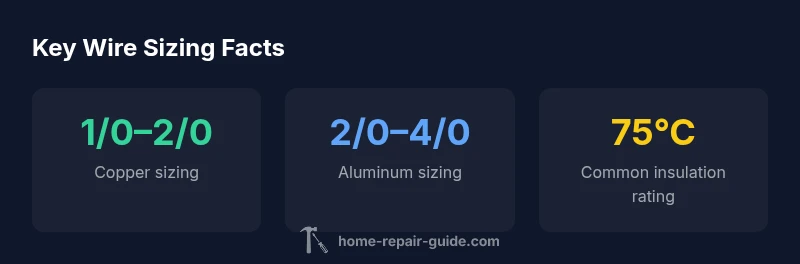
For a 150 amp panel, copper conductors are typically sized from 1/0 AWG to 2/0 AWG, while aluminum conductors range from 2/0 AWG to 4/0 AWG, depending on insulation rating (60°C, 75°C, or 90°C) and panel labeling. Material choice, run length, and local codes affect the exact size; consult a licensed electrician.
What size service wire for a 150 amp panel: Practical overview
According to Home Repair Guide, selecting the correct service wire for a 150 amp panel is essential for safety and reliability. This section introduces the core concepts: what the service conductors do, how ampacity is determined, and why the insulation temperature rating matters. Readers should understand that the wire size must match the panel's main disconnect rating, the service entrance rating, and the available space in the meter socket. The goal is to explain, without assuming a license to perform electrical work, how sizing decisions are made, what factors drive those decisions, and when to call a licensed electrician. Throughout, we'll reference the general guidelines used by Home Repair Guide Analysis, 2026, to illustrate typical practice while noting that local codes can add requirements.
Copper vs aluminum conductors: which is common for 150A panels
Copper conductors offer higher ampacity per size and generally lower resistance, making them a popular choice for 150A service feeders in many homes. Aluminum, usually less expensive per foot, requires larger cross-sections to reach the same current rating and can be more challenging to terminate securely in some panels. For 150A service entries, copper is often sized in the 1/0 AWG to 2/0 AWG range, whereas aluminum typically falls in the 2/0 AWG to 4/0 AWG range, depending on insulation and rating. Always check the panel manufacturer’s labeling and NEC reference tables; the exact size is influenced by temperature rating (60°C vs 75°C vs 90°C) and installation conditions. This material choice affects long-term durability, voltage drop, and service life.
Sizing guidelines by conductor material (copper)
When using copper conductors with modern insulation rated at 75°C or higher, the common sizes for a 150A service are often 1/0 AWG or 2/0 AWG. The panel’s main breaker or main lugs will specify a maximum allowable size; if a 90°C rating is present, a smaller gauge might be permitted. The rule of thumb is to select the smallest conductor that can safely carry 150A under the installed conditions, taking into account temperature derating and ambient temperature. If your run is short and the panel labeling allows 75°C insulation, 1/0 AWG copper is a typical starting point. For longer runs or high ambient temperatures, you may need to step up to 2/0 AWG to maintain safe margins.
Sizing guidelines by conductor material (aluminum)
Aluminum conductors used for 150A service often range from 2/0 AWG to 4/0 AWG, with 4/0 being a common upper size for longer runs or hotter environments. Aluminum has higher resistivity than copper, so a larger size is needed to achieve the same ampacity. The choice between 2/0 and 4/0 will depend on the insulation type (e.g., XHHW-2, SER) and the temperature rating of the panel. Always verify the conductor’s rating against the panel label and the NEC allowances for service conductors under prevailing climate conditions. Remember that aluminum requires proper anti-oxidant compound on joints and careful torque at terminations to prevent loosening over time.
Temperature ratings, insulation, and code references
The temperature rating of the wire insulation (60°C, 75°C, or 90°C) dramatically influences the allowable ampacity. Modern panels and conductors often use 75°C or 90°C insulation, which allows smaller sizes for the same ampacity compared with older 60°C-only ratings. However, you must rely on the panel’s labeling and NEC tables (310.15) to confirm which rating applies. For example, a 150A service often assumes 75°C insulation, but some panels still use 60°C lugs; in those cases, you may need larger conductors. The Home Repair Guide analyses emphasize confirming the exact rating before purchasing wire; mis-sizing can lead to overheating or failed inspections.
Distance, voltage drop, and practical planning
As runs lengthen, voltage drop becomes a practical concern. A typical rule is to keep voltage drop under 3% for feeders and service conductors in residential settings, especially for sensitive loads like electronics or HVAC. Achieving that target may require stepping up from 1/0 to 2/0 copper or the equivalent aluminum size on longer runs. The exact calculation depends on circuit length, conductor material, temperature rating, and the load composition of the home. In most homes with a 150A service, a relatively short run from the meter to the panel will not require exotic sizes, but long feeder runs should be sized accordingly, and a licensed electrician should perform the voltage drop calculations.
Safety, permits, and code considerations
Electrical work involving service wires is high-risk and typically subject to permitting and inspection. Always check your local jurisdiction’s requirements, and ensure that your work aligns with the NEC and the panel manufacturer’s labeling. If you are not experienced with service conductors, hiring a licensed electrician is strongly advised. Home Repair Guide emphasizes that sizing must be verified with the panel’s labeling, the service disconnect rating, and local code amendments. Mis-sizing, improper terminations, or failure to apply anti-oxidant compounds on aluminum connections can lead to overheating and insurance problems.
Step-by-step sizing workflow you can discuss with your electrician
- Identify the panel model and main rating; 2) Check insulation rating on the conductor; 3) Determine distance; 4) Choose copper or aluminum; 5) Verify terminal lug compatibility; 6) Confirm with permit and inspection. This workflow helps align you with NEC requirements and local rules while avoiding common penalties or rework.
Common mistakes to avoid and quick checks
- Relying on old sizing charts not updated to the panel label; - Ignoring temperature rating; - Skipping the use of anti-oxidant on aluminum joints; - Mismatching lugs with conductor size; - Forgetting permits or inspection; - Underestimating voltage drop on long runs. A quick review with your electrician can prevent costly corrections.
Sizing options for 150A service conductors by material
| Conductor Type | Typical Size Range | Notes |
|---|---|---|
| Copper SE conductors (THHN/XHHW-2) | 1/0 AWG – 2/0 AWG | Common for 150A with 75°C insulation; check panel labels |
| Aluminum SE conductors (SER/XHHW-2) | 2/0 AWG – 4/0 AWG | Common for 150A with 75°C insulation; larger for long runs |
FAQ
What is the minimum size copper wire for a 150A panel?
Typically 1/0 AWG copper for 150A with 75°C insulation, but panel label must be followed.
Typically 1/0 copper for a 150-amp panel, but always follow the panel label.
Can I use aluminum wire for a 150A service?
Yes, aluminum can be used, commonly 2/0 to 4/0 AWG, depending on insulation and code; must be matched with meter base and main breaker.
Yes, aluminum is common, but size and rating depend on insulation and local rules.
Do I need to upgrade the service panel if I change wire size?
Often the panel and meter combo determine compatibility; changing wire size may require panel rating check and permit.
Sometimes you must upgrade the panel or main breaker to match the new wire size.
What role does temperature rating play in wire sizing?
Wires rated for 75°C or 90°C enable smaller gauge for the same ampacity; always follow NEC table 310.15 and panel labeling.
Temperature rating matters a lot; higher rating may allow smaller wires.
How do I account for long runs and voltage drop?
Long runs require larger conductor to limit voltage drop; consider a feeder calculation or professional sizing.
If the run is long, you may need bigger wire.
Is a permit required for service wire sizing?
Yes, most jurisdictions require permits and inspection; consult a licensed electrician.
Yes, you usually need a permit and inspection.
“Choosing the correct service conductors requires understanding the panel's label and NEC guidelines; the right size ensures safety, proper ampacity, and reliable service.”
Key Takeaways
- Confirm panel labeling before sizing conductors
- Copper typically uses 1/0–2/0 AWG for 150A; aluminum uses 2/0–4/0 AWG
- Higher insulation temperature ratings can reduce required size
- Account for distance to minimize voltage drop
- Always involve a licensed electrician for code compliance