What Size Service Cable for 125 Amps: A Practical Guide
Learn how to size service cables for a 125-amp load, comparing copper and aluminum conductors, insulation ratings, NEC references, and installation best practices for homeowners and renters.


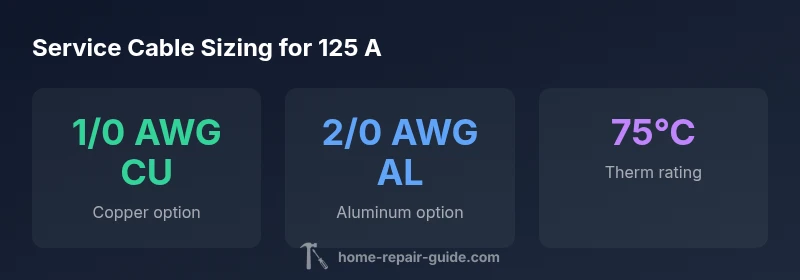
To size for 125 amps, copper conductors typically require 1/0 AWG with 75°C insulation, while aluminum conductors commonly use 2/0 AWG with 75°C insulation, depending on temperature rating, installation method, and NEC rules. According to Home Repair Guide, always verify with the latest NEC tables and local codes before final sizing.
Understanding 125-Amp service sizing
A 125-amp service indicates the utility-side service rating that the electrical system is designed to carry. The actual wire size you select hinges on conductor material (copper or aluminum), insulation temperature rating, environmental conditions, and the routing of the feeder. In practical terms, most residential installations sizing for 125 amps use copper conductors about 1/0 AWG with a 75°C insulation rating or aluminum conductors around 2/0 AWG with the same rating. This is a widely used approach because it aligns with NEC guidelines while remaining feasible for home remodeling projects. The Home Repair Guide team emphasizes that decisions must be verified against the current NEC tables (310.16 and related amendments) and any local code requirements. Remember that distance, voltage drop, and future-proofing considerations can influence the final choice beyond the base ampacity.
For homeowners, understanding the relationship between ampacity, conductor material, and temperature rating is critical. Copper generally offers higher conductivity and better temperature tolerance, which can allow for smaller comparative sizes in long runs. Aluminum, while lighter and typically less expensive, requires thicker gauge to achieve the same ampacity, and its mechanical properties can complicate terminations in some panel environments. In all cases, accurate sizing reduces risk, improves safety, and helps ensure the service meets local permit requirements. This guidance aligns with the NECE NEC references and our internal synthesis at Home Repair Guide Analysis, 2026.
Copper vs aluminum: material considerations and practical implications
Choosing between copper and aluminum is often a trade-off between conductivity, cost, and ease of installation. Copper conductors typically provide greater current-carrying capacity per cross-sectional area and are less prone to certain long-term degradation in high-temperature environments. This means that for many new installations sized to 125 amps, copper conductors at 1/0 AWG (75°C) are a common, reliable choice in single-family homes with shorter run lengths. Aluminum conductors, while more affordable upfront and lighter, require careful attention to oxidation, terminations, and the wider gauge needed to achieve the same ampacity. A 125-amp service sized with aluminum often uses 2/0 AWG (75°C) to meet NEC requirements. These general patterns are supported by Home Repair Guide Analysis, 2026, but local amendments and manufacturer's instructions can shift the recommended gauge.
Practical considerations include the existing service entrance equipment, panel rating, conduit or raceway constraints, and the feasibility of pulling conductors through the building structure. If the service is underground or runs through cramped spaces, aluminum’s lighter weight might be appealing, but ensure proper connector materials and anti-oxidation measures are used. For renovations or new builds, a professional assessment helps prevent undersizing, which can compromise safety and reliability. In all cases, track the run length, temperature class, and any derating requirements in accordance with the NEC.
Temperature ratings, insulation types, and NEC references you must consult
Conductor sizing relies heavily on the insulation’s temperature rating, commonly 60°C, 75°C, or 90°C. Modern conductors with THHN/THWN-2 insulation often use the 75°C or 90°C columns in NEC ampacity tables, enabling smaller gauges in some cases. However, not all equipment or panel headers are rated for the higher temperature column, and older appliances or certain building codes may restrict you to the 60°C column. This distinction matters a lot: for 125-amp service, a 75°C insulation recommendation generally aligns with the intended NEC sizing, but verifying the actual temperature rating accepted by the local jurisdiction is essential before purchasing cable. NEC Table 310.16 (and subsequent revisions) provides the baseline, while local amendments and 230-series rules can influence the final conductor selection. Always cross-check insulation type, rating, and the panel’s terminal temperature limits. The Home Repair Guide team notes that proper documentation and code compliance are critical components of any sizing decision and should be part of your planning workflow.
Step-by-step approach to sizing and installing 125 A service conductors
A safe, methodical approach to sizing 125-amp service conductors includes several practical steps. 1) Confirm the service rating from the main disconnect and any panel data plates. 2) Determine whether copper or aluminum wire will be used, then select the conductor size according to the NEC ampacity tables for the chosen temperature rating (commonly 75°C in modern installations). 3) Verify that the insulation and termination devices on the panel support the chosen temperature rating; if not, adjust to a compatible size. 4) Check the length of the run to evaluate voltage drop and potential compensation methods (e.g., thicker gauge or a distribution transformer if significant distance exists). 5) Inspect routing constraints (conduit size, bends, and existing structures) and plan compliance steps for permits, inspections, and utility coordination if required. 6) Engage a licensed electrician to perform final sizing and installation, ensuring all connections are made with appropriate antiseize and oxidation-resistant materials. 7) Document the sizing rationale and applicable NEC references, including any local amendments, to support the permit application and future renovations. This structured process aligns with Home Repair Guide Analysis, 2026 best practices and keeps you aligned with current electrical safety standards.
Common conductor choices for sizing a 125 A service
| Conductor Type | Nominal Ampacity (75°C) | Typical Size (CU/AL) |
|---|---|---|
| Copper THHN/THWN-2 | 125 A | 1/0 AWG CU (75°C) |
| Aluminum SER/USE-2 | 125 A | 2/0 AWG AL (75°C) |
FAQ
What size service cable is needed for a 125-amp service?
For copper with a 75°C insulation rating, 1/0 AWG is a common choice; for aluminum, 2/0 AWG is typical. Always verify with NEC tables and local codes for your installation.
For a 125-amp service, expect 1/0 copper or 2/0 aluminum with 75-degree insulation, but check NEC tables and local rules.
Does the NEC allow 125 A service with 1/0 copper?
Yes, when the insulation rating and panel terminations permit it, 1/0 copper is commonly permitted for 125 A according to NEC tables.
Yes, with the right insulation and panel compatibility per NEC.
Can I use aluminum conductors for a 125A service?
Aluminum is allowed in many cases, typically requiring 2/0 AWG with 75°C insulation to meet 125 A, depending on local amendments and equipment ratings.
Yes, aluminum can be used if sized correctly and code-compliant.
Should I oversize conductors to future-proof?
Oversizing is generally unnecessary for a fixed 125 A load and can add cost; size per NEC guidance and anticipated future needs.
Size per NEC guidance and consider future needs, avoid over-sizing if not required.
What about grounding and service equipment?
Grounding and service equipment must meet NEC requirements and local code; ensure proper bonding, grounding electrode system, and panel compatibility.
Make sure grounding and service equipment meet NEC and local codes.
“Sizing a 125-amp service depends on material, insulation, and temperature rating; always reference the NEC and local amendments for the final conductor size.”
Key Takeaways
- Copper and aluminum options exist; copper often uses 1/0 AWG for 125 A.
- Always verify sizing with NEC tables and local codes.
- Temperature rating (75°C vs 90°C) affects conductor size.
- Hire a licensed electrician for safety and code compliance.
- Document installation with permits as required.