When to Replace vs Repair: A Practical Guide
An objective, in-depth comparison of replacing vs repairing home appliances and systems, with decision criteria, cost considerations, and real-world scenarios to help homeowners decide confidently.


TL;DR: Replace when reliability is uncertain, repair costs approach replacement, or a newer, more efficient model offers meaningful energy savings and a warranty. Repair when issues are minor, the unit remains under warranty, or you can spread costs with a targeted fix and minimal downtime. This article provides criteria, not a single rule, to guide your choice.
Understanding the Replace vs Repair decision
Choosing how to respond when a device or system fails hinges on more than a single price tag. Homeowners must determine whether to replace the entire unit or repair the existing one. This is precisely the challenge of when to replace vs repair: balance reliability, cost, downtime, and future risk. According to Home Repair Guide, the most durable decisions emerge from a structured assessment rather than quick fixes. In practical terms, you weigh upfront purchase or installation costs against ongoing maintenance, energy use, and the likelihood of recurring failures. You also consider warranties, service availability, and disposal impacts. By anchoring your choice to a clear cost-to-benefit equation, you can avoid overinvesting in an aging machine or letting a small fault spiral into a major disruption.
Key decision criteria
There are several criteria that consistently influence the replace vs repair choice. First and foremost, cost: the immediate repair bill should be compared to the price of a replacement unit, including installation. Reliability matters: if failures become frequent or unpredictable, replacement often wins. Age is a major driver: almost all manufacturers expect meaningful performance degradation after a certain number of years. Safety and risk: a fault that risks fire, gas leaks, or electrical hazards usually favors replacement. Warranty status: items still under warranty or covered by a service plan change the math. Downtime and convenience: repairs may be quicker, but repeated outages reduce quality of life. Finally, energy efficiency and environmental impact: newer models can reduce operating costs and emissions, which can tip the balance in favor of replacement over time.
Age, reliability, and safety thresholds
As devices age, the likelihood of failures rises and the cost of ongoing repairs often compounds. A pragmatic guideline is to re-evaluate major home appliances around the 5-to-7-year mark for basic reliability, and 10-to-15 years for systems such as furnaces or heat pumps. Of course, model quality and usage patterns matter: a well-maintained high-efficiency unit can outlive a bargain model that runs hard. Safety is non-negotiable: a fault that risks electrical shock, gas leaks, or water contamination is a red flag that repair may not close the book on risk. In that context, replacing with a newer, safer option may be the only responsible choice. The Home Repair Guide analysis shows that longevity alone is not the only determinant; total risk reduction and reliability matter as much as price.
Total cost of ownership: repairs vs replacement
Financially, the decision comes down to total cost of ownership (TCO) over the next several years. A repair might cost a few hundred dollars for a single issue, but multiple repairs add up quickly. Replacement involves a larger upfront investment but can deliver longer-term savings through reduced energy use and fewer service calls. To illustrate, a mid-range appliance repair might cost $200–$600 per incident, while replacing with a new unit could range from $1,200 to $4,000, depending on type and installation needs. For heating or cooling equipment, the energy efficiency of a modern model can significantly lower operating costs, potentially offsetting the greater upfront price over 5–10 years. When planning, also factor in financing, disposal costs, and potential tax incentives. Home Repair Guide's experience shows the math is rarely black-and-white, but the framework helps you project cost trajectories under realistic usage.
Energy efficiency and rebates
Energy efficiency often drives the replacement argument, especially when newer models offer fractionally lower energy use or improved performance. Rebates, tax incentives, and utility programs can shave the upfront cost, shortening the payback period. If your current unit is nearing the end of its rated efficiency or requires frequent repairs, upgrading to a high-efficiency model can yield tangible savings. Even if initial costs are higher, the long-term savings on electricity, gas, or water bills can be substantial. In some cases, the replaced unit also qualifies for disposal or recycling programs that reduce environmental impact. The Home Repair Guide team notes that a greener choice is not always the cheapest upfront, but it often proves cheaper in the long run.
Practical guidelines by category
-
Major appliances (refrigerator, dishwasher, dryer, washer): if a critical component fails and replacement parts are scarce or expensive, replacement can be more reliable. If the unit is under a service plan and the repair is minor, fix it, but assess the probability of future failures.
-
Heating, ventilation, and air conditioning (HVAC): because these systems are large, complex, and energy-heavy, replacement often wins when the equipment is old (beyond 12–15 years) or the repair requires frequent service calls; however, a targeted repair may be sensible if the system is otherwise healthy, still under warranty, and energy costs are acceptable.
-
Water heaters and plumbing fixtures: tank-water heaters typically provide longer-term value through repair if the tank is in good condition and the unit is not too old; for tankless water heaters, repairing certain sensors or valves may delay replacement.
-
Electrical panels and safety-critical components: due to safety risks and insurance requirements, replacement is commonly the safer choice when the panel is outdated or undersized.
-
General maintenance: a proactive maintenance plan can extend the life of both repaired and replaced units and minimize downtime.
Warranty considerations and disposal
Before deciding, verify what your warranty covers and for how long. A repair might be warranted separately, but a replacement usually comes with a new, longer warranty. Safety concerns and environmental disposal costs should also factor into the decision. If disposal fees or recycling programs are available, they can affect the overall value of replacement. If you own a unit for a long time, consider the opportunity to upgrade to a model with better safety features and improved energy performance. A thoughtful approach also includes arranging for proper disposal so that old equipment is recycled where possible.
Step-by-step decision checklist
- Define the problem and gather repair quotes.
- Assess the unit's age, condition, and warranty status.
- Estimate short-term repair costs versus replacement costs.
- Consider energy efficiency, potential rebates, and long-term savings.
- Evaluate downtime, repair lead times, and installation scheduling.
- Review disposal options and recycling programs.
- Consult a trusted technician for an independent assessment.
- Make the decision with a plan for financing and a clear transition strategy.
Real-world scenarios and how to decide
Story A: A 9-year-old refrigerator with intermittent cooling and a leaky door seal might be cheaper to repair if the compressor is healthy, the seal is easily replaced, and energy costs remain reasonable. If the compressor shows early wear or the unit is noisy and inefficient, replacement is prudent. Story B: A 6-year-old washing machine with a failed motor bearing could be a strong repair candidate if the drum and belt system are solid, parts are readily available, and the cost stays within a modest fraction of a new unit. Story C: A 15-year-old furnace with rising fuel bills and frequent service calls typically benefits from replacement, particularly if the new unit offers energy rebates and improved safety features. In all scenarios, compare the costs, downtime, and long-term value to make the most informed decision.
Comparison
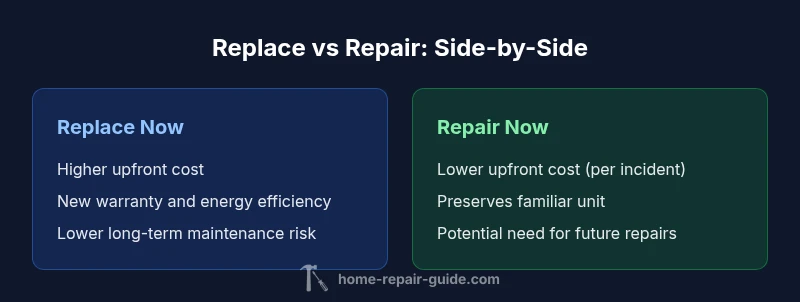
| Feature | Replace now | Repair now |
|---|---|---|
| Typical upfront cost range | $1,200-$4,000 | $100-$800 per incident |
| Lifespan extension after action | Longer-term, depends on new unit | Depends on repair quality; limited if multiple failures occur |
| Time to implement | Days to weeks (planning/installation) | Hours to days (depending on parts) |
| Energy efficiency impact | High potential gains with newer model | Low to moderate unless multiple components are upgraded |
| Risk of cascading issues | Medium to high if the failure signals broader problems | Low for a single targeted repair, may rise with multiple repair needs |
| Warranty status after action | New unit warranty applies | Repair warranty varies; may be none for older units |
| Best for | Long-term reliability and energy savings | Short-term cost control and minimal downtime |
Upsides
- Lower upfront costs with selective repairs
- Preserves familiar equipment and avoids disposal
- Repairs can extend life for a short period
- Less downtime than replacement in some cases
- Potential leverage in negotiations with service providers
Disadvantages
- Can lead to higher lifetime cost if repairs accumulate
- Repair may mask underlying issues and lead to future failures
- Replacement often yields better energy efficiency and warranties
Replacement generally offers better long-term value when reliability is uncertain or repair costs approach replacement price.
If the appliance or system is aging beyond its economical life or frequent repairs are required, replacement reduces risk and energy costs. Repair is sensible for younger units or when a minor fault can be resolved without sacrificing performance. The best choice balances cost, reliability, and energy usage while considering warranties and disposal.
FAQ
What factors should determine whether to replace or repair?
Key factors include upfront costs, ongoing maintenance, reliability, age, safety risks, warranty status, downtime, and potential energy savings. A structured comparison helps avoid emotional decisions.
Focus on costs, reliability, safety, and energy savings to decide between repair and replacement.
Is there a universal age threshold for appliances?
No universal threshold exists. General guidelines suggest reviewing major appliances around 5–7 years for reliability and 10–15 years for HVAC or water heating systems, but model quality and usage matter.
Age helps, but the best choice depends on condition and performance.
How do energy efficiency and rebates affect the decision?
Energy efficiency can tip the balance toward replacement if rebates and lower operating costs offset the upfront price over the payback period. Rebates and incentives reduce effective cost.
Energy rebates can make replacement more attractive in the long run.
What questions should I ask a technician about repair?
Ask about parts availability, expected lifespan after repair, cost vs replacement, whether the issue indicates broader problems, and any safety or warranty implications.
Ask about parts, lifespan after repair, and total costs.
Are there tax incentives when replacing appliances?
Some regions offer tax incentives or rebates for energy-efficient replacements. Check local programs and utility company offerings to understand eligibility.
Look for local rebates and incentives before deciding.
How can I estimate repair costs accurately?
Get written quotes for the repair, including parts and labor, and compare to the replacement price with installation. Factor in potential follow-up repairs in the near term.
Get a formal quote and compare to replacement costs.
Key Takeaways
- Evaluate total cost of ownership over several years
- Prioritize safety, reliability, and warranty status
- Lean replacement when energy savings offset upfront costs
- Use a structured decision checklist to avoid emotional decisions
- Plan disposal and recycling to minimize environmental impact