When to Replace or Repair a Refrigerator: A Practical Guide
Analytical guide helping homeowners decide when to repair or replace a refrigerator, weighing age, costs, energy efficiency, and long-term value with clear decision criteria.


TL;DR: When deciding whether to repair or replace a refrigerator, consider age, repair cost, and energy efficiency. If the unit is under about a decade old and the repair is minor with a solid track record, repairing is usually sensible. For older fridges with frequent failures or rising energy bills, replacement often saves money and reduces risk.
Understanding the Decision: When to Repair vs Replace a Refrigerator
The question of when to replace or repair a refrigerator is not purely aesthetic; it has implications for safety, energy use, and long-term costs. This guide frames the decision around age, fault severity, and total ownership costs. According to Home Repair Guide, a practical way to anchor this decision is to ask: when to replace or repair a refrigerator? If the appliance can be restored with a reasonable repair and will continue to operate safely and efficiently, a repair can be warranted. If you anticipate repeated breakdowns, spiraling repair bills, or intolerable energy costs, replacement often becomes the smarter option. In this section, we unpack the lever points that sway the choice, focusing on age, fault type, cost-to-fix, warranty status, and the potential for energy improvements with a newer model.
A refrigerator is typically a long-lived appliance; many units last a decade or more with proper care. As a rule of thumb, repairs that cost less than a portion of a new unit price are more palatable when the fridge is relatively young. Conversely, a unit beyond its mid-life stage with multiple faults is more likely to benefit from replacement, especially if energy consumption is noticeably higher.
Key takeaway: start with a repair if the fault is minor, the unit is reasonably new, and the expected repair cost is modest relative to a new model.
The Age Factor: How Old is Too Old?
Age is a central driver in the decision to repair or replace a refrigerator. Modern models typically deliver better energy efficiency, longer warranties, and improved reliability compared to older units. If your fridge is approaching or past its tenth year, even a small fault can foreshadow more serious failures. This is where you weigh the cost of future repairs against the price of a newer, more efficient model. The Home Repair Guide team emphasizes that the cumulative risk of multiple failures grows with age, and energy costs tend to rise as components wear. If you notice persistent noises, cooling inconsistencies, or rising electricity bills, it is prudent to evaluate replacement alongside repair quotes. For households with tight budgets, a well-timed repair can extend life by several years and buy time for a planned replacement.
For a unit younger than ten years, a single, well-bounded repair is often worth it, especially if a reputable technician offers a clear fix window and a reasonable warranty on parts. If the age is in the range of 10–12 years or more, and the unit has required multiple repairs already, replacement becomes a more compelling option due to the potential savings from energy efficiency improvements and reduced risk of sudden outages.
Cost Considerations: Repair Costs vs Replacement Costs
Cost is frequently the deciding factor in whether to repair or replace a refrigerator. A repair can be economical when the fault is localized—a compressor component, thermostat, door seal, or defrost timer—and the labor-plus-parts bill remains moderate. However, if the fault involves the compressor, refrigerant handling, or sealed systems, costs can escalate quickly, approaching or exceeding a portion of a new unit’s price. In such cases, replacement often offers better long-term value because it eliminates recurring failure risks and includes new warranties. In practical terms, compare: (a) the quoted repair price and any labor warranty, (b) estimated remaining useful life if repaired, (c) the price of a comparable new model with current energy efficiency standards, and (d) potential costs for disposal or recycling of the old unit. Home Repair Guide analysis shows that owners who ran the numbers across a multi-year horizon typically favor replacement when repair costs approach half or more of a new unit’s price.
Be mindful of hidden costs: delivery, installation, and potential upgrade needs (like an upgraded outlet or space adjustments). If you’re unsure, request a second opinion from an independent technician who can provide a separate estimate for the repair and an appraisal of the fridge’s remaining useful life. Remember to factor in potential rebates or energy-efficiency incentives for a newer model.
Energy Efficiency and Operating Costs
Energy efficiency is a critical lens for considering replacement. New refrigerators generally consume far less electricity per year due to advanced compressors, better insulation, and smarter controls. If your current unit is older, a replacement could yield substantial savings over time, even if the upfront cost is higher. Use a simple payback analysis: estimate annual energy costs with the current unit, estimate annual energy costs with a typical modern model, and divide the upfront delta by the annual savings to gauge the break-even horizon. The Energy Star program provides a framework for comparing efficiency across models, and many households find that even moderate upfront costs are recouped through energy savings. The Home Repair Guide analysis shows that energy considerations often tilt the balance toward replacement for households with high usage or units that fail to meet basic cooling performance.
If you decide to repair, ensure you address energy-related issues that contributed to inefficiency, such as poor door seals, clogged condenser coils, or abnormal thermostat readings. Correcting these can significantly improve performance without a full replacement.
Reliability and Repairability: What Fails Most
Understanding the most common failure points can clarify the repair-versus-replace decision. Typical issues include door seals, defrost systems, thermostats, evaporator coils, and fans. Sealed system failures (such as compressors or refrigerant leaks) are particularly costly because they often require specialist equipment and refrigerant handling. Even when a repair is technically feasible, the probability of future problems increases with age and cumulative operating hours. If your fridge has a history of repeated repairs or if major components have already reached or surpassed their expected lifespan, replacement reduces the risk of a sudden breakdown that could spoil groceries and disrupt daily routines. In contrast, newer or relatively healthy units with a single fault are prime candidates for repair, especially when the repair improves reliability and doesn’t compromise safety features.
A practical rule: when the repair extends the fridge’s useful life by several years and the remaining warranty on the repair is solid, it can be worth proceeding with the fix. Otherwise, plan for replacement to avoid escalating downtime and ongoing repair bills.
Practical Decision Framework: Quick Checklist
Use this checklist to guide the decision in real time. Start with the age estimate and recent repair history, then weigh the cost-to-fix against prospective replacement costs. If you answer yes to the following, repair is reasonable: (1) the unit is relatively young (or has a strong track record of reliability), (2) the repair cost is modest (well under a third of a new model’s price), (3) cooling performance is stable after the fix, and (4) there are no safety concerns (e.g., frayed wiring, burnt smells). If you answer yes to the following, replacement is reasonable: (1) the fridge is older than a decade and has had multiple significant repairs, (2) energy bills show a noticeable uptick linked to the appliance, (3) the interior condition is poor or the unit presents frequent frost/defrost problems, and (4) a modern model would offer meaningful capacity or features that align with your needs. This framework keeps you focused on practicality rather than a single repair or replacement impulse.
Real-World Scenarios: When to Replace or Repair a Refrigerator
Scenario A: A 6-year-old refrigerator develops a noisy fan and occasional cooling inconsistency. A technician quotes a repair for the fan motor plus a thermostat check, with a one-year parts-and-labor warranty. The cost is reasonable, and the unit’s energy use remains competitive. In this case, repairing and completing a preventative maintenance plan is a sound choice. Scenario B: An 11-year-old refrigerator begins to show frost buildup and an escalating energy bill, with multiple past repairs. The compressor has intermittent performance issues. A modern energy-efficient replacement would remove ongoing uncertainty and likely provide better long-term savings. In this case, replacement is recommended, especially if your household relies on the fridge for daily groceries.
How to Budget for Replacement or Repair
Budgeting is easier when you separate the decision into short-term and long-term costs. For repairs, anticipate not only the current quote but also the probability of future breakdowns and needed follow-up visits. For replacement, consider the upfront price, delivery, installation, and any potential rebates or financing options. Create a side-by-side forecast for at least five years, factoring in estimated energy savings, disposal of the old unit, and the expected lifespan of the new model. The more you can quantify the long-term costs and benefits, the more confident you’ll be in the choice. Home Repair Guide recommends gathering multiple quotes and running a break-even analysis to compare the two paths against your home’s budget and consumption patterns.
Authoritative Guidance and Next Steps
Before finalizing the decision, consult authoritative sources that specialize in home energy efficiency and appliance standards. Energy.gov emphasizes consumer guidance on appliances, including refrigerators, and Energy Star provides model-specific efficiency comparisons. Both sources underpin the practical decision framework in this article. If you need a hands-on plan, contact a qualified technician for diagnostic testing and a written cost estimate that clearly separates repair components from any cooling-system work. The Home Repair Guide team believes that a informed homeowner makes the best long-term choice and encourages readers to document the decision, including the rationale and the expected yearly energy savings, to inform future maintenance.
mainTopicQuery":"refrigerator repair"
Comparison
| Feature | Repair | Replace |
|---|---|---|
| Typical cost to fix vs replace | Repairs usually cost hundreds in labor plus parts | Replacement often costs more up-front but excludes recurring repair bills |
| Downtime | Short downtime for repair | Potential longer downtime for delivery/installation of a new unit |
| Energy efficiency impact | Depends on repair quality; energy usage may stay similar | Typically the best energy efficiency improvements with a new model |
| Reliability and lifespan after action | Repair can restore reliability temporarily | Replacement provides renewed lifespan and warranty |
| Best for | Minor faults on younger fridges | Older fridges with repeated failures or high energy use |
Upsides
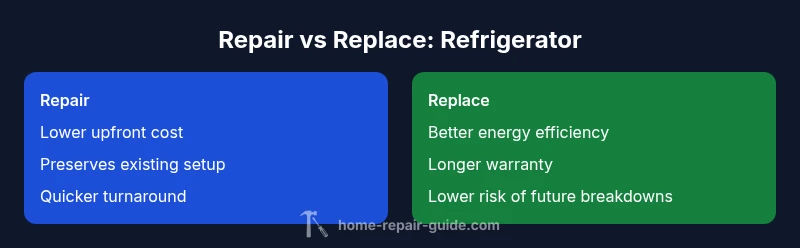
- Repairs preserve current setup and avoid disposal hassles
- Lower upfront cost when fixes are minor
- Can extend useful life without replacing major components
Disadvantages
- Risk of recurring failures and ongoing downtime
- Long-term costs may exceed a replacement over time
- Older units may lack modern energy-efficiency features
- Hidden issues may surface after a repair
Repair is preferred for younger, reliable units with a minor fault; replacement is better for older refrigerators with frequent failures or high energy costs.
If the fridge is relatively new and the fix is simple, repair it to maximize value and avoid the hassle of disposal. For older units with repeated issues or rising bills, replacement typically offers lower risk and better long-term energy savings.
FAQ
When should I repair a fridge instead of replacing it?
Repair is sensible when the fault is minor, the unit is relatively new, and repair costs are a small fraction of a new model’s price. If the appliance has a history of failures or energy bills are rising, replacement is often the smarter long-term choice.
Repair if the fix is small and the fridge isn’t old. Otherwise, consider replacing to avoid ongoing outages.
Is replacement cheaper than repair for an old refrigerator?
In many cases, yes—especially if the unit is past its mid-life and has had multiple repairs. A new model also offers energy efficiency benefits that can lower operating costs over time.
Often, replacement pays off in the long run when repairs keep piling up.
How long does a typical refrigerator repair last?
A repair can last from months to several years, depending on the fault, quality of parts, and maintenance. If the issue recurs quickly, it may indicate an underlying problem that warrants replacement.
Repairs don’t guarantee long-term reliability; watch for recurring issues.
What maintenance helps extend a fridge’s life?
Regularly clean coils, check door seals, keep the temperature stable, and defrost if needed. Proper maintenance reduces wear and improves efficiency, delaying the need for bigger repairs or replacement.
Simple maintenance can extend life and save energy.
Does energy efficiency justify replacing an old fridge?
If energy use is a notable portion of your bill and the fridge is older than a decade, a new, energy-efficient model can pay for itself over time through energy savings.
Energy savings add up; a newer model often makes financial sense.
Key Takeaways
- Assess fridge age and repair history before deciding
- Weigh energy costs of running an old fridge against replacement
- Consider repair feasibility, warranties, and aftercare
- Budget for long-term costs with a clear five-year horizon
- Get multiple quotes and compare payback periods for energy savings