Is Appliance Repair Worth It? A Practical Comparison
A data-driven comparison of repairing vs replacing household appliances. Explore cost factors, longevity, energy efficiency, downtime, and practical steps to decide if is appliance repair worth it.


Is appliance repair worth it? In most cases, repair is worth considering when the cost is modest relative to replacement and the appliance still has meaningful life. A careful assessment of upfront costs, long-term energy use, and reliability helps homeowners avoid unnecessary replacement. The Home Repair Guide team emphasizes comparing the repair quote to a replacement quote and factoring in safety, downtime, and potential future repairs, across common appliances like washers, refrigerators, and ovens.
Understanding the core question: is appliance repair worth it
For many homeowners, the question is is appliance repair worth it. The short answer varies, but the guiding principle remains the same: balance immediate costs with long-term value. When you repair rather than replace, you typically preserve your everyday routines with less downtime and lower upfront spending. According to Home Repair Guide, a practical decision starts with comparing the repair's price to a replacement quote and assessing whether the appliance still has meaningful service life. This is especially true for items that are well-built, still perform core tasks, and have a reasonable track record of reliability. In this guide we unpack the key decision drivers, define terms, and set up a framework you can apply across kitchens and laundry rooms alike.
The financial math: when does repair pay off?
Financial sense is the backbone of the is appliance repair worth it question. The math isn’t a single formula; it’s a careful comparison of the repair cost against the price of a new unit and the expected life extension from repair. A repair that buys you several more years of reliable use often makes sense, especially when the appliance remains in the same place with compatible dimensions and features. The Home Repair Guide analysis notes that the decision improves when the repair addresses not just the symptom but underlying wear, and when the cumulative cost of recurring issues is likely to outpace a fresh, more efficient model. The key is to estimate how much additional life the repair buys and weigh that against the upgrade you’d get from a newer model, including energy and warranty benefits.
Age and condition: judging the appliance’s remaining life
Age matters more than the headline cost. Beyond years, consider the appliance’s maintenance history, noise level, cooling or heating performance, and any recurring faults. A well-kept unit with a known problem that has a reasonable repair solution may still deliver reliable service. In contrast, a unit with frequent failures, outdated components, or signs of corrosion is more likely to require ongoing repairs or fail soon after. The goal is to form a realistic estimate of remaining service life, not a best-case scenario. When in doubt, consult a pro for a diagnostic that reveals whether aging components can be safely and effectively rehabilitated.
Repair costs: what to expect and how to evaluate
Repair costs vary by appliance and by the nature of the fault. You typically face three cost elements: a diagnostic or service call, replacement parts, and labor. Some repairs are simple and inexpensive; others involve sealed compressors, control boards, or refrigerant components that drive price up. Before confirming a repair, ask for a detailed parts-and-labor breakdown and a written estimate of both the initial fix and any anticipated follow-on repairs. If the diagnostic reveals multiple issues, consider whether a single repair will restore full performance or just delay a larger failure. Also factor in safety implications—replacing a component that could compromise safety is a higher priority than cosmetic fixes.
Replacement costs: what you get when you replace
Replacing an appliance is more than paying for a new box. You’ll consider the unit price, delivery, installation, and potential removal of the old appliance. New models offer improved energy efficiency, better reliability, and a fresh warranty, all of which can lower ongoing operating costs and reduce downtime. When you compare replacement quotes, look beyond sticker price to total cost of ownership. Include installation fees, removal or recycling, and any upgrading you might need for nearby outlets, gas lines, or venting. If your old unit has poor energy ratings, the long-term savings from a new model can be meaningful, even after a higher upfront investment.
Energy efficiency and long-term savings
Energy efficiency is a critical factor in deciding between repair and replacement. A newer model often uses less energy, makes less noise, and reduces wear on other components tied to the system. While a repair may restore performance, it usually does not address fundamental energy inefficiencies tied to an aging design. If energy costs are a concern, compare the energy rating and estimated annual usage of the replacement against the current running costs of the repaired unit. The potential for rebates or incentives for upgrading to energy-efficient appliances can further tilt the calculation toward replacement in some cases.
Reliability, downtime, and daily life impact
Reliability and downtime are practical, real-world factors that influence is appliance repair worth it. A failed appliance disrupts meals, laundry, and comfort. A repair with a solid parts supply and a known fix can minimize downtime and restore normal routines quickly. In contrast, recurrent repairs or long wait times for parts can accumulate frustration and create repeat disruptions. When downtime translates to missed work or expensive service calls, replacement becomes more attractive, even if the upfront cost is higher. For many households, keeping the schedule intact matters as much as the price tag.
Common repair vs replacement patterns by appliance type
Different appliances tend to follow different repair-or-replace patterns. Refrigerators and freezers with sealed refrigeration systems often justify repair if the unit is relatively young and the compressor is still healthy, but replacement becomes more sensible as components age. Washers and dryers may be worth repairing if the drum or lid switch is the primary fault and the machine is modern enough. Ovens and ranges with faulty heating elements or control boards may favor replacement when safety and consistent performance are at stake. Dishwashers often fall into a repair window when basic pumps and seals fail but become candidates for replacement if leaks or complex electronics appear.
How to evaluate quotes and estimates
To make a sound decision, obtain a written, itemized quote from a licensed professional. Ensure the quote specifies parts, labor, and any required add-ons such as refrigerant handling or safety checks. Ask about the expected lifespan after the repair and whether the repair affects warranty eligibility for the appliance. Compare this against a replacement quote that includes the price of a new model, delivery and installation, and a new warranty. If possible, seek a second opinion to verify the assessment and explore whether refitting a newer model with compatible dimensions is feasible.
Alternatives: warranties, maintenance plans, and DIY basics
In some cases you can improve value without fully repairing or replacing. Warranties on a repaired unit may be limited, but maintenance plans can extend life through regular servicing. For some households, small DIY tasks such as replacing door seals, cleaning coils, or clearing drainage lines can prevent expensive failures. However be mindful of safety risks with DIY repairs, especially for electrical or refrigerant-related issues. When in doubt, stick to manufacturer-recommended practices and consult a professional for complex tasks.
A practical decision framework you can apply today
Follow this step-by-step framework to decide if is appliance repair worth it:
- Get a written repair quote with a clear parts and labor breakdown.
- Obtain a replacement quote for a like-for-like model, including delivery and installation.
- Compare total costs and estimate the remaining life after repair versus the expected life of a new model.
- Consider energy efficiency, warranty coverage, and downtime impact on your daily routine.
- Weigh non-monetary factors such as compatibility, safety, and ease of use.
- Make a decision based on the best balance of cost, reliability, and convenience.
Real-world scenarios and case studies
Consider a mid-range refrigerator that is about eight years old and still performs adequately. A repair that fixes a faulty defrost timer and compressor-related issue could extend useful life, especially if the unit covers a standard size and dimensions. In another scenario, a high-end washer with persistent motor problems may justify replacement if the repair would require multiple major components and could be followed by further issues. These examples illustrate how the decision depends on the specific fault, the age and efficiency of the unit, and the cost of upgrade versus ongoing service.
Final checklist before deciding
- Compare repair quotes with replacement costs, including warranties and energy efficiency.
- Assess the appliance’s age and reliability history.
- Consider downtime, installation, and disposal costs.
- Check for safety implications and potential future repairs.
- Decide based on total cost of ownership, not just the sticker price.
Comparison
| Feature | Repair | Replace |
|---|---|---|
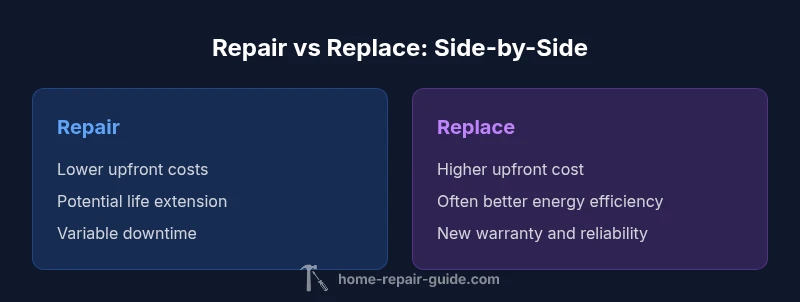
| Initial outlay | Lower upfront cost | Higher upfront cost |
| Estimated lifespan impact | Can extend life with proper service | Typically yields longer life with newer model |
| Maintenance needs | Depends on issue; may require ongoing maintenance | Generally lower maintenance when new |
| Energy efficiency | Depends on current unit age | New model typically more efficient |
| Downtime during service | Variable downtime during repair | Short downtime for delivery/installation |
| Resale value impact | Lower resale value after repair | Higher resale value when replaced |
| Warranty coverage | Repair work usually has limited warranty | New unit often includes comprehensive warranty |
| Total cost of ownership | Uncertain; depends on repairs | Lower risk of recurring failures; higher upfront cost |
Upsides
- Lower upfront costs with repair
- Preserves familiar appliance and layout
- Potentially extends appliance life with proper fixes
- Less downtime than buying new when parts available
- Short-term disruption avoided
Disadvantages
- Uncertain long-term cost if multiple repairs are needed
- Older units may be less reliable and less energy-efficient
- Repair may not address underlying issues (e.g., outdated tech)
Repair is often worth it when repair costs are modest relative to replacement and the appliance still has reliable life.
In many cases, repairing saves money and preserves routines; replace when the unit is old, unreliable, or significantly less energy-efficient, to unlock long-term savings and fewer outages.
FAQ
Is appliance repair worth it?
Repair is worth it when the cost is reasonable relative to replacement and the appliance still has usable life. If the repair would need repeating, or the unit is inefficient, replacement may offer better value. Use a structured compare-and-contrast approach.
Repair is worth it if the price is modest and the appliance has life left. If costs are high or efficiency is poor, consider replacement.
Should I repair an appliance past its planned life?
If the unit is very old and show signs of recurring issues, replacement often provides better long-term value and reliability. When in doubt, get a diagnostic and compare the projected costs of continued repairs with a new model.
Very old units with recurring faults usually favor replacement.
What should I ask a technician when getting a repair quote?
Request a clear parts-and-labor breakdown, the expected lifespan after repair, and whether the repair affects warranty eligibility. Also ask about potential follow-up repairs and safety implications.
Ask for a written, itemized quote and future-life expectations.
Are DIY repairs ever a good idea?
Some minor fixes are safe, but avoid complex electrical or refrigerant work. For anything beyond basic tasks, hire a licensed professional to ensure safety and code compliance.
Tackle simple tasks only; call a pro for complex jobs.
Does warranty affect the decision?
A new unit often comes with a warranty and better energy efficiency; repairs usually don’t carry the same, long-term coverage. Consider how warranty terms influence risk and potential out-of-pocket costs.
Warranties can tilt the decision toward replacement for long-term protection.
How long can a repaired appliance last after a fix?
Repairs can add meaningful life if the issue was isolated and the rest of the unit is sound. If problems recur, expect shorter remaining life and more frequent service.
Repairs extend life if the rest of the unit is healthy; frequent failures reduce benefit.
Key Takeaways
- Begin with both repair and replacement quotes.
- Age and reliability drive value, not price alone.
- Account for energy efficiency and ongoing operating costs.
- Ask for a detailed parts-and-labor breakdown.
- Use a structured decision framework before acting.