When to Repair vs Replace a Car: A Practical Guide
A data-driven comparison to decide whether repairing or replacing your car is the smarter move, weighing cost, reliability, safety, and resale value.


According to Home Repair Guide, deciding when to repair or replace a car hinges on cost, reliability, safety, and resale value. This quick answer outlines how to assess immediate repair costs, potential recurring issues, and the long‑term value of keeping versus upgrading. Use the framework below to reach a decision that fits your budget, daily driving needs, and tolerance for risk.
Understanding the Dilemma: When to Repair vs Replace Car
Deciding whether to repair or replace a car is not simply about the sticker price of a fix. It involves forecasting how well the vehicle will perform in the coming months and years, how much you are willing to invest in maintenance, and what you expect from your transportation in terms of safety, reliability, and total cost of ownership. According to Home Repair Guide, the central challenge is balancing immediate repair costs against the vehicle’s remaining lifespan and potential resale value. A thoughtful approach starts with a clear picture of your driving needs, budget, and risk tolerance. The goal is to minimize downtime while maximizing value, which often means weighing single, well-chosen repairs against a planned upgrade. The decision gets more nuanced with age, mileage, and the rate at which different systems wear out. This guide provides a framework to quantify those trade-offs and translate them into a concrete plan.
For many drivers, this decision emerges from a straightforward question: If a repair restores essential function without introducing new problems, is it worth the cost now, or is it wiser to invest in a newer vehicle that offers reliability, safety features, and lower maintenance risk in the near term? The answer depends on the specific failure, the vehicle’s overall condition, and how you use the car. Home Repair Guide emphasizes a methodical approach: estimate repair costs, project future maintenance, and compare that with the price, warranties, and expected life of a replacement.
A useful rule of thumb is to separate “fix-it-now” decisions from longer-range plans. For a recent model with a single issue, repair may be the most economical path. For a high-mileage older car with frequent defects, replacement may yield better value and safety. This perspective aligns with practical home-repair thinking: invest in fixes that meaningfully improve reliability while avoiding perpetual patchwork on a vehicle nearing its end of life.
Comparison
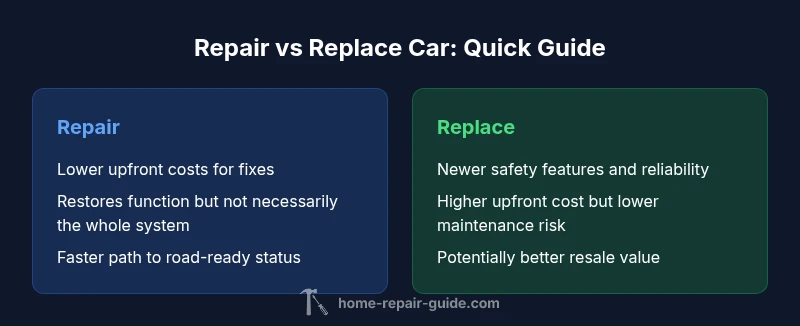
| Feature | Repair | Replace |
|---|---|---|
| Cost over lifecycle | Lower upfront repair costs for isolated issues | Higher upfront cost for replacement, but lower ongoing maintenance in some cases |
| Reliability & performance | Restores a specific function but may leave other aging systems | Newer vehicle offers modern reliability and features |
| Downtime / inconvenience | Typically shorter downtime for simple repairs | Longer downtime to shop for a vehicle and complete transfer |
| Warranty & coverage | Repairs may be covered by existing warranties for parts or labor | New vehicle includes fresh warranty coverage and potential lender protections |
| Resale value impact | Repair quality and overall condition influence resale modestly | Replacement can boost resale value more predictably |
| Environmental impact | Extends lifecycle and reduces waste if repairs succeed | Replacement may increase lifecycle emissions unless efficiency is gained |
Upsides
- Lower upfront costs for minor fixes
- Preserves familiarity with the current vehicle and maintenance routine
- Quicker turnaround for urgent needs
- Opportunity to extend life with targeted, well-chosen repairs
- Potentially better environmental footprint when repairs extend lifecycle
Disadvantages
- Risk of escalating repair costs if multiple issues appear
- Potential safety or reliability concerns with aging components
- Residual value may decline if the car remains old or poorly maintained
- Frequent repairs can interrupt budget planning and limit driving flexibility
Repair when costs are sustainable and reliability can be restored; replace when safety, reliability, or total cost favors a newer vehicle.
If a single or few fixes restore core function without introducing new risks, repair is usually the smarter choice. When many systems are aging or safety features are outdated, replacement often saves money and improves safety over the vehicle’s remaining life. Use a structured decision framework to weigh immediate costs against long-term value.
FAQ
What factors should I consider when deciding to repair or replace my car?
Think about immediate repair costs, expected remaining life of the car, safety, reliability, and resale value. Also weigh how long you plan to keep the vehicle and your tolerance for risk. A structured approach helps you compare repairs to replacement in practical terms.
Consider cost, reliability, safety, and how long you want to keep the car.
Is it ever cheaper to replace a car than to repair it?
Yes, especially when multiple major repairs are needed or safety features are outdated. Compare total ownership costs, depreciation, and expected lifespan to determine which path minimizes risk and expense over time.
Often replacement pays off when repairs pile up.
How can I estimate repair costs without a mechanic?
Ask for written estimates from trusted shops and compare against typical repair costs for your car model. Use maintenance records to identify recurring issues and assess whether a single fix or a pattern of problems is likely.
Get written estimates and compare against the car’s history.
What role do warranties play in repairs vs replacement?
Warranties can cover parts and labor for specific repairs, reducing out-of-pocket costs. A new vehicle comes with a fresh warranty, which can influence the decision if you plan to hold the car for a shorter period.
Warranties shift risk and can affect your choice.
How do I value a new vs used replacement?
Evaluate total cost of ownership, depreciation, and the vehicle’s expected life. A newer used car often offers a balance of modern features and lower depreciation than a brand-new model.
A newer used car can be a smart middle ground.
When should I stop repairing and start replacing for safety reasons?
If essential safety systems are failing or repeatedly breaking, replacement is usually safer and more cost-effective in the long run.
Safety concerns are a strong signal to replace.
Key Takeaways
- Assess repair cost against expected remaining life
- Prioritize safety and reliability in your evaluation
- Include resale value and warranties in the math
- Consider downtime and budget stability
- Use a formal decision framework rather than ad-hoc fixes