Difference Between Repair and Replace: A Practical Guide to Durable Home Fixes
An analytical guide on when to repair versus replace. Learn practical criteria, costs, and scenarios to help homeowners make durable, informed decisions for home repairs.


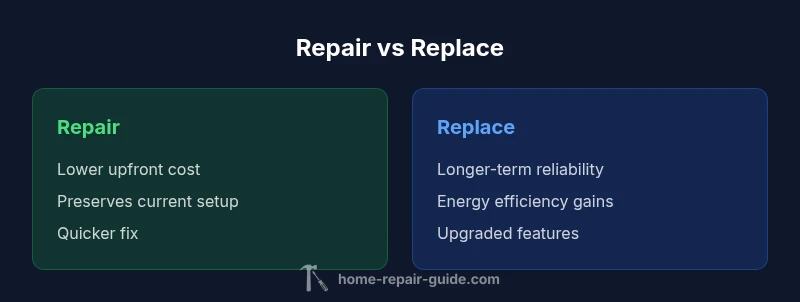
The difference between repair and replace hinges on cost, reliability, and long term goals. Repair saves upfront money and preserves familiar setups, but may invite recurring issues. Replacement costs more initially but can boost efficiency and dependability. Use a structured test: consider age, failure pattern, downtime, and potential upgrades to decide wisely.
Why the difference between repair and replace matters
Understanding the difference between repair and replace is essential for homeowners. According to Home Repair Guide, choosing correctly can affect long-term costs, reliability, and downtime. In practice, the difference between repair and replace reveals itself across appliances, plumbing, and HVAC, shaping how households balance budget, comfort, and safety. This section sets the stage for a methodical approach to decide when to fix or upgrade, and why that decision should hinge on patterns of failure, age, and the potential for upgrading efficiency. The Home Repair Guide team emphasizes that a clear framework helps homeowners avoid emotional choices and sunk costs, especially in busy seasons when downtime disrupts daily routines. By focusing on the core distinction, readers can translate theory into practical actions that protect value and avoid waste.
The emphasis on the difference between repair and replace is not just about the item itself; it’s about overall home performance. A thoughtful choice affects energy use, downtime, and resale value, and it should factor in your household’s tolerance for disruption. This is where a practical guide from Home Repair Guide proves valuable, offering checklists, questions, and a rational process that keeps you focused on durable outcomes.
Defining repair vs replace
A precise definition helps cut through jargon and emotional bias when weighing whether to repair or replace. Repair implies restoring a fault to working condition using existing components, preserving the current setup and space. Replace means removing the affected unit or component and installing a new one, often with updated features and improved efficiency. The difference between repair and replace becomes especially clear during routine maintenance decisions, where a small fix might yield more life, or where a full upgrade could deliver longer reliability and better energy performance. In both cases, the objective is to restore function with the least overall cost and disruption. This section will map out typical outcomes and how to test the options without guessing.
When repair makes sense
Repair makes sense when the fault is isolated, the component is still structurally sound, and the cost of fixing is a fraction of the price of a full replacement. In practical terms, consider the age of the equipment, the likelihood of repeat failures, and the potential for extended life with a targeted repair. The difference between repair and replace here hinges on reliability trajectories: a small repair may extend usable life without introducing new risks, while a patch that doesn’t address root causes can lead to repeated issues. Maintenance history, part availability, and the ability to secure a warranty on the repair all influence the decision. Think about downtime: if a quick fix minimizes disruption and you expect several more productive years, repair can be prudent. Remember, the goal is durable performance, not just a temporary fix.
When replacement is wiser
Sometimes replacement is the wiser route, particularly when the existing unit is at or near end-of-life, safety concerns arise, or newer technology offers substantial efficiency gains. The difference between repair and replace narrows when age degrades reliability or when replacement unlocks features that reduce operating costs over time. Replacements may reduce maintenance needs, improve energy efficiency, and provide compatibility with modern standards. While upfront costs are higher, the long-term value—less downtime, fewer repairs, and enhanced performance—can justify the decision. This section explains how to forecast those long-term benefits without assuming perfect future conditions.
Cost considerations without numbers
Cost considerations are central to the repair versus replace decision, yet real numbers can be elusive in early planning. Instead, use qualitative terms to compare upfront costs, ongoing maintenance, and potential downtime. Repair generally offers lower initial outlay while replacement introduces higher upfront expenditure but may reduce ongoing costs. When weighing the difference between repair and replace, translate these factors into a simple equation: do you expect to gain more value from reduced downtime, improved efficiency, and longer lifespan with replacement, or is a conservative repair approach sufficient to meet current needs? This section provides a practical framework to estimate these tradeoffs without precise pricing.
Reliability and risk assessment
Reliability is a core driver in the difference between repair and replace. If a system shows a pattern of recurring faults, or if the underlying technology is aging and no longer supported, replacement often reduces risk of sudden failure. Conversely, a dependable repair that addresses root causes and preserves core components can dramatically extend life without the disruption of a full upgrade. Assessing risk involves examining failure history, the availability of parts, and the likelihood of downstream issues after a repair. A conservative approach prioritizes stability, while a progressive approach prioritizes modernization and future-proofing. In both cases, a clear risk profile helps guide the decision.
Energy efficiency and environmental impact
The decision also has energy implications. Replacement with newer equipment can offer meaningful efficiency gains, especially when old units consume disproportionate energy or water. The difference between repair and replace in this context means weighing potential energy savings and the environmental footprint of continued operation against disposal and manufacturing impacts. Home Repair Guide encourages readers to consider not just immediate energy costs but long-term environmental benefits. Even modest efficiency improvements can translate into noticeable savings over time, especially in households where equipment runs frequently.
Practical decision framework
To navigate the difference between repair and replace, use a practical framework: identify the fault and its impact on daily life, estimate maintenance and downtime, assess the age and expected remaining life, compare the cost of a repair against the cost of a replacement, and consider potential upgrades that improve efficiency and safety. Create a simple tally of pros and cons for each path, then test different scenarios for downtime, comfort, and financial impact. This method keeps the discussion grounded in real-world needs, rather than abstract probabilities. The framework can be applied to appliances, plumbing fixtures, and home electrical components alike, making it broadly useful across common repair tasks.
Common scenarios: appliances, plumbing, electrical
The difference between repair and replace is often most visible in everyday scenarios: a refrigerator that runs continuously but cools inconsistently, a leaky faucet, or a breaker that trips during peak usage. For each scenario, weigh the repair options against the benefits of replacement. In some cases, a targeted repair can restore reliability without major disruption. In others, replacing with a newer model can deliver quieter operation, better performance, and longer life. The key is to remain objective about expected outcomes and to avoid assuming a repair will outperform a full upgrade in every circumstance.
How to plan repairs for durability
Durability planning starts with a clear inspection and a documented maintenance plan. If you decide to repair, ensure replacement components are from reputable sources and that the repair is supported by a warranty where possible. For replacements, plan for proper installation, compatibility with existing systems, and a transition period that minimizes downtime. The difference between repair and replace here is that durability planning aims to extend the useful life of your system while maintaining safety and reliability. A thoughtful approach can reduce repeat visits and ensure a stable, long-lasting solution.
Long-term budgeting: repairs vs replacement
Long-term budgeting should factor in the expected life of both repaired components and replacements. When the difference between repair and replace is evaluated over time, replacements that improve efficiency and reliability can yield more favorable lifetime value, even if initial costs are higher. A steady, pro-active budgeting approach that accounts for routine maintenance, future upgrades, and potential downtime helps homeowners align repairs with financial goals. Home Repair Guide recommends building a small reserve for essential upgrades and routine service to avoid abrupt, disruptive expenses.
Conclusion and next steps
This section recaps practical considerations for the difference between repair and replace, emphasizing a structured approach rather than a knee-jerk choice. By combining historical performance, maintenance history, and future needs, homeowners can select the path that delivers the best balance of reliability, cost, and comfort. The next steps involve applying the decision framework to your specific scenarios, gathering quotes, and consulting trusted guides to confirm the most durable choice. While there is no one-size-fits-all answer, a disciplined process leads to outcomes that support long-term home performance.
Comparison
| Feature | Repair | Replace |
|---|---|---|
| Upfront cost | lower upfront cost | higher upfront cost |
| Long-term reliability | depends on fault isolation and components | typically higher reliability after upgrade |
| Downtime | shorter downtime with targeted fix | potentially longer downtime for removal and install |
| Energy efficiency impact | may offer modest gains if only minor parts improve | often larger gains with newer technology |
| Environmental impact | less waste if repair extends life | more waste through disposal and new manufacture |
| Upgrade potential | limited upgrade options within current setup | better opportunity to upgrade features and standards |
Upsides
- Lower upfront cost keeps immediate cash flow stable
- Preserves existing setup and space without disruption
- Faster turnaround for minor faults
- Keeps familiar performance and settings during fixes
- Reduces waste when repairs are sufficient
Disadvantages
- Risk of recurring issues if root causes aren’t addressed
- Limited ability to improve energy or safety features
- Hidden costs if repairs require rare parts
- No guarantee of long-term reliability in some cases
Replacement often wins for end-of-life or efficiency upgrades; repair remains viable for localized faults.
Choose repair when the fault is isolated and upgrades aren’t needed. Choose replacement when aging systems fail repeatedly or when new technology promises meaningful efficiency and reliability gains.
FAQ
What is the difference between repair and replace in home maintenance?
The difference between repair and replace centers on whether the existing component can be restored or a new unit is needed. Repairs fix faults within the current setup, while replacements swap in a new unit with updated features. Each choice affects cost, downtime, and long-term reliability.
Repair fixes the existing part; replacement installs a new one. Consider cost, downtime, and future reliability when deciding.
How do I decide whether to repair or replace an appliance?
Begin with the fault pattern, age of the appliance, and available warranty. If a repair addresses the root cause and the unit has enough life left, repair may be best. If failures persist or efficiency matters, replacement could be wiser.
Look at the fault history and age. If repairs keep costs down and life is reasonable, repair. If not, consider replacement.
Are repairs always cheaper than replacements?
Not always. Repairs can be cheaper upfront but may lead to higher costs over time if failures recur. Replacements often come with longer warranties and efficiency improvements that lower ongoing costs.
Not always. Repairs can save money now but sometimes replacement saves more in the long run.
What about warranties when choosing repair or replacement?
Warranties on repairs can protect against repeat faults, while manufacturer warranties on replacements provide coverage for new components. Review terms to understand what is covered and for how long.
Check warranty terms on both repair work and new units to understand coverage.
How can I estimate the long-term cost of repairs?
Track the history of faults, estimated parts availability, and labor needs for repairs. Compare this against the cost of a replacement plus installation. A simple long-term view helps avoid recurring expenses.
Track repair history and labor costs, then compare with replacement costs to assess long-term value.
Key Takeaways
- Assess end-of-life status before deciding
- Balance upfront cost against downtime and reliability
- Consider energy efficiency gains from replacement
- Use a structured decision framework for appliances and plumbing
- Consult Home Repair Guide for a disciplined approach