Repair vs Replace Calculator: A Practical Guide for Homeowners
Learn how a repair vs replace calculator helps homeowners compare upfront repair costs, ongoing energy use, and downtime to decide between fixing now or replacing later, with practical steps and a clear framework.


Use a repair vs replace calculator to quickly decide whether to fix an appliance or replace it. It compares upfront repair costs, ongoing energy use, repair frequency, and downtime to estimate which option provides lower long-term expenses. The tool helps you see how energy efficiency and warranty terms affect the decision, guiding you toward a durable choice.
Introduction and purpose of a repair vs replace calculator
According to Home Repair Guide, a repair vs replace calculator is a decision-support tool that helps homeowners weigh two paths for a failing system or fixture: repair it now or replace it with a modern alternative. The goal is not to predict the exact outcome, but to illuminate the long-term financial and practical implications of each option. By aggregating input such as initial repair estimates, replacement costs, expected energy use, downtime, and maintenance needs, the calculator creates a clear comparison that reflects real-world usage patterns. In practice, many households find that a cautious repair approach is sensible for modest issues, while a replacement often pays off when energy efficiency, reliability, or safety become dominant concerns. The Home Repair Guide team emphasizes using this calculator as a structured thinking tool that informs conversations with technicians and contractors rather than as a final arbiter at the kitchen table.
How to approach a repair vs replace calculator
A well-designed calculator starts from simple inputs and evolves toward a long-term view. You’ll typically enter the age of the item, the estimated repair cost, and the anticipated replacement price. Then you add factors like ongoing energy bills, anticipated maintenance frequency, and expected lifetime after repair versus after replacement. The output translates these inputs into a side-by-side comparison, highlighting scenarios where repair saves money and scenarios where replacement yields energy or reliability gains. While the exact numbers will vary by appliance and location, the framework remains consistent: compare the total cost of ownership over a chosen horizon, and consider non-monetary factors like downtime, convenience, and environmental impact.
Core inputs you should expect to provide
- Item age and typical remaining life expectancy
- Estimated repair cost and likelihood of recurrence
- Replacement cost and installation considerations
- Ongoing energy use and potential efficiency improvements
- Downtime during repair versus installation time for replacement
- Warranty status, availability of parts, and service quality
- Possible tax credits, rebates, or disposal costs
This section also explains how to handle uncertain inputs, such as a repair that may or may not fix the problem on the first attempt. By exploring optimistic, pessimistic, and most-likely scenarios, you create a robust decision envelope rather than a single guess. The end result is a transparent, repeatable framework you can reuse for future repairs. The calculator thus acts as a decision-support tool, not a magic oracle, helping you align choices with your budget, tolerance for hassle, and long-term goals.
Outputs and how to interpret them
Most calculators produce a clear recommendation and a breakdown of two major metrics: total upfront and ongoing costs for repair, and total upfront and ongoing costs for replacement. Some tools also quantify non-financial benefits such as improved reliability, better indoor comfort, or reduced emissions. Interpreting the outputs involves looking beyond the numbers:
- If repair offers a lower total cost of ownership within your time horizon, and the reliability remains solid, repair is often sensible.
- If replacement shows lower lifetime costs due to energy savings, fewer failures, or a longer warranty, replacement may be the smarter move.
- Pay attention to risk indicators, such as high likelihood of repetitive repairs or safety concerns, which can justify early replacement.
A good calculator also shows the break-even horizon—the point at which the cumulative cost of repair equals the cumulative cost of replacement. This helps you plan, stake out the decision window, and compare with contractor quotes. For homeowners watching every dollar, this horizon is the practical place where intuition meets math. The conclusions drawn from the outputs should be discussed with a trusted technician to verify assumptions about parts availability and service reliability.
Real-world scenarios and what the calculator tells you
Consider three representative cases:
- A mid-sized home appliance with a minor, common fault and affordable parts. The calculator may show repair as the wiser option in the short term, provided the part is widely available and the fix is durable.
- An aging furnace with rising energy bills and a history of random outages. Replacement often wins here, thanks to improved efficiency, modern safety features, and a longer warranty.
- A refrigerant-leak-prone air conditioner with uncertain future reliability. The calculator might favor replacement if the combined costs of repeated repairs and energy inefficiency exceed the price of a newer, more efficient unit.
In each case, the calculator helps you quantify tradeoffs and set expectations for performance, longevity, and comfort. The approach supports smart budgeting and forward planning, especially when prices and incentives shift over time. Home Repair Guide emphasizes using the tool alongside a professional assessment to validate inputs and ensure you’re not overlooking critical factors such as code compliance and disposal requirements.
Incorporating maintenance history and usage patterns
Your personal usage pattern significantly influences the decision. A high-use household with frequent dishwashing, laundry, or cooling cycles will stress equipment and increase repair frequency, tipping the balance toward replacement sooner. Conversely, a device that serves a light or seasonal role may tolerate repairs much longer without escalating costs. Maintenance history matters too: regular servicing can extend life and reduce the probability of expensive, unpredictable failures. The calculator can model these patterns by adjusting expected maintenance frequency and lifespan estimates, providing a more realistic forecast of costs and reliability over the chosen horizon. For renters or homeowners with limited budget flexibility, the tool’s scenario comparisons become central to a practical, proactive maintenance strategy.
Non-monetary factors that influence the decision
The calculator isn’t only about dollars. Consider convenience, downtime, safety, and the ability to upgrade to newer features when replacement is chosen. Upgrading to a more energy-efficient model can yield long-term savings and improved comfort, while a repair might preserve the existing layout and wiring. Warranty considerations also matter: a replacement often offers new warranties and easier access to parts, while a repair can preserve an existing warranty if the manufacturer permits it. Finally, consider environmental impact: repairing reduces waste when feasible and supports a circular economy, whereas replacement increases disposal needs but may enable better refrigerants, insulation, or refrigerant containment in newer equipment.
Step-by-step guide to using a repair vs replace calculator
- Collect baseline data: current energy bills, repair estimates, replacement costs, and typical usage patterns.
- Input item age and expected remaining life.
- Enter repair cost and replacement cost, plus anticipated maintenance needs.
- Add energy usage data and any potential efficiency gains from replacement.
- Include downtime and installation considerations.
- Review the side-by-side outputs, paying attention to break-even horizons and the best-for scenarios.
- Validate inputs with a professional estimate for parts availability and installation constraints.
- Make a decision, document the rationale, and revisit the calculator if circumstances change.
Practical tips to maximize value from the calculator
- Always verify input accuracy; small errors compound over years.
- Model multiple horizons (3, 5, 7 years) to see how sensitivity shifts.
- Consider financing options for replacement and any incentives that could tilt the balance.
- Keep a record of performance, maintenance, and unexpected repairs to refine future decisions.
- Use the outputs to guide conversations with contractors and suppliers, not as a binding directive.
Environmental and policy considerations that influence repair vs replace decisions
Policy incentives, rebates, and energy codes can shift the math toward replacement when upgrading to high-efficiency equipment. In some regions, rebates for energy-efficient appliances, heat pumps, or smart controls can shorten the payback period for replacement. Conversely, programs that encourage repair, refurbishment, and recycling reduce waste and extend the useful life of existing assets. Understanding these programs and their eligibility criteria is essential for an accurate assessment. The Home Repair Guide team recommends checking local utility websites and federal energy programs for current incentives that might improve the economics of repair or replacement over your chosen horizon.
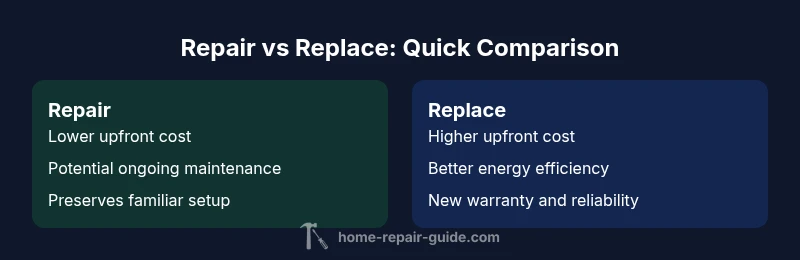
Comparison
| Feature | Repair | Replace |
|---|---|---|
| Upfront cost | Low-to-moderate | Moderate-to-high |
| Long-term cost impact | Potentially lower if repair is durable | Usually higher upfront but lower ongoing costs if energy efficiency is realized |
| Energy efficiency impact | Variable; depends on repair quality | Typically higher with newer, efficient units |
| Downtime and disruption | Lower disruption, shorter downtime | Higher disruption during installation and setup |
| Reliability risk | Depends on repair quality and parts | Higher risk if aging system components recur |
| Warranty coverage | May preserve existing warranty where allowed | New warranty with replacement |
| Environmental impact | Less waste if repair extends life | More waste without proper recycling of old unit |
| Resale value | Typically none or minimal for fixed units | Potential value increase with newer tech |
Upsides
- Repairs often require lower upfront investment
- Maintains familiar system and layout
- Minimizes downtime when parts are readily available
- Preserves existing warranty where applicable
Disadvantages
- Repair costs can accumulate with frequent failures
- Not ideal if reliability is already compromised
- Partial repairs may lead to recurring issues
- Long-term energy savings may be limited without upgrades
Repair is usually the better short-term option; replacement may win on long-term energy savings and reliability.
If the current system is still viable and repair parts are readily available, repairing keeps costs predictable and minimizes disruption. Replacement becomes attractive when energy efficiency, safety, and reliability offer meaningful long-term benefits that justify the upfront investment.
FAQ
What is a repair vs replace calculator, and how does it work?
A repair vs replace calculator is a decision-support tool that weighs repair costs, replacement costs, energy use, and downtime to show which option saves more money over time. It helps you compare scenarios and plan for maintenance or upgrades without committing to a single guess.
It’s a practical tool that compares fix versus replace options so you can plan for the long term. Use it as a guide, then verify with a pro.
When should I trust the calculator’s recommendation?
Treat it as a decision aid rather than a final answer. Ensure inputs reflect your actual costs, usage, and available incentives. Validate the result with a professional estimate for parts, installation, and any regional rebates.
Use the calculator as a guide, then confirm with a qualified technician.
Can energy efficiency sway the outcome?
Yes. More efficient replacements can dramatically reduce ongoing energy costs and maintenance, shifting the balance toward replacement over time, even if initial costs are higher.
Energy efficiency often tilts decisions toward replacement when payback is favorable.
How do rebates or tax credits affect the result?
Rebates and credits lower the effective replacement cost, shortening the payback period and sometimes making replacement the better financial choice.
Incentives can make replacement more affordable and quicker to recoup.
What if the item is still under warranty after repair?
If a repair is allowed under the existing warranty, it can be cost-effective to repair. If the warranty terms are tied to replacement, you may gain protection with a new unit.
Check warranty terms before deciding; sometimes repair preserves coverage.
Are repair decisions better for the environment?
Repairing extends the life of existing assets and reduces waste, but some repairs may be less effective than upgrading to a higher-efficiency unit.
Repair helps the planet by reducing waste, when feasible.
Key Takeaways
- Assess long-term costs, not just upfront price
- Factor energy efficiency when comparing options
- Account for downtime and convenience in your decision
- Include warranties and rebates in the math
- Use the calculator as a decision-aid, then verify with a pro