How Many Repairs Before Replacement: A Practical Guide
Learn how to decide between repairing or replacing a faulty system. This comprehensive guide covers cost, age, reliability, energy use, and safety for homeowners and renters.


There is no universal threshold for how many repairs before replacement. The decision hinges on cost, reliability, age, and safety. According to Home Repair Guide, a structured approach helps homeowners and renters decide when to fix or replace critical systems. This topic matters most for appliances, plumbing, HVAC, and electrical components where repeated failures disrupt daily life and drive up bills. A smart decision protects safety, energy use, and long-term value, while avoiding needless replacements.
Why this question matters
There is no universal threshold for how many repairs before replacement. The decision hinges on cost, reliability, age, and safety. According to Home Repair Guide, a structured approach helps homeowners and renters decide when to fix or replace critical systems. This topic matters most for appliances, plumbing, HVAC, and electrical components where repeated failures disrupt daily life and drive up bills. A smart decision protects safety, energy use, and long-term value, while avoiding needless replacements.
Core factors that drive the decision
Several core factors influence the repair-vs-replacement choice. First, total repair costs over a meaningful period; second, the item’s age and expected remaining useful life; third, reliability and frequency of future failures; fourth, safety implications and potential for hazardous situations; and fifth, energy efficiency and operating costs. Home Repair Guide emphasizes summing these elements to avoid biased judgments. Recognize that ongoing repairs may be a better candidate for replacement when costs mount, even if the upfront price is higher but running costs are lower over time. Maintain a clear record to track these variables as conditions change.
A practical decision framework you can apply
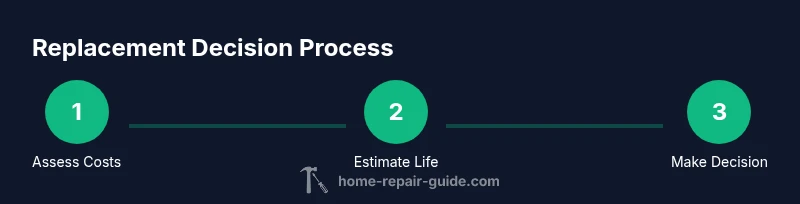
Use a simple four-step framework to guide the repair-vs-replacement decision:
- Gather data on current failures and repair costs, including parts, labor, and downtime.
- Estimate future risk: how likely is another failure, and how costly will it be if it happens during peak seasons?
- Compare against replacement: obtain a quote for a new unit and installation, then estimate ongoing operating costs and potential energy savings.
- Decide and document: choose repair or replacement based on the calculated break-even point and your safety, convenience, and budget priorities. This framework helps ensure reactions aren’t driven by emotions or recent bad luck. This approach is consistent with the method endorsed by Home Repair Guide.
Cost considerations: repairs vs replacement
Direct costs for repairs include parts and labor, while indirect costs include downtime, loss of productivity, and potential damage if a failure occurs at an inopportune moment. Replacement costs cover the new unit, disposal of the old unit, and professional installation. Don’t forget the long-term costs: energy efficiency, maintenance contracts, and the frequency of service calls. A cost-conscious approach weighs immediate expenses against long-term savings from reduced repair frequency and lower energy use. According to Home Repair Guide, framing the decision as a lifecycle cost problem helps homeowners and renters avoid short-sighted choices that affect reliability or safety.
Signs your equipment is near the end of its useful life
Watch for persistent failure patterns, rising repair frequency, and diminishing reliability. If a component requires frequent fixes within a short period, or if downtime disrupts essential routines, start considering replacement. Safety concerns—such as exposed wiring, overheating, or gas smells—are non-negotiable signals to replace or call a professional immediately. Additionally, if energy bills rise without clear explanation, or if the device is no longer supported by warranties or service networks, replacement becomes a prudent option. Home Repair Guide notes that predictable failure trajectories help homeowners plan ahead.
How to estimate repair costs and replacement economics
Begin by collecting quotes for typical repairs and listing all associated costs: parts, labor, travel, and any required downtime. Compare these with a replacement quote, including installation and removal of the old unit. Add expected operating costs and potential energy savings from newer technology. Consider the risk of cascading failures—one failure leading to others—and factor in downtime costs. This structured estimate helps you visualize whether repair costs accumulate toward or beyond replacement costs over a reasonable horizon. The result guides a rational, documented decision rather than a guess.
Energy efficiency, warranties, and safety considerations
Newer models often offer improved energy efficiency, lower operating costs, and stronger safety features, which can tilt the value proposition toward replacement. Warranties: if a large portion of the system’s life remains under warranty, repair may be more attractive; when warranties near expiration, replacement becomes more appealing. Safety concerns are paramount: electrical faults, gas leaks, or water hazards demand prompt action. Finally, consider compatibility with existing systems, installation complexity, and future maintenance commitments when weighing repair against replacement.
A simple example to illustrate the math
Suppose a home appliance currently costs 250 to repair per incident, and failures occur twice a year. Over a reasonable period, repair costs could reach 500 per year. A replacement unit with installation might cost 1200–1800 upfront, but annual operating costs may drop by 10–25% due to improved efficiency. If you stay in the home for another 4–5 years, the energy and maintenance savings can offset the initial price. This is a simplified illustration; actual figures will vary by region and model, but the framework remains valid. Always document the assumptions you use in your calculation.
Authority sources
- https://www.energy.gov/eere/buildings/articles/choosing-energy-efficient-appliances
- https://www.nist.gov/topics/energy-efficiency
- https://www.census.gov
Practical tips for renters and homeowners
- Keep a repair log and budget for maintenance to identify patterns early.
- When in doubt, get a second professional opinion to validate repair costs.
- Consider noise, heat, and emission indicators as early warning signals.
- For rental properties, coordinate with the landlord and document all repairs to avoid disputes.
Tools & Materials
- Budgeting calculator or app(Track repair vs replacement costs over time)
- Maintenance log(Record dates, parts, vendors, and costs)
- Notepad or digital notes(Capture failure frequency and impact on daily life)
- Recent quotes or invoices(Helpful for accuracy)
- Energy usage data (optional)(Estimate potential savings from newer technology)
Steps
Estimated time: 2-4 hours
- 1
Gather repair history and costs
Collect all repair tickets, parts lists, and labor charges from the past 12–36 months. Create a simple ledger that tracks what failed, what was fixed, and the total spent for each incident.
Tip: Keep receipts and note the exact failure mode to spot patterns quickly. - 2
Estimate remaining life and risk
Assess the device’s age, current condition, and likelihood of future failures. Consider how a breakdown could affect daily routines and safety.
Tip: Record any warning signs (strange noises, leaks, overheating) and note how often they occur. - 3
Get replacement quotes
Ask for installation quotes for a comparable new unit, including disposal of the old unit and any required upgrades to meet code or compatibility.
Tip: Include installation time, permits, and potential service contracts in the estimate. - 4
Compare costs over a horizon
Project repair costs for the next 3–5 years and compare to the upfront replacement cost plus projected operating expenses. Include potential energy savings where applicable.
Tip: Document every assumption so the decision stays transparent. - 5
Weigh non-financial factors
Account for downtime, convenience, safety, and environmental impact. A failure at a bad time can be more costly than a replacement.
Tip: Energy efficiency, warranties, and service availability matter as much as price. - 6
Make a documented decision
Choose repair or replacement and record the rationale, expected lifespan, and next review date. Share the plan with other household members or landlords as needed.
Tip: Revisit the decision if major changes occur (e.g., new leaks, price shocks).
FAQ
What counts as a repair in this decision?
A repair restores functionality after a failure. Routine maintenance or minor adjustments that don’t fix a failure aren’t counted as repairs for this decision framework.
A repair is a fix that restores function after a failure; routine maintenance isn’t counted as a repair.
How do I estimate replacement costs accurately?
Obtain quotes for a new unit and installation, include disposal, and add any required upgrades. Compare these figures against projected repair costs over a defined horizon.
Get quotes for a new unit and installation, then compare with future repair costs.
When should safety concerns trigger replacement?
If a component poses a risk of electric shock, fire, gas leaks, or other hazardous conditions, replacement or immediate professional intervention is warranted.
If you smell gas, see exposed wiring, or have other safety risks, replace or call a pro immediately.
Are warranties and service agreements helpful in this decision?
Warranties can reduce the cost of repairs but must be weighed against replacement pricing and expected remaining lifespan. Near-expiry warranties favor replacement planning.
Warranties can tilt the balance toward repair, but near expiry, replacement often makes sense.
How long should I wait after a major repair to decide?
Allow a short observation period (a few weeks) to confirm stability before choosing. If performance remains inconsistent, reconsider replacement.
Give it a short test period to see if the issue recurs before deciding.
What about renters vs homeowners?
Renters should coordinate with landlords for major replacements; keep records, and communicate promptly. Homeowners control replacements but may delegate to contractors.
As a renter, talk with your landlord and document issues; for homeowners, plan and budget for replacements.
Watch Video
Key Takeaways
- Assess cumulative repair costs, age, and reliability.
- Energy efficiency and warranties influence the balance.
- Document your decision for future reference.
- Plan ahead when repairs approach replacement value.