Car AC Repair Price Guide: Costs, Ranges, and Savings for 2026
Explore realistic car AC repair price ranges, factors that drive costs, and smart saving tips—based on Home Repair Guide Analysis, 2026, for homeowners and renters.


Typical car AC repair prices span from about $100 for simple recharge to well over $2,500 for major component replacement. The final bill depends on parts availability, labor rates, vehicle make/model, and diagnostic findings. According to Home Repair Guide analysis in 2026, most common repairs cluster between the low hundreds to around $1,000. DIY attempts rarely save more than a fraction of the total cost, and may affect warranties.
Pricing foundations
Pricing for car air conditioning repairs is built from several core components: diagnostic time, replacement parts, and labor. In most shops, you pay a diagnostic fee to determine why the system isn’t cooling, then separate line items for parts and labor. Costs can also include core charges for refrigerant, freon handling, and recycled materials. When you’re budgeting, think about the full scope: a simple recharge may only require a refrigerant refill and a brief check, while major work requires extensive parts and longer labor hours.
From Home Repair Guide’s analysis in 2026, the typical price tier spans across three bands: under $200 for minor maintenance or recharge, roughly $200-$800 for common component repairs, and $800-$2,500+ for major work like compressor replacement. These brackets reflect diverse vehicle designs and regional rates. Also consider that some cars require specialty refrigerants or OEM parts, which can push the cost higher.
What drives AC repair costs
The price you see is driven by several factors. Labor rate differences among regions can double or triple the price of a given part. Vehicle make, model, and age influence both parts availability and complexity. Refrigerant costs vary with policy changes and supply. Parts like compressors, condensers, evaporators, and expansion valves have widely different price points, and some repairs require additional hardware such as hoses and seals. Finally, the diagnostic process can uncover multiple issues, increasing the final bill even if you only intended a single fix.
To obtain an accurate quote, ask for a written estimate that includes parts, labor, and shop supplies. Request a breakdown that shows the cost of refrigerant, any disposal fees, and warranty terms.
Common AC repairs and price ranges
Here are representative tasks and their typical cost ranges, noting that actual prices depend on your vehicle and locale:
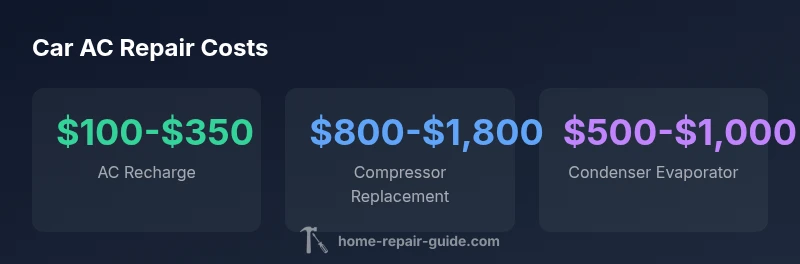
- AC recharge (refrigerant): $100-$350
- Compressor replacement: $800-$1,800
- Condenser replacement: $500-$1,000
- Evaporator replacement: $600-$1,000
- Duct/hose repair or replacement: $200-$600
These ranges come from broad industry data and Home Repair Guide Analysis, 2026. Always get a written estimate before authorizing repair work, and compare multiple shops if possible.
Regional and shop differences
Labor costs vary widely by region. Urban areas with higher living costs will typically charge more per hour for technician labor than rural shops. Franchise outfits may have standardized pricing structures, while independent shops price more variably. In some states, environmental disposal fees or refrigerant handling requirements add small but persistent charges. When region matters, the same component repair can swing by several hundred dollars depending on the shop’s overhead, warranty terms, and certifications.
To minimize surprises, ask for a detailed quote with labor hours, hourly rate, parts cost, and any mandatory fees. Confirm whether the price includes installation accessories, hoses, and gaskets, and whether there is a warranty on parts and labor.
How to read a repair quote
A professional repair quote should itemize parts, labor, and ancillary charges. Look for:
- Part name and part number, with OEM vs aftermarket notes
- Labor time estimates and hourly rate
- Refrigerant quantity and disposal fees
- Diagnostic fee application and whether it is credited toward the final bill
- Warranty terms for parts and labor, and any return or restocking fees
If a quote lacks one of these elements, ask for clarification before approving any work. A transparent breakdown helps avoid sticker shock and ensures you’re paying for what you actually need.
DIY vs professional repair: when to DIY
Car AC systems involve pressurized refrigerant and electrical components. For safety and legality, handling refrigerants typically requires certification, and improper work can cause more damage or leaks. Even if a DIY approach seems cheaper, you may end up paying more for tools, refrigerant, and rework. In most cases, professional service delivers higher reliability, proper reclaim of refrigerant, and a warranty on the repair. If you’re set on a DIY route, focus on basic tasks like cleaning exterior components or clearing obstructed airflow, and leave refrigerant-related work to pros.
Saving strategies and warranties
Smart saving starts with preventive maintenance. Regular cabin air filter changes, belt inspections, and engine cooling system checks help prevent costly AC failures. Shop around for price quotes, but beware of unusually low bids; they can indicate low-quality parts or insufficient labor. Ask about warranty coverage on both parts and labor, and consider extended warranty options if you plan to keep the vehicle long-term. Some shops offer maintenance plans that include annual inspections and discounted refrigerant top-offs.
Case studies: typical scenarios
Case 1: A 6-year-old sedan presents with weak cooling. A recharge and leak test fix the issue, with a total bill around the low hundreds to about $400. Case 2: A compact SUV develops a compressor failure. Replacement plus labor lands in the $1,200–$1,800 range. Case 3: An older vehicle requires evaporator replacement due to persistent leaks; the price can reach $1,000–$2,000 depending on access and labor complexity. These examples illustrate how age, model, and access influence the final cost.
Planning for yearly maintenance costs
Budgeting for car AC maintenance is part of annual vehicle care. Even without major repairs, you should expect occasional recharges, filter changes, or hose maintenance. A conservative estimate would set aside $100–$300 per year for minor servicing, with higher allocations possible if your climate requires frequent use of air conditioning. Keeping a maintenance log and staying current with refrigerant type and component wear can prevent unexpected outages and help you avoid costly emergency repairs. Home Repair Guide recommends a proactive maintenance calendar to spread costs more evenly over time.
Car AC repair cost comparison
| Repair Type | Typical Cost Range | Notes |
|---|---|---|
| AC Recharge (refrigerant) | $100-$350 | Diagnostics may apply |
| Compressor Replacement | $800-$1,800 | High labor and parts; varies by car |
| Condenser Replacement | $500-$1,000 | Depends on vehicle |
| Evaporator Replacement | $600-$1,000 | Complex access |
| Duct/Hose Repair | $200-$600 | Minor repairs |
FAQ
What factors influence car AC repair prices?
Prices vary by repair type, vehicle, location, and labor rates. Diagnostic findings can reveal multiple issues, raising the final cost. Always request a detailed, written estimate before work.
Prices depend on repair type, vehicle, and location; always get a written estimate first.
Is it cheaper to fix or replace a failed compressor?
In many cases, replacement is the most cost-effective long-term solution, especially if the compressor is seized or has internal damage. A professional inspection will confirm whether repair is feasible.
Often replacement is needed for a lasting fix; get a diagnosis first.
Do diagnostic fees apply toward the repair cost?
Diagnostic fees cover the technician’s time to identify the problem. In some shops, the diagnostic charge is credited toward the final repair bill if you proceed with the repair.
The diagnostic fee is typically credited if you repair with that shop.
Can I save money by buying parts myself?
Buying parts yourself can save money if you know the correct part numbers and quality. However, incorrect parts or mismatched specifications can cause delays and higher costs in the long run.
You may save money buying parts, but confirm compatibility first.
How long does a car AC repair typically take?
Most standard AC repairs take a few hours to a full day, depending on the shop’s queue and the repair’s complexity. Complex evaporator work can extend the timeline.
Most repairs take hours to a day, depending on the job.
Are prices different by region or mechanic?
Yes. Labor rates, overhead, and refrigerant handling rules vary by region and shop, influencing the final price. Compare multiple quotes to gauge a fair price.
Prices vary by region and shop; get several quotes.
“Reliable pricing comes from transparent quotes and a clear understanding of parts and labor scope. Home Repair Guide Team emphasizes written estimates before any work.”
Key Takeaways
- Know the rebuild path: recharge to compressor replacement
- Get a written, line-item quote
- Expect regional and shop-driven price differences
- Budget for both parts and labor
- Check warranties before authorizing