How Much to Repair Car AC: Costs, Causes, and Fixes
Explore realistic cost ranges for car AC repairs, what drives price, and practical steps to save. From refrigerant recharge to compressor replacement, know what to expect and how to plan.


Typical car AC repairs cost between $150 and $1,500, depending on the issue, with a recharge or leak repair on the lower end and compressor or condenser replacement on the higher end. According to Home Repair Guide analysis, most homeowners see costs cluster around $300-$900 when basic maintenance is excluded. The actual price depends on parts, labor, vehicle make, and regional rates.
Understanding car air conditioning systems and typical repair scenarios
If you’re grappling with car AC performance, you’re not alone. The system relies on a refrigerant loop, a compressor, a condenser, an evaporator, and a network of hoses and valves. When one part fails, you’ll often notice reduced cooling, unusual odors, or intermittent cold air. According to Home Repair Guide, many failures stem from refrigerant leaks that go undetected until performance drops. A practical way to frame the problem is to think about how components fail: leaks drain efficiency; mechanical failures like the compressor interrupt pressure and flow; and electrical faults can prevent the system from engaging at all. For the search term how much to repair car a c, the answer depends on the diagnosed culprit. A quick, accurate assessment helps map out the right repair path without overbilling. In the real world, you’ll see a spread in prices based on the brand and model, regional labor rates, and whether OEM or aftermarket parts are used. A careful diagnostic is worth the cost because it prevents unnecessary replacements.
Cost ranges by repair type
Costs vary with the scope of the repair. Here are typical ranges you’ll encounter in many shops:
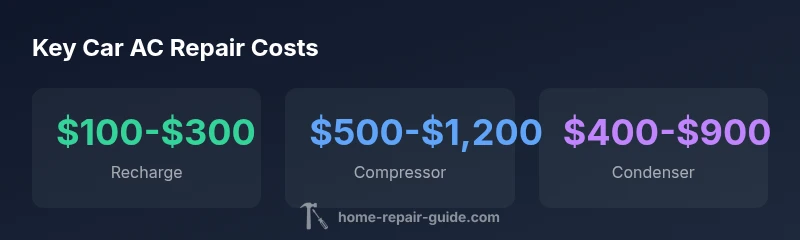
- Refrigerant recharge or leak repair: $100–$300 for a simple recharge; $150–$350 for a dye-based leak test and sealing
- Compressor replacement: $500–$1,200 for the parts plus labor
- Condenser replacement: $400–$900 depending on vehicle layout and refrigerant loss
- Evaporator replacement: $600–$1,500 when the dashboard must be opened
- Drier/accumulator replacement and related plumbing: $150–$400
These figures reflect common scenarios and assume labor rates in a typical market. They are not quotes and can vary with car make, refrigerant type (R-134a vs. R-1234yf), and warranty status. Remember that many repairs involve more than a single part—labor intensity and diagnostic time can push total costs higher. The key is to get a detailed written estimate that itemizes parts and labor so you can compare apples to apples.
What affects price: vehicle, location, and shop rates
Several factors influence the final bill. Vehicle complexity matters: luxury or newer models with advanced HVAC control modules or integrated climate systems tend to cost more due to specialized parts and longer labor. Regional labor rates vary widely; urban shops typically charge more than rural ones, and seasonal demand can drive prices up. Refrigerant type matters too—some newer cars use alternatives that require different handling and recovery methods. If your car is still under warranty or covered by an extended service plan, some parts or labor may be discounted or fully covered. Finally, the choice between OEM vs. aftermarket parts can swing the price. OEM parts are usually higher in cost but may offer better compatibility and warranty support.
How to get an accurate quote and plan ahead
To avoid surprises, start with a diagnostic from a licensed technician. Ask for a multi-point inspection that includes leak testing, refrigerant charge level, compressor function, electrical wiring, and the condenser’s condition. Request a written estimate with line-item parts and labor, plus a clear rubric for any potential additional work (e.g., if a leak is found elsewhere). If you’re comparing shops, factor in diagnostic fees and whether they apply toward the final repair if you proceed there. It’s wise to obtain at least three quotes and ask for the total time to complete the job. For the most predictable costs, get a fixed-price repair on a confirmed scope of work rather than a best-guess estimate for a broad problem.
Saving money without compromising safety
Preventive maintenance goes a long way toward reducing future repair costs. Regularly inspect for leaks, replace cabin air filters, and run the AC at least once a week during warm weather to keep seals flexible. If a leak is detected, addressing it early can prevent evac and compressor damage. Compare prices for core components (compressor, condenser) but prioritize quality and warranty coverage over the lowest price. Ask about recycled or remanufactured parts for non-safety-critical components, and ensure the shop uses proper refrigerant handling to meet EPA guidelines. Finally, consider bundled service plans with routine AC checks to spread out costs over time and catch problems before they escalate.
Long-term considerations and warranties
Some repairs may be covered under a vehicle’s factory warranty or extended service plan, depending on the date of manufacture and the issue. If your car has a known refrigerant leak, ask about a leak-free guarantee or a service warranty for the newly installed parts. Keep a log of service visits, refrigerant recharge dates, and any shocks to the AC system (like a head gasket issue or electrical system fault) since these events can influence both cost and reliability in the long run. A transparent repair history helps you defend against sudden, expensive repairs and informs future maintenance decisions.
Typical cost ranges for common car AC repairs
| Repair Type | Typical Cost Range | Notes |
|---|---|---|
| Refrigerant recharge | $100-$300 | Often part of leak diagnosis |
| Leak repair (diagnosis/test) | $150-$350 | Leak source location required |
| Compressor replacement | $500-$1,200 | Labor-intensive; model-dependent |
| Condenser replacement | $400-$900 | Can be paired with radiator work |
| Evaporator replacement | $600-$1,500 | Dashboard access needed |
FAQ
What is the typical cost to recharge a car AC?
Recharge costs vary by refrigerant type and system condition, but a simple recharge is often in the $100–$300 range. If a leak is present, the diagnostic and leak repair add to the total.
Recharge costs usually fall between one hundred and three hundred dollars, depending on leaks and system type.
Why can car AC repairs be expensive?
Labor-intensive components like the compressor and condenser require significant time and special tools. Additionally, refrigerant handling and leak testing add to costs, especially on newer vehicles using specialized refrigerants.
Complex parts and specialized refrigerants drive up labor and material costs.
Can I fix car AC myself?
Basic maintenance, like changing the cabin air filter and visually inspecting for leaks, can be DIY-friendly. Major repairs, especially those involving the refrigerant or the compressor, should be handled by a licensed technician due to safety and warranty concerns.
Some basic checks you can do at home, but major repairs should be done by a pro.
How long does a typical car AC repair take?
Most repairs take a few hours in a shop, with diagnostic time added. Simple refrigerant recharge can sometimes be done the same day, while complex replacements may require overnight parts sourcing.
Most repairs are completed within a few hours, with some jobs taking longer if parts need to be ordered.
Should I repair or replace the entire AC system?
If a leak is localized and repairable, a component-level fix may suffice. For major failures like compressor failure or multiple failing components, replacement could be more cost-effective in the long run.
It depends on the extent of the damage and the vehicle's age and value.
What should I ask for in a quote?
Request a written quote with a breakdown of parts, labor hours, and any diagnostic fees. Ask about warranty coverage on new parts and whether the quote is binding if further issues are found.
Get a written breakdown with labor, parts, and warranty terms.
“Car AC repair costs can vary widely, but a precise diagnosis before any replacement is essential to avoid wasted spend.”
Key Takeaways
- Know that cost varies by fix and vehicle
- Get multiple quotes to compare scope and price
- Address leaks early to prevent bigger bills
- Ask about OEM vs. aftermarket parts and warranties