Frigidaire Microwave Repair: Step-by-Step Guide
Learn to diagnose and safely repair common Frigidaire microwave issues with practical steps, essential tools, and guidance on when to call a pro. A Home Repair Guide tutorial for trusted home repair guidance.


Frigidaire microwave repair at home is doable when you follow a safety-first, step-by-step plan. This guide covers diagnosing no-power conditions, keypad errors, door latch faults, and magnetron symptoms, with clear tool lists and clear indications for when to stop and call a pro. Follow these steps in order for safe testing, avoiding shock, fire, and warranty voids.
Understanding Frigidaire Microwave Repair
Frigidaire microwaves combine compact design with complex electronics. When they stop working, it can be tempting to replace the whole unit, but many issues are repairable by homeowners with careful, methodical steps. According to Home Repair Guide, a structured approach that prioritizes safety reduces risk and typically saves time and money. This section explains what 'Frigidaire microwave repair' usually involves, how to evaluate symptoms, and how to plan a repair without voiding warranties unnecessarily. Before you start, identify whether the symptom is a simple fix or something that requires part replacement. For example, no power is often caused by a door interlock or a blown fuse, while odd noises might indicate a failing magnetron or capacitor. With the right precautions, most repairs remain DIY-friendly when you stay within your comfort zone and follow manufacturer-approved guidelines. Always consult your model's manual as a reference and confirm that any replacements meet OEM specifications. The goal is to restore safe operation, not to rush the process.
Common Causes of Frigidaire Microwave Problems
Many issues with Frigidaire microwaves originate in worn door switches, faulty diodes, fuses, or loose wiring. The door interlock is a common failure point for Frigidaire models; when the switch or interlock fails, the oven may not start or will stop mid-cycle. Another frequent problem is a blown high-voltage diode in older units, which can cause no power or arc flashes. The control board and keypad can also fail, leading to unresponsive buttons or erratic timers. Finally, a magnetron problem may manifest as weak heating or unusual buzzing. While some problems are self-diagnosed with simple tests, others require professional replacement. In all cases, avoid probing the HV circuitry with power connected, and use a rated multimeter to confirm continuity and proper voltages before ordering parts.
Safety and Preparedness for DIY Frigidaire Microwave Repair
Safety must govern every repair attempt. Always unplug the microwave and wait for capacitor discharge; some high-voltage components can retain a dangerous charge even after unplugging. Keep the work area dry and well-lit, and use insulated tools and non-conductive mats. If your model has a sealed chassis, avoid prying or opening the HV section unless you have the proper equipment and a service manual. Some Frigidaire models have dual interlocks; testing these requires the use of a non-contact voltage tester and a precise wiring diagram. If you smell burning insulation, see signs of arcing, or notice a hot chassis, stop immediately. Do not operate the appliance with a damaged cord, cracked cabinet, or missing safety interlocks. Finally, check your local codes for disposal requirements if you replace a magnetron or power supply.
Tools and Materials You'll Likely Need
Before you start, gather a basic set of tools and a few replacement parts. Common items include a screwdriver set with Phillips and flat blades, a multimeter for continuity and voltage checks, insulated pliers, a non-conductive mat or workspace, and a plastic pry tool to avoid cabinet damage. Have replacement components on hand if you diagnose a faulty door switch, diode, or magnetron. Always verify compatibility with your Frigidaire model and use OEM-approved parts when possible.
How the Repair Process Fits Together
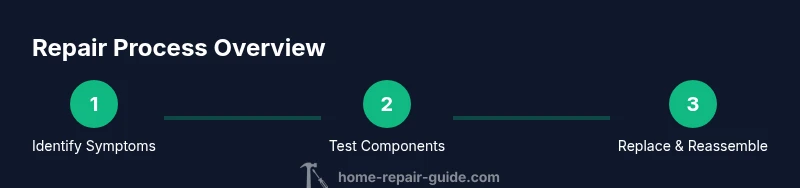
This section gives a high-level view of the repair workflow. Start with safety steps: unplug, discharge, and inspect visible wiring. Move to diagnosis by testing the most common trouble spots first: door interlock, high-voltage diode, fuse, and control panel. After identifying a faulty component, plan the replacement, reassemble carefully, and perform a cautious test with a safe load. If the unit still fails after these checks, it’s time to consult a professional or the manufacturer’s service channels.
Testing and Verification After Repair
With the repair complete, run a controlled test to verify operation. Use a cup of water and a low-wattage setting to observe heating without overloading the system. Listen for unusual sounds, watch for arcing or smells, and check that the turntable runs smoothly. Confirm door latches seal properly and that the display responds to keypad input. If any issue persists, re-check the suspected component or seek professional help.
Tools & Materials
- Screwdriver set (Phillips and flat)(Phillips #2 and flat-head #1 or #2; assorted sizes)
- Multimeter(DC/AC voltage and continuity testing)
- Insulated needle-nose pliers(9-12 inch length)
- Plastic pry tool(Nylon tool to avoid cabinet damage)
- Safety gloves(Insulated, non-slip)
- Non-conductive work mat(Dry surface for components)
- Replacement parts (door switch, diode, capacitor, magnetron)(Only if diagnosed faulty)
Steps
Estimated time: 30-60 minutes
- 1
Power off and unplug
Unplug the unit from the wall and confirm the outlet is dead. This prevents shock and keeps you safe while you inspect internal components.
Tip: If you can’t locate the plug, switch off the circuit breaker feeding the kitchen. - 2
Open the cabinet carefully
Remove the outer cover per the model’s manual, keeping track of screws and clips. Avoid forcing panels; misalignment can damage latches or vents.
Tip: Take photos as you go to help reassembly. - 3
Inspect the door interlock and switch
Visually inspect the door latch and interlock assembly. Use a multimeter to test continuity and ensure the switch closes when the door engages.
Tip: Replace if the switch shows open circuit or physical wear. - 4
Check high‑voltage path components
With the unit de-energized, test the high‑voltage diode and capacitor for continuity and leakage, following the service manual. Do not touch exposed HV parts.
Tip: If you’re unsure, stop and consult the manual or a pro. - 5
Evaluate the control board and keypad
Cycle power and test keypad inputs. Look for unresponsive keys or abnormal backlight behavior that suggests a failed control board.
Tip: Reset the control logic only if the manual instructs you to do so. - 6
Replace faulty component
Install the identified part, ensuring proper orientation and secure connections. Double-check harness pins and connectors before reassembly.
Tip: Use OEM parts and avoid mismatched voltage ratings. - 7
Reassemble and test safely
Reinstall the cover, reconnect power, and perform a cautious test with a water load. Observe heating, time, and turning action for several cycles.
Tip: If any abnormal smell, smoke, or arcing occurs, power down immediately.
FAQ
What are the most common signs that a Frigidaire microwave needs repair?
Typical symptoms include no power, unresponsive keypad, faulty door latch, visible arcing, or unusual heating behavior. Start with safety checks and test basic components before replacing parts.
Common signs are no power, a keypad that won’t respond, or unusual heating. Start with safety checks and basic tests.
Is it safe to repair a microwave at home without professional training?
DIY repair is possible for simple issues, but high voltage components are dangerous. If you’re unsure, stop and consult the manual or a professional.
DIY repair can be safe for simple fixes, but high voltage parts are dangerous. If unsure, seek professional help.
Can I reset the microwave's control board after a fault code?
Some fault codes reset with power cycling, but many require a service procedure. Always check the model manual before attempting resets.
Sometimes a power cycle clears codes, but many require specific steps per model.
What should I do before ordering replacement parts?
Identify the exact symptom, confirm model number, and consult the service manual to verify part compatibility before ordering.
Know the symptom and your model number, and check the manual to confirm compatibility.
How much does Frigidaire microwave repair typically cost?
Costs vary by part and labor. Budget for parts and a service call if you’re not performing the full replacement yourself.
Costs vary; you pay for parts and possible service. It’s best to estimate based on the suspected component.
When should I replace the microwave instead of repair?
If the magnetron or control board fails repeatedly or the unit is older, replacement may be more cost-effective and safer.
If failures recur or the unit is old, replacement may be more cost-effective.
Watch Video
Key Takeaways
- Identify the symptom before disassembly and follow a plan.
- Prioritize safety when working with high voltage components.
- Use OEM parts and model-specific manuals for best results.
- Document steps to simplify reassembly and future repairs.
- If in doubt, consult a professional to avoid safety risks.