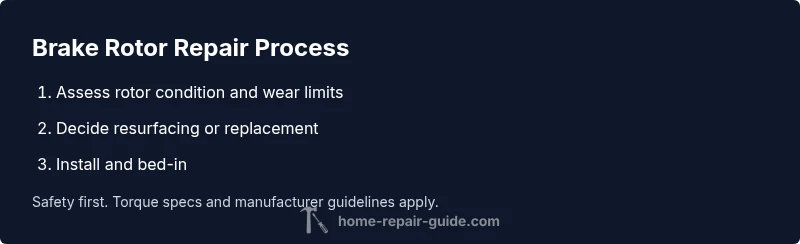
Brake Rotor Repair: A Step-by-Step Home Guide
Learn how to assess brake rotor wear, decide between resurfacing or replacement, and safely complete rotor repair at home with clear steps, tools, and maintenance tips from Home Repair Guide.


Brake rotor repair involves diagnosing rotor wear, deciding between resurfacing or replacement, and performing the service with proper safety and torque procedures. Before you begin, gather the right tools, ensure the vehicle is stable, and plan for a clear workspace. This quick answer previews the steps and safety checks you’ll follow in the detailed guide.
What brake rotor repair covers
Brake rotor repair encompasses restoring a smooth, effective braking surface either by resurfacing (turning) the rotor or by replacing it when wear or damage is too extensive. The process focuses on removing imperfections, ensuring proper runout, and maintaining safe contact with the brake pads. According to Home Repair Guide, a careful assessment of rotor condition and caliper operation is essential before you begin. If the rotor is deeply scored, warped beyond tolerance, or shows cracks, replacement is the safer choice. In many cases, early inspection and maintenance prevent costly repairs later, and the decision between resurfacing and replacement hinges on material thickness and the vehicle manufacturer's specifications. This section explains how rotors wear, what qualifies as damage, and how you choose the best path for your vehicle and driving needs. Keep in mind that the safety margin depends on the entire braking system, including pads, calipers, and brake fluid.
Safety-first: tools, workspace, and precautions
Before you touch any braking components, set the parking brake, place wheel chocks, and raise the vehicle on a sturdy lift or jack stands. Wear eye protection and gloves, and avoid working on a sloped surface. The Home Repair Guide team emphasizes never relying on a single jack to hold the car; always use two jack stands and chocks on the opposite wheels. Disconnect the battery if recommended by your vehicle manual to avoid accidental activation of safety systems. When removing the wheel, inspect the hub for rust and presentable mounting surfaces; clean any debris. If you must compress the caliper piston, use the correct tool to avoid damage. Keep a clean workspace and label fasteners to simplify reassembly. Based on Home Repair Guide research, clean mounting surfaces and fresh lubrication of caliper bolts help prevent future sticking and uneven wear.
Resurface vs replace: making the right call
The choice between resurfacing and replacement depends on rotor condition and manufacturer specifications. If the rotor cannot be resurfaced to restore a true running surface, or if there is deep scoring, heat cracks, or runout beyond spec, replacement is the safer option. Depth of grooves, rotor thickness relative to the OEM minimum, and overall wear guide the decision. Always verify pad compatibility and ensure the new surface will seat evenly with the caliper and piston action. While resurfacing can save cost, it should be done by a machine shop or an equivalent professional setup to avoid altering rotor geometry in ways that compromise braking performance. This section helps you weigh cost, safety, and driving needs when planning rotor work.
How to inspect rotors for wear and damage
Begin with a visual check for scoring, heat rings, rust buildup, and cracks. Measure rotor thickness with a caliper and compare against manufacturer specs; if you don’t have the spec, consult the vehicle manual or a trusted repair guide. Check rotor runout with a dial indicator or a reliable runout tool to detect warping. Rotate the wheel and listen for unusual sounds during light braking and gentle road testing. If you notice pulsation in the brake pedal or steering, it could indicate rotor runout or caliper issues requiring further inspection. Keep notes on any corrosion around the anti-rattle clips and pad retainers, as these affect wear patterns over time.
Practical considerations and maintenance tips
After any rotor work, bedding in new rotors and pads correctly is essential for optimal friction and stopping power. Follow the manufacturer’s bedding procedure, which typically involves a sequence of steady braking to transfer a uniform layer of pad material to the rotor. Avoid hard braking for the first 200-500 miles (or the recommended duration) and inspect for abnormal noise, vibration, or vibration. Re-torque axle components after a short drive if your vehicle’s manual instructs it, and replace brake fluid per the service interval. The Home Repair Guide team recommends coordinating rotor work with pad replacement when signs of pad wear are evident, ensuring a balanced braking system.
Final thoughts and ongoing safety checks
Rotor repair is a critical maintenance task that directly affects braking performance. Regular visual inspections, listening for new noises, and periodic runout checks help you catch issues early. If you’re unsure about rotor condition or need specialized equipment, seek professional service. For ongoing rotor health, schedule periodic inspections as part of your vehicle maintenance routine. The Home Repair Guide team recommends prioritizing safety and accuracy over speed, especially when dealing with critical systems like brakes.
Tools & Materials
- Floor jack(Rated for vehicle weight; use on level ground)
- Jack stands(Two or more, steel, adjustable height)
- Wheel chocks(Place against the wheels opposite the lifted corner)
- Lug wrench / impact wrench(Remove lug nuts; torque wrench for re-tightening)
- Torque wrench(To spec when re-tightening lug nuts and caliper bolts)
- Caliper piston tool / C-clamp(Compress caliper piston safely)
- Micrometer or digital caliper(Measure rotor thickness precisely)
- Dial indicator or runout gauge (optional)(Precise runout measurement)
- Brake cleaner, rags, PPE(Protective gloves and eye protection)
- Replacement rotor(s) or resurfacing service(Choose based on inspection results)
- Brake lubricant / anti-seize(Apply to caliper bolts and contact surfaces)
Steps
Estimated time: 60-120 minutes per axle (varies by vehicle and whether resurfacing is performed by a shop)
- 1
Prepare vehicle and safety
Park on a level surface, engage the parking brake, and place wheel chocks. Loosen lug nuts slightly before lifting, then raise the vehicle with a floor jack and support with jack stands. Ensure the workspace is clear of bystanders and hot components.
Tip: Always chock wheels on the opposite end and double-check jack stands before starting. - 2
Remove wheel, caliper, and rotor
Remove the wheel to access the brake assembly. Unbolt the caliper (support it without hanging by the brake hose) and slide the rotor off. Wipe surfaces with brake cleaner and inspect mounting faces for corrosion or debris.
Tip: Label fasteners and lay them out in order for easier reassembly. - 3
Inspect rotor and decide resurfacing vs replacement
Measure rotor thickness at multiple points and check for runout and cracks. If thickness is below spec or there are deep grooves/cracks, replacement is needed. If within spec and not warped, resurfacing may be considered by a professional.
Tip: If unsure about runout, consult a machine shop for an accurate assessment. - 4
Resurface (or replace) as decided
If resurfacing, take the rotor to a machine shop for trueing. If replacing, install the new rotor with clean mounting surfaces and apply anti-seize to bolts as recommended. Reinstall the caliper and ensure pads seat evenly.
Tip: Do not reuse a rotor that can't be resurfaced to within tolerances. - 5
Reinstall and torque to spec
Mount the wheel and snug lug nuts by hand, then torque to the vehicle manufacturer’s specification using the torque wrench. Reconnect any brake lines or sensors if removed, and ensure the caliper moves freely.
Tip: Torque carefully to avoid warping the rotor or damaging threads. - 6
Bed-in and test
Follow the bedding procedure specified for new rotors and pads. Do several moderate braking events from moderate speeds to evenly transfer pad material. Do a slow, cautious test drive to confirm braking performance and listen for abnormal noises.
Tip: Avoid hard braking for the first few miles to prevent glazing or Imbalanced wear. - 7
Document and monitor
Record rotor type, replacement or resurfacing decision, and torque values. Monitor braking performance over the next few drives and recheck lug nut torque after a short drive if recommended by the manual.
Tip: Keep a simple maintenance log for future reference.
FAQ
What is brake rotor repair?
Brake rotor repair includes resurfacing or replacing rotors to restore a smooth braking surface and safe braking performance. The choice depends on wear, thickness, and damage like cracks or scoring.
Brake rotor repair means resurfacing or replacing rotors to restore braking surface; the decision depends on wear and damage like cracks or grooves.
When should rotors be replaced rather than resurfaced?
Replace rotors when they are below manufacturer minimum thickness, show deep scoring, heat cracks, or visible cracks. Resurfacing is only appropriate if the rotor can be brought back to true running surface without compromising safety.
Replace rotors if they’re too thin or cracked; resurfacing is only safe if the rotor can be restored to a true surface.
Can warped rotors cause pedal pulsation?
Yes. Warping or excessive runout can cause pedal pulsation and steering wheel vibration. If pulsation occurs, inspect rotor runout and caliper alignment as part of the diagnosis.
Warped rotors can cause pulsing brakes; check runout and caliper alignment to diagnose.
Do I need to flush brake fluid after rotor work?
A fluid flush isn’t always required after rotor work, but if you opened hydraulic lines or noticed degraded braking performance, consult your vehicle manual or a mechanic. Brake fluid should be replaced per schedule or when contaminated.
Flushing isn’t always needed, but follow the manual or consult a pro if lines were opened.
Is rotor repair a DIY task for beginners?
Rotor work can be risky for beginners due to high-pressure systems and precise tolerances. Simple maintenance tasks are possible, but for resurfacing, measurement accuracy, and safety, it’s wise to seek professional service.
Rotor repair can be risky for beginners; consider professional service for resurfacing and safety-critical steps.
Should pads be replaced with rotor work?
If pads are worn or contaminated, you should replace them when you install new rotors. Mismatched wear can cause uneven braking and noise.
Replace worn pads when installing new rotors to ensure balanced braking.
Watch Video
Key Takeaways
- Assess rotor condition before any work.
- Choose resurfacing or replacement based on wear and specs.
- Use proper safety gear and torque specs during reassembly.
- Bed-in rotors and pads for optimal braking performance.
- Schedule follow-up inspections to maintain brake health.