Repair Boiler: Safe DIY Guide for Home Heating
A comprehensive, step-by-step guide to diagnosing and safely repairing common boiler problems, with maintenance tips, safety precautions, and guidance on when to hire a professional.


In this guide you will learn how to diagnose common boiler problems, perform safe maintenance, and identify when professional help is needed. You'll find practical, step-by-step tasks, safety checks, and tool lists to restore heat efficiently while reducing risk. Note that boilers involve gas, electricity, and pressure systems, so always prioritize safety and know when to shut down utilities.
Why repair boiler matters\n\nA boiler is central to home comfort during cold seasons. When it fails, you risk cold rooms, high energy bills, and safety hazards from gas or heat exchangers. According to Home Repair Guide, regular inspection and timely minor fixes reduce the likelihood of emergency breakdowns and keep efficiency higher. A well-maintained boiler can run more reliably and last longer, protecting your family and your investment. This guide focuses on practical, safe steps you can take to diagnose common issues, perform basic maintenance, and know when to call a licensed professional. It emphasizes that boiler repair, when done properly, contributes to comfort, safety, and energy savings.
Safety first: before you begin\n\nWorking with boilers involves exposed heat, electrical components, and potentially combustible gases. Before any inspection or repair, switch off power at the main breaker and shut off the gas supply if you can do so safely. Ventilate the area; keep doors and windows open if you’re working in a confined space. Use CO detectors and a smoke alarm in the same zone to monitor for dangerous conditions. If you smell gas, leave the area immediately and call the gas provider. This section uses general guidelines; for specifics refer to the equipment manual in your boiler model.
Diagnosing common boiler problems\n\nMany boiler problems show up as no heat, fluctuating temperatures, odd noises, or leaks. Start with the simplest explanations: check for a tripped fuse or blown fuse, ensure the thermostat is calling for heat, and inspect the pressure gauge. If the pilot light is out on a gas boiler, follow the manufacturer’s relight procedure only if you feel confident. Look for water leaks around the joints, expansion vessel, or safety valve. Each symptom points to a different pathway for repair or service.
Tools and materials you'll need (check before you start)\n\nHere is a practical list of essential items for safe, basic boiler maintenance and minor repairs: safety gloves, safety glasses, screwdrivers, an adjustable wrench, pliers, a digital multimeter, a boiler pressure gauge or manometer, towels or rags, a CO detector, and the boiler manual. Always keep a clean workspace and have a bucket or container ready to catch drips. Refer to your model's manual for any specialty parts that may be required.
Boiler types and parts you should know\n\nBoilers come in several configurations, and some repair steps vary by model. A combi boiler provides hot water on demand and often has fewer expansion components, while a system boiler uses a separate hot water cylinder with a larger expansion vessel. Understanding the basic parts a technician checks — boiler pump, heat exchanger, pressure relief valve, expansion vessel — helps you assess symptoms and communicate clearly with a professional when needed.
When to call a licensed professional and next steps\n\nIf you encounter gas odors, a persistent loss of heat, frequent cycling, or if you see active leaks from joints or the pressure relief valve, stop and call a licensed professional immediately. DIY work is best limited to basic safety checks and maintenance tasks that do not involve gas control systems or sealed electrical connections. After any repair, arrange a professional boiler inspection annually to maintain efficiency and safety. Read your manual, document codes, and track energy bills to spot repeating issues early.
Tools & Materials
- Safety gloves(Heat-resistant, non-slip)
- Safety glasses(Eye protection)
- Screwdrivers (Phillips and flat-head)(Magnetic tips preferred)
- Adjustable wrench(Size range 8-24 mm)
- Pliers(For hose clamps or clamps)
- Digital multimeter(For electrical checks if accessible)
- Boiler pressure gauge or manometer(To verify system pressure)
- Towels or old rags(To catch drips)
- CO detector(Ensure proper ventilation)
- Owner's manual(Model-specific guidance)
Steps
Estimated time: 40-60 minutes
- 1
Power down and isolate the boiler
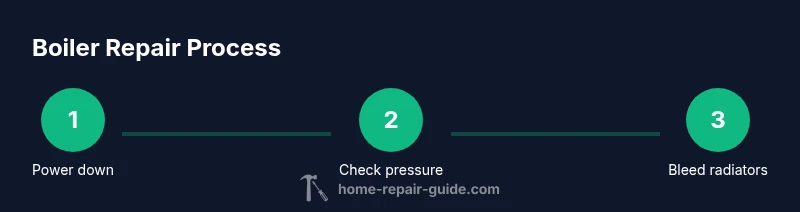
Turn off the boiler's power at the switch or circuit breaker. If you can safely access the gas valve, shut it off too. Allow the system to cool for several minutes before touching components.
Tip: Verify power with a tester and do not rely on light switches alone. - 2
Check for obvious hazards and leaks
Inspect for damp spots, corrosion, or leaked water around joints and valves. Address any obvious hazard by closing valves and cleaning the area before proceeding. If you smell gas, leave immediately and call the gas supplier.
Tip: Use a flashlight and keep a spill container handy. - 3
Check boiler pressure and fill if needed
Locate the pressure gauge; typical residential boilers operate between 1 and 2 bar when hot. If pressure is low, use the filling loop to restore it gradually while watching the gauge.
Tip: Do not exceed 2 bar when filling; over-pressurizing can cause safety valve discharge. - 4
Bleed radiators to remove trapped air
Starting with the highest radiator, use a radiator key to release air until water appears, then close the valve. Check the system pressure again after bleeding.
Tip: Keep a cloth handy to catch drips and avoid scorched skin. - 5
Relight pilot or reset the boiler
If your unit has a pilot, follow the manufacturer’s relight procedure. For modern sealed units, use the reset button as directed in the manual.
Tip: Never force a lone spark; follow the exact relight steps. - 6
Test operation and safety devices
Restore power and gas (if applicable) and run the boiler. Listen for unusual sounds, monitor heat delivery, and ensure the pressure returns to normal after cycling.
Tip: If it fails to run properly, stop and arrange a professional inspection.
FAQ
What should I do if my boiler won't ignite?
Check the thermostat, confirm power and gas supply, and use the manufacturer relight procedure if available. If it still won't ignite, contact a licensed professional. Do not force ignition methods that are not in the manual.
If your boiler won't ignite, check the thermostat, power, and gas supply, then try the relight procedure if the manual allows. If it still won't start, call a licensed professional.
How can I tell if my boiler has a leak?
Look for puddles or damp areas around joints, radiators, and the expansion vessel. A sudden loss of pressure or moist spots may indicate a leak. If you detect a leak, shut off the boiler and contact a professional.
Look for water around joints or damp spots, and note any sudden pressure loss. If you see a leak, shut off the boiler and call a pro.
Is bleeding radiators necessary?
Bleeding is only needed if you feel cold spots at the top of radiators or hear gurgling sounds. After bleeding, recheck boiler pressure to ensure it’s within the safe range.
Bleed radiators if you notice cold spots at the top; recheck pressure afterwards.
What is boiler pressure and why is it important?
Boiler pressure indicates the system's hydraulic load. Typical residential range is around 1-2 bar when hot. Pressures outside this range can reduce efficiency or trigger safety shutoffs.
Boiler pressure shows the system load; keep it in the 1-2 bar range when hot.
When should I replace a boiler?
If the boiler is over 10-15 years old and requires frequent repairs or shows declining efficiency, replacement may be more cost-effective than ongoing fixes. Consult a licensed professional for an assessment.
Consider replacement if the boiler is old and prone to repairs; have a pro assess efficiency and cost.
Can I repair a boiler myself?
DIY work is best limited to basic safety checks and maintenance. Gas or sealed system repairs should be performed by a licensed technician to avoid dangerous situations.
DIY repairs should be limited to basic maintenance; for gas or sealed systems, hire a professional.
Watch Video
Key Takeaways
- Shut off power and gas before inspection
- Check pressure and bleed radiators if needed
- Know your limits; call a pro when in doubt
- Maintain records for future service