Boiler Repair Near Me: A Practical Homeowner's Guide
Learn how to locate reliable boiler repair near me, verify credentials, compare quotes, and prevent future breakdowns with practical, actionable steps from Home Repair Guide.


By the end of this guide, you’ll be able to locate reliable boiler repair near me, verify credentials, and compare options without overpaying. You’ll learn how to recognize urgent versus routine issues, what questions to ask, and how to prepare for a service visit. Use this steps-first approach to protect your home’s heating and safety.
Why boiler repair near me matters
When your boiler falters, comfort and safety hinge on speed and accuracy. A failing boiler can leave you in the cold and create safety risks from gas leaks or carbon monoxide. Finding boiler repair near me quickly matters because qualified technicians bring not only heat back but also proper diagnostics and safe shutdown procedures. According to Home Repair Guide, the fastest way to reduce risk is to confirm a technician is licensed, insured, and experienced with your boiler type. In many homes, boiler issues are symptoms of worn seals, clogged condensate pipes, or air in the system; a trained pro can pinpoint the root cause, order genuine parts, and complete the repair with the right safety checks. This section equips you to recognize urgent signs (persistent gas smell, high CO alarms, sudden pressure drops) and non-urgent maintenance that prevents future breakdowns. Your goal is reliable heat, energy efficiency, and peace of mind during cold weather.
How to evaluate boiler repair technicians
Choosing the right pro begins before you pick up the phone. Verify licensing that matches your state and boiler type; ask for proof of insurance and a company name that appears on a policy. Home Repair Guide analysis shows that reputable technicians provide written estimates, transparent parts lists, and clear warranty terms. When you contact a shop, ask about their diagnostic process, whether they perform gas line safety checks, and what certifications (e.g., gas-safe or HVAC credentials) they hold. Request a copy of the service agreement and any upcoming maintenance plan. Compare response times for emergency calls, and check if they offer after-service follow-up or annual tune-ups. A trustworthy contractor should be willing to explain the problem in plain language, show photos or reports, and provide an itemized bill. If something feels rushed or vague, consider a second estimate. A good pro prioritizes safety, not just price.
What to expect during a boiler service visit
A typical service begins with a safety briefing, verification of gas and electrical connections, and a quick visual inspection of the boiler and venting. The technician will typically perform a combustion test, check draft, examine pressure and temperature readings, and listen for abnormal noises. You should expect a detailed report that explains the diagnosed fault, recommended parts, and a cost estimate. If a part is on backorder, discuss options for temporary fixes and timelines. The technician will often test system re-ignition, safety switches, and expansion vessel function. If your boiler uses a condensate pump or seals, ensure these components are checked for leaks. Home Repair Guide emphasizes asking for written notes or a digital diagnostic so you can track repairs and future maintenance. Most visits conclude with a demonstration that the system runs normally and safe CO levels are confirmed.
Cost considerations and budgeting for boiler repairs
Boiler repair costs depend on the problem, boiler type, and the need for parts or labor. Expect variation by region and service level. In general, plan for diagnostic fees (if charged separately), parts (valves, gaskets, pumps), and labor. A basic repair (seal or valve) tends to be less than a full heat exchanger replacement, but complex fixes can run higher. The Home Repair Guide analysis shows that reliable shops provide itemized estimates with labor rates, parts, and travel fees. Always ask about warranty on repairs and what happens if a part fails again within a specified period. If your boiler is older and less efficient, you may weigh the long-term cost of continued repairs against replacement with a newer, more efficient unit. A sensible budget also accounts for potential temporary heating alternatives during peak winter months. Remember to request written quotes and compare them side-by-side rather than choosing the lowest upfront price.
Maintenance and preventive measures after a boiler repair
After the repair, schedule a tune-up at the manufacturer-recommended interval and set reminders for annual inspections. Keep the area around the boiler clean to improve venting and reduce dust buildup that can affect sensors. Regularly check the pressure gauge and ensure the expansion tank is within the correct range; a technician can recalibrate as needed. Replace any worn gaskets or seals during routine maintenance to prevent future leaks. Consider installing a CO detector near the boiler and a dedicated smoke alarm on every level. Home Repair Guide encourages homeowners to keep a simple maintenance log: date, service performed, parts used, and next due date. Finally, set up an annual service plan with a local boiler technician to catch problems early, extend equipment life, and maintain efficiency.
Tools & Materials
- Safety gear: gloves and eye protection(Tou must wear protection when handling any boiler components or leaks)
- Gas shut-off valve tool or adjustable wrench(Essential to quickly isolate the boiler if needed)
- Multimeter or voltmeter(For basic electrical checks on controls and ignition circuit)
- Manometer or boiler pressure gauge(Used to verify system pressure and expansion tank function)
- Flashlight(Improve visibility in tight boiler compartments)
- Smartphone or camera(Capture photos of labels, connections, and leaks for later reference)
Steps
Estimated time: 2-4 hours
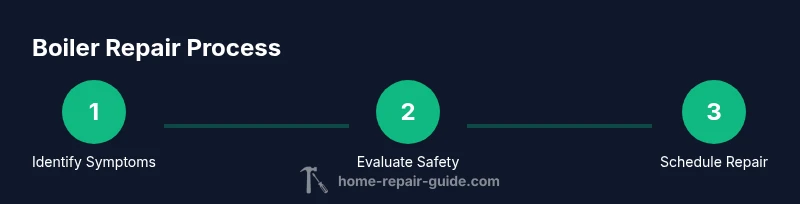
- 1
Identify problem symptoms
Listen for unusual noises, check for cold spots, leaks, or error codes, and note when the issue started. Record any recent changes to settings or wiring. This helps the technician diagnose quickly.
Tip: Note exact times, temperatures, and whether the issue occurs on startup, during heat call, or when cycling off. - 2
Shut off power and gas safely
Locate the boiler switch and shut off electrical power. If you suspect a gas issue, evacuate and call the gas utility or emergency services. Never attempt to manipulate gas lines or ignition components.
Tip: If you smell gas, leave the area immediately and avoid using switches or phones near the leak. - 3
Gather boiler details
Find the model and serial number, rule out obvious leaks, and prepare a list of symptoms and recent maintenance. This helps the technician identify compatible parts and service history.
Tip: Take clear photos of the rating plate and any labels for reference. - 4
Check simple fixes you can safely perform
If you are trained, check manual bleed radiators, verify pressure on the gauge, and ensure the expansion tank is not fully drained. Do not attempt complex repairs.
Tip: Only perform steps you are comfortable with; unsafe tasks require a professional. - 5
Request written estimates
Call or email for written quotes that include diagnostics, parts, labor, and travel. Compare at least two estimates to gauge fairness and scope.
Tip: Ask about warranty length on parts and whether labor is covered for future failures. - 6
On-site evaluation by a technician
During the visit, listen to the diagnosis, review the proposed parts, and ask for a plain-language explanation. Request a digital diagnostic report if possible.
Tip: Ask to see any failed components or test results that confirm the diagnosis. - 7
Test, verify, and schedule maintenance
After repair, test the system for proper ignition, heat output, and safe CO levels. Schedule a follow-up or annual maintenance to prevent future failures.
Tip: Keep a maintenance calendar and note any part replacements for future reference.
FAQ
What counts as an emergency boiler repair?
Gas smells, CO alarms, lack of heat in freezing weather, or visible leaks require immediate professional attention. Call the utility or emergency services if danger is suspected.
Gas smells or CO alarms near a boiler are emergencies. Call your utility or emergency services right away.
How do I verify a boiler technician’s license?
Ask for license numbers and insurance certificates and verify them with the relevant state or provincial board. Request references or prior work examples when possible.
Ask for their license and insurance, then verify with the state board. Request past customer references.
How long does boiler repair usually take?
Time varies by fault and parts availability. Most diagnostic visits take 1-2 hours, with repairs ranging from a few hours to a full day for complex replacements.
Most repairs take a few hours, though complex replacements can take longer depending on parts.
Can I fix a boiler leak myself?
Minor leaks may be addressed only by a qualified technician. Attempting DIY fixes on gas or high-pressure systems can be dangerous.
Leaks on boilers should be handled by a licensed pro; DIY fixes can be dangerous.
Should I replace instead of repairing an old boiler?
Consider boiler age, efficiency, repair cost, and long-term savings. If repairs exceed a reasonable portion of replacement cost, replacement with a newer unit may be wiser.
If the boiler is old or repairs keep climbing in cost, replacement might be more economical in the long run.
What questions should I ask a boiler pro?
Ask about warranty terms, parts sources, expected downtime, and safety checks performed. Request a written plan with timelines and a clear payment schedule.
Ask about warranties, parts, downtime, safety checks, and request a written plan.
How can I lower boiler repair costs safely?
Get multiple quotes, compare scope of repairs, and schedule preventive maintenance to avoid costly emergency fixes. Keep up with annual tune-ups to reduce risk.
Shop around for quotes and keep up with regular maintenance to avoid big, surprise repairs.
Watch Video
Key Takeaways
- Prioritize safety before any repair action.
- Verify licenses and warranties before hiring.
- Get written estimates and compare scope.
- Schedule preventive maintenance to reduce future failures.