Why is My Service Not Working? A Practical Troubleshooting Guide
Facing a service outage at home? This urgent, practical guide walks you through common causes, fast checks, and a step-by-step plan to diagnose and fix the issue safely, with pro tips and when to call a pro.


If your service isnt working, the most common culprits are a power issue, a connection problem, or a misconfigured setting. Start with a quick check: confirm the service is powered on, inspect cables or pipes for interruptions, and review recent changes. If the problem persists, proceed through the diagnostic flow below. This approach helps homeowners identify whether to reset, reseat connections, or call for service.
Common Causes of Service Issues
When homeowners ask "why is my service failing?", the answer is usually straightforward. Most service issues stem from power or supply problems, loose connections, or incorrect settings. Others come from worn components, outdated firmware, or environmental factors (temperature or moisture) that disrupt operation. By understanding these categories, you can prioritize your checks and avoid unnecessary steps. In many cases, addressing a simple power issue or reseating a loose hose resolves the problem without tools. The Home Repair Guide team emphasizes starting with the fundamentals, because skipping basic checks often leads to chasing complex causes unnecessarily. The goal is to restore reliable service quickly while keeping safety at the forefront. Always verify that any action you take aligns with the appliance or system manual to prevent accidental damage.
Quick Checks You Can Do Right Now
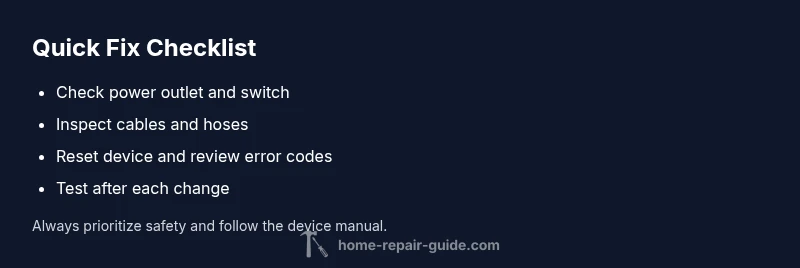
Before you dive into deeper diagnostics, perform these fast checks. They cover the majority of non-hardware failures and help you decide whether professional help is needed. - Verify the main power source is on and switch is not tripped. - Inspect visible cables, hoses, and connectors for kinks, wear, or disconnections. - Check for any blinking indicators or error codes on the unit or control panel. - Reset the device by turning it off, waiting 30-60 seconds, and turning it back on. - Review recent changes or updates that might have affected settings. - If you have more than one device or a shared service, test with a different unit to rule out a single faulty device.
Understanding Symptoms and Prioritize Fixes
Not all symptoms point to the same fix. An intermittent restart usually signals connection or power issues, while a steady failure may indicate a misconfiguration or damaged component. Leaks or unusual noises suggest plumbing or mechanical problems that require immediate attention. Slow performance or error codes help narrow down to firmware, settings, or compatibility issues. By categorizing symptoms, you can triage efficiently and avoid wasting time on unlikely causes. Keep a log of when the symptom occurs, what changed recently, and any codes shown; this will speed up diagnosis and save you headaches if you need professional help later. The goal is to map symptoms to the most probable causes so you can apply the simplest, safest fix first.
Diagnostic Flow Overview
A logical, stepwise approach reduces frustration. Start with the easiest checks (power, connections, resets) and only move to more involved steps if the issue persists. For each symptom, consider these questions: Did anything change recently (new install, update, or relocation)? Is there a clear indicator (alarm, light, code)? If a fix doesnt work, ask: could this be a broader service issue or something that requires a professional like a licensed technician? Following this flow helps you stay organized and increases the chance of a quick resolution without unsafe work.
Step-by-Step: Fixing the Most Common Cause
This section provides a concrete, safe procedure you can perform to address the most frequent reason for service failures: a power/connection issue. The steps are designed to be completed with common household tools and without specialized training. If at any point you feel uncertain or encounter unusual behavior (sparks, smoke, burning smell), stop immediately and seek professional help.
Safety, Warnings, and When to Call a Pro
Safety is non-negotiable. Always unplug devices before inspecting internal components, and never work inside electrical panels unless you are qualified. Wear appropriate PPE (gloves, eye protection) when handling copper, wiring, or plumbing. If you notice exposed wiring, leaks, corrosion, or if the device continues to operate abnormally after basic checks, contact a licensed professional. Attempting advanced repairs without proper training can cause injury or further damage.
Prevention: Keep Your Service Running Smoothly
Proactive maintenance reduces the likelihood of future outages. Schedule regular inspections of cords, hoses, and seals; update firmware when applicable; and keep a written maintenance log. Test critical connections quarterly and after any home improvement projects that involve wiring or plumbing. A small upfront investment in routine checks saves larger, disruptive repairs later.
Steps
Estimated time: 30-45 minutes
- 1
Check power and source
Begin by confirming the main power source is active. Verify the outlet is live by plugging in a tester or another known-good device. If you use a breaker, ensure it hasn’t tripped and reset if needed. This quick check rules out the most common cause of service outages.
Tip: If you see a tripped breaker, reset it and test again; if it trips repeatedly, stop and seek professional help. - 2
Inspect connections and hoses
Trace visible cables, hoses, and connectors for signs of wear, kinks, or looseness. Firmly reseat any loose connections and ensure clamps or fittings are secure. A simple reseat often resolves intermittent faults.
Tip: Take a photo before loosening anything so you can reference the original setup. - 3
Power cycle the device
Power off the unit completely, unplug it, and wait 60 seconds. Plug back in and power on. A full reset clears transient faults and reinitializes the control logic.
Tip: If the device has a battery backup, ensure it is charged before a full reboot. - 4
Check settings and status indicators
Review the current settings or diagnostics display for error codes. Compare with the manual to interpret codes, then adjust as required. A mismatched setting can cause immediate failure or degraded performance.
Tip: Document codes for reference if you need to contact support. - 5
Escalate if unresolved
If the issue remains after these steps, collect logs, photos, and a brief description of symptoms, then contact customer support or a licensed technician. Do not attempt disassembly beyond basic inspection.
Tip: Having documentation speeds up diagnosis and reduces follow-up back-and-forth.
Diagnosis: Service outage or malfunction
Possible Causes
- highPower issue
- highLoose connections
- mediumMisconfiguration or settings error
- lowComponent wear or failure
Fixes
- easyCheck outlet and ensure device is powered on; inspect circuit breakers/fuses
- easyInspect cables, hoses, and connectors for looseness or damage; reseat where applicable
- easyReset device/system and reconfigure settings if needed
- mediumIf the issue persists, consult the device manual or contact support
FAQ
What is the first thing I should check when my service wont start?
Begin with the basics: ensure the device is powered, the outlet is live, and breakers are not tripped. Then inspect visible connections for looseness and reset the device if needed.
Start with power, outlet, and breaker checks, then look at connections and perform a reset if needed.
Could a software setting cause a service outage?
Yes. Misconfigured settings can stop a service from functioning properly. Review recent changes and compare them to the device manual, then revert to a known good configuration if available.
Settings can cause outages—check recent changes and revert to a known good setup if you can.
When should I call a professional?
If power issues persist after basic checks, if you detect physical damage, or if error codes indicate hardware failure, its time to contact a licensed technician.
Call a professional if power problems persist or you notice damage or alarming error codes.
Is it safe to troubleshoot on my own?
General checks are usually safe if you follow basic safety rules and unplug devices before inspecting. Stop if you see heat, smoke, or sparks, and seek professional help immediately.
Yes, basic checks are often safe, but stop and call a pro if you see danger signs like smoke.
What if none of the steps fix the issue?
Document everything and contact support with your notes. A recurring problem may require a replacement part or a professional inspection.
If unresolved after steps, reach out with details for professional assistance.
Watch Video
Key Takeaways
- Start with power and connections to rule out the simplest causes
- Follow a safe, stepwise diagnostic flow before complex repairs
- Document codes and settings to speed up future troubleshooting
- Call a pro when safety or reliability is at risk or if issues persist