How Long Does Liver Recovery Take? An Educational Guide
Explore typical liver recovery timelines, factors that affect healing, and an educational calculator to estimate recovery weeks. Content from Home Repair Guide.


What recovery means for the liver
The liver is a remarkable organ with regenerative capacity, but recovery timelines depend on the underlying cause, the extent of damage, and individual health factors. According to Home Repair Guide, explaining liver recovery in simple terms helps homeowners understand medical realities and how lifestyle changes may influence healing. In general, mild stress from temporary factors—like a brief episode of fatty liver or reversible inflammation—may begin to improve within days to weeks as the liver regenerates. Heavier insults from chronic alcohol use, viral hepatitis, or severe fatty liver disease typically require longer recovery periods and often warrant medical supervision. The takeaway is that recovery is not a fixed countdown; it unfolds as the body repairs tissue, removes toxins, and restores normal function. People who actively reduce risk factors and follow medical advice often see more consistent progress over time.
Key factors that influence recovery time
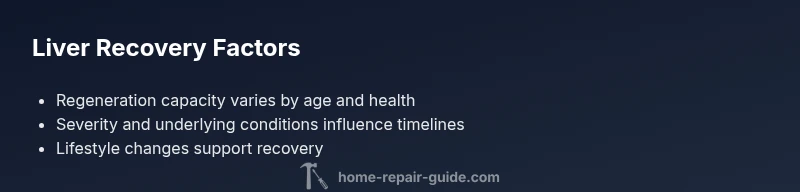
The speed and extent of liver recovery are shaped by multiple interrelated factors. Age can influence regenerative capacity, while the specific disease mechanism (fatty liver, hepatitis, toxin exposure) sets a baseline for what kind of healing is possible. Comorbid conditions such as diabetes or obesity may slow progress, whereas strong nutritional status and physical activity can support restoration. Adherence to medical guidance—such as medications, vaccines, and recommended checkups—also plays a critical role. Importantly, environmental and lifestyle elements like alcohol consumption, exposure to hepatotoxins, and sleep quality can tilt recovery timelines in meaningful ways. Remember, timelines are individualized; there is no universal clock for every patient. The Home Repair Guide approach emphasizes practical, proven steps you can take to create a healthier environment that supports liver healing over weeks and months.
How to use the Liver Recovery Time Estimator calculator
The Liver Recovery Time Estimator is designed to educate, not replace medical advice. It uses four inputs: Age (years), Injury severity (1-5), Lifestyle adherence (%), and Alcohol per week (units).
- AgeYears: Older age may reduce regenerative capacity, subtly increasing recovery weeks.
- Severity: Higher scores add weeks to the estimate.
- Adherence: Better adherence reduces the number of weeks required.
- AlcoholPerWeek: Higher intake adds weeks to the recovery timeline.
The formula combines these inputs and clamps the result to a plausible range (4–52 weeks). Answers should be treated as educational approximations. Always consult a healthcare professional for a precise plan tailored to your situation.
Explanation: The estimator uses a straightforward model to demonstrate how these factors might interact, but individual medical conditions can lead to very different outcomes. Use the result as a starting point for discussion with your clinician.
Real-world scenarios and rough timelines
Scenario A: A middle-aged adult with mild fatty liver due to temporary dietary choices and no major comorbidities. With good adherence to medical guidance and lifestyle changes (balanced diet, regular exercise, and abstaining from alcohol), initial improvements may be noticed within a few weeks, with more complete normalization over a couple of months. Scenario B: An older individual with chronic liver inflammation and a history of alcohol use. Recovery timelines can extend beyond several months, and continuous medical monitoring is often necessary. In both cases, the trajectory improves with sustained healthy habits, and timelines are best estimated with clinician input.
Practical steps to support liver recovery
Practical steps echo daily home-maintenance routines that also support internal health. Focus on:
- Hydration and a balanced diet rich in fruits, vegetables, and lean proteins.
- Regular physical activity tailored to ability level.
- Adequate sleep and stress management.
- Avoidance of hepatotoxins, including alcohol and certain over-the-counter medications without physician guidance.
- Regular medical follow-ups and vaccination against liver diseases when advised. By cultivating these habits, you create a supportive environment for regeneration and healing over weeks to months.