Repair Microwave Near Me: Safe DIY Guide and Pro Help
Learn how to handle microwave repairs near you with safety-first guidance. Decide between DIY maintenance and professional service, and find trusted pros with tips from Home Repair Guide.


To address microwave repairs near you, start by confirming warranty status and choosing between DIY maintenance and a licensed technician. Unplug the unit, inspect the door latch, vent, and interior for obvious issues, and gather model information. If high voltage components are involved, prioritize safety and hire a pro. Always verify credentials before booking service.
Understanding Why You Might Search for Repair Microwave Near Me
According to Home Repair Guide, microwaves are common appliances people try to repair locally when they want to save money or avoid waiting for mail-in service. The search term repair microwave near me often reflects a desire for quick, hands-on advice and access to nearby technicians. Before you call a pro, it helps to understand how these devices work, what parts tend to fail, and the safety considerations involved. This guide equips homeowners and renters with practical steps, safety checks, and reliable ways to evaluate local options so you can choose the best path forward.
Microwave operation hinges on a few high‑level components: the magnetron (the heat source), control board, door interlock switches, high-voltage capacitor, and cooling/ventilation paths. Even troubleshooting seemingly simple issues like a non-heating symptom can involve several subsystems. If you’re unsure about access panels or testing points, err on the side of caution and consult a professional. Remember that older units may contain components that degrade over time, increasing the risk of electric shock or fire if mishandled. Home Repair Guide’s approach emphasizes safety, proper diagnostics, and practical decision-making so you can protect your home and investment.
DIY vs Pro: When to Try It Yourself and When to Hire a Pro
DIY can handle routine cleaning, door latch inspection, vent clearance, and basic visual checks that don’t involve exposing live circuitry. Simple maintenance like clearing the vent, removing built-up grease, or reseating a loose turntable can extend appliance life and improve performance. However, many microwave repairs involve potentially dangerous parts: high-voltage capacitors, the magnetron, interlock switches, and sealed components that can store charge or arc if mishandled. The cost of an incorrect repair or a missed hazard can be high, including electrical shock, fire risk, and collateral damage to nearby circuitry. The Home Repair Guide team stresses avoiding high‑risk work unless you have formal training or a cited manual for your model. When in doubt, opt for a licensed appliance technician who can safely discharge capacitors and diagnose complex failures using proper test equipment. The decision to DIY should align with your comfort level, available tools, and the specific symptoms your unit presents.
Common Microwave Problems and What They Mean
Microwaves can fail in a handful of predictable ways. Not heating can indicate issues with the magnetron, high‑voltage diode, or fuse, but it may also be a door interlock problem. A spinning turntable failure often points to the drive motor or coupling. A light that won’t come on or a display that remains dark can signal a control board fault or loose wiring. If the unit buzzes, hums, or makes unusual noises, a magnetron issue or fan problem could be at fault. Error codes vary by brand and model; always refer to your owner’s manual for code definitions. If a problem seems intermittent, document when it happens, what you were doing, and the exact model to help a technician diagnose the fault efficiently. Understanding these patterns helps you decide whether a quick DIY fix is feasible or if a professional service is warranted. Home Repair Guide analysis shows that clearly documenting symptoms and model information reduces diagnostic time and improves repair outcomes.
How to Find a Nearby, Trustworthy Repair Service
Locating a nearby, reputable appliance repair service starts with credential checks and transparent quoting. Look for technicians who are licensed or certified in electrical safety and appliance repair. Verify that they service your microwave’s brand and model, and ask about diagnostic fees, travel charges, and the expected turnaround time. Read independent reviews and check for customer complaints on consumer protection sites. Request written estimates that itemize parts and labor, and confirm any warranty on parts and workmanship. If your unit is under warranty, contact the manufacturer or an authorized service center first. According to Home Repair Guide, a careful evaluation of credentials, warranty coverage, and upfront pricing significantly lowers risk and improves satisfaction. Keep your model number, serial, and a short symptom log handy when you call.
To minimize downtime, ask whether the technician can quote a repair cost range over the phone and whether they stock common parts for your model. Some repairs may be straightforward and cost-effective, while others require OEM parts and more extensive disassembly. If you prefer to compare options, collect at least three quotes and compare not just price but timelines, parts quality, and service guarantees. A solid local option will be transparent, communicative, and safety‑minded.
What to Expect During a Service Visit
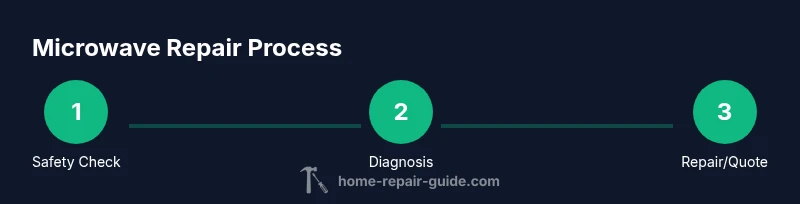
A professional visit typically starts with a safety briefing and a power-off check, followed by a model verification and a diagnostic scope. Expect the technician to inspect the door interlock system, wiring harnesses, control board, and magnetron for visible signs of damage. They may test voltage, continuity, and resistance with a calibrated meter, and verify that the high‑voltage section is safely discharged before any internal work. If a fault is confirmed, the technician will provide a repair plan, required OEM parts, and a time estimate. They should also explain potential alternatives, such as replacing the unit if repair costs approach a new unit price. If you’re uneasy about any part of the process, ask for a live walk-through or a photo walkthrough of the affected components. Home Repair Guide’s guidance emphasizes clear communication and documenting all steps for future reference.
Safe, Pre-Visit DIY Steps You Can Do Now
Before arranging a service, you can perform several safe, low-risk steps. Unplug the microwave and unplug any power cords from the wall to eliminate the risk of shock. Clean the interior and door gasket to remove debris that may affect door sealing. Check that the turntable is properly seated and spins freely. Inspect the exterior for signs of damage or burnt smells. Keep a log of symptoms, including times and any noises or error codes, so a technician has precise information. Do not attempt to discharge the high‑voltage capacitor, remove the magnetron, or test energized circuits unless you are trained and follow the manufacturer’s safety procedures. If you’re unsure about any step, pause and contact a professional. The Home Repair Guide team reminds readers that safety always comes first and that many tasks are best left to trained technicians.
Quick Do‑It‑Yourself Maintenance Checklist
- Regularly clean the interior and vents to prevent overheating and grease buildup.
- Ensure the door seals are intact and the latch engages fully.
- Keep turntable mechanism clean and correctly aligned.
- Review the user manual for error codes and recommended reset procedures.
- If you observe electrical arcing, unusual smells, or device shock, stop and seek professional help immediately. The Home Repair Guide team recommends prioritizing safety and pro consultation for any doubt about internal components.
Tools & Materials
- Owner’s manual / model number(Model number, serial, and service manual.)
- Non-contact voltage tester(Verify no live circuits before handling panels.)
- Screwdriver set (Phillips and flathead)(Precision sizes for interior screws)
- Pliers and needle-nose pliers(Useful for clamps or wire leads)
- Multimeter(Diagnose continuity or resistance if you’re trained)
- Soft cloth and isopropyl alcohol(Clean components and contacts safely)
- Heat-safe gloves(Extra protection when handling hot surfaces)
Steps
Estimated time: 60-120 minutes
- 1
Unplug and verify power
Ensure the microwave is unplugged from the wall and that the outlet shows no signs of heat or scorch marks. Confirm the plug is fully disengaged to prevent any stray current while you work. This step reduces the risk of electric shock during inspection and panel removal.
Tip: If the outlet feels warm, wait for it to cool and inspect for wiring issues before replugging. - 2
Discharge high‑voltage safety (if trained)
Only proceed if you have formal training and access to the proper discharge procedures. Improperly discharging can cause shock or arc damage. If you are not trained, skip this step and move to a professional.
Tip: Never touch internal components while the unit is connected to power; always verify with a tester first. - 3
Open access panel and inspect interlocks
Remove the outer cabinet screws as per the model manual and gently lift the cover. Check door interlock switches for sticking or broken parts. A faulty interlock can prevent the magnetron from operating even if the door looks closed.
Tip: Document any misaligned or burnt components with photos for the technician. - 4
Inspect the door latch and seals
Examine the door latch and gasket for wear or damage. A compromised seal can cause heat loss and erratic operation. If the latch doesn’t engage firmly, it may prevent normal safety interlock signaling.
Tip: Clean away any residue around the latch with a soft cloth; avoid using harsh solvents. - 5
Check for obvious wiring damage
Look for loose connectors or frayed wires at the control board and power input. Do not tug on wires; use proper tools to reseat connectors. Loose connections can cause intermittent failures and dangerous arcing.
Tip: If you spot damaged insulation, stop and call a pro—the risk of shorting is high. - 6
Reassemble and test safely
If you’ve completed inspections and found no hazardous signs, reassemble the cabinet following the manual. Plug in and run a short test cycle without food to confirm basic operation. If any abnormal noises, smells, or heat appear, turn off immediately and seek professional service.
Tip: Record the test results and any codes shown on the display for the technician.
FAQ
Can I repair a microwave near me myself, or should I hire a pro?
DIY steps are suitable for basic cleaning and simple checks, but high-voltage components require professional handling. Always assess your comfort level and consult the manual. When in doubt, hire a licensed technician to avoid safety risks.
DIY is okay for simple cleaning, but high-voltage parts should be handled by a licensed pro. If unsure, call a technician.
What are common signs that a microwave needs repair?
Not heating, turning table failure, unusual buzzing, error codes, or a door that won’t latch correctly are common indicators. If any symptom persists, document details and seek professional evaluation.
Not heating, a buzzing sound, or a door that won’t latch are common repair signals. Document symptoms and consult a pro.
Is it safe to unplug and reset a microwave?
Yes, unplugging before any inspection is essential for safety. A simple reset may fix minor control glitches, but avoid probing high-voltage parts.
Unplug before inspecting. A reset can help with minor glitches, but don’t touch high-voltage parts.
Will repairing void my warranty?
Warranty terms vary by manufacturer and service type. Check the original warranty or contact the maker for guidance on authorized service.
Warranty terms vary; check the manual or contact the maker for guidance on authorized service.
How long does microwave repair usually take?
Repair time depends on parts availability and the scope of work. Simple fixes may take a few hours, while complex issues could require several days if parts must be ordered.
It varies; simple fixes can be hours, complex ones may take days if parts are needed.
How much does microwave repair typically cost?
Cost varies by model, parts, and local labor rates. Obtain multiple quotes and ask for a written estimate detailing parts and labor before work begins.
Prices vary; get several quotes and a written estimate before work starts.
Watch Video
Key Takeaways
- Understand when to DIY and when to hire a pro
- Document symptoms and model details for faster repair
- Prioritize safety over quick fixes
- Choose licensed nearby technicians with transparent quotes
- Having the right tools reduces risk and improves outcomes