Repair or Replace a Microwave: Is It Better?
Explore whether it's cheaper and safer to repair or replace a microwave, with practical guidance on cost, safety, lifespan, and when to call a pro from Home Repair Guide.


Is it better to repair or replace a microwave? For most households, the answer hinges on the appliance's age, the repair cost, and safety concerns. If the fix is simple and the unit is relatively new, repairing can be sensible; if the price of repair approaches a new unit or safety is questionable, replacement is often the wiser choice. According to Home Repair Guide, making a decision with these factors in mind saves time, money, and frustration.
is it better to repair or replace a microwave
Is it better to repair or replace a microwave? This question sits at the intersection of value, safety, and practical inevitability. The Home Repair Guide team emphasizes a pragmatic, decision-driven approach: start with the problem, assess the age and usage of the microwave, and then weigh the immediate repair costs against the price and benefits of a new model. The phrase is used here to anchor the discussion in a clear, repeatable framework that homeowners and renters can apply when a fault occurs. By focusing on cost-to-value rather than instinct, you reduce the chance of throwing good money after bad. Throughout this guide, we reference reliable best practices from Home Repair Guide to help you make an informed choice that aligns with your household’s needs and safety considerations.
Cost and lifetime value: the core trade-off
Deciding whether to repair or replace hinges on the balance between repair cost and the expected lifetime benefit of a new unit. If a simple door latch fix or element replacement resolves the fault and the microwave is relatively young, repair can extend useful life without a large upfront expense. Conversely, if the appliance has already shown multiple problems or the fault involves a critical component (like the magnetron or control board), replacement becomes attractive: a newer model often means better reliability, improved energy efficiency, and an extended warranty. The Home Repair Guide framework suggests calculating the repair’s cost in relation to the new unit’s price, then evaluating the incremental lifespan gain you’d receive from a replacement. While we avoid hard numbers here, the principle is straightforward: repair if the expected additional life is short; replace if you’d gain substantial, predictable years of service and safety improvements.
Identifying common failure modes and repair viability
Many microwave faults fall into a few categories: cosmetic or door-related issues, power or control panel faults, magnetron or high-voltage component failures, and turntable or fan problems. Simple fixes—like replacing a door interlock switch, a worn door seal, or a faulty fuse—are often feasible for a skilled, safety-conscious technician. Complex failures, especially those involving the magnetron or high-voltage circuits, typically favor replacement due to safety risks and the likelihood of cascading problems. The decision to repair or replace should consider the reliability of the current unit, how frequently you’ve faced issues, and whether a repair would merely delay the next failure. Home Repair Guide’s assessment emphasizes conservative risk management and safe handling of high-voltage equipment.
Safety, warranties, and professional involvement
Electrical appliances, including microwaves, carry inherent safety considerations. When evaluating is it better to repair or replace a microwave, factor in potential safety hazards from cracked housings, damaged insulation, or compromised shielding. Repairs on high-voltage components should only be performed by qualified technicians; attempting DIY fixes can result in electric shocks or fire risk. Check warranty status: if the microwave is still under warranty and the fault is covered, repair can be cost-effective; if not, replacement might offer better long-term value and safety guarantees from a newer unit. The Home Repair Guide team stresses professional assessment for safety-related faults to protect you and your home.
How to estimate repair viability without guessing
A practical approach involves three steps: (1) obtain a written repair estimate from a certified technician, (2) compare that estimate to the price of a like-new unit, and (3) assess the appliance’s age and condition. If the repair is a small fraction of a new microwave and the unit is reasonably modern, repair is usually reasonable. If the repair would require expensive parts or multiple fixes, replacement may be more economical in the long run. Keep in mind hidden costs, such as labor rates, diagnostic fees, and potential after-repair reliability. Home Repair Guide recommends transparency from technicians and a pause-and-compare moment before making a final decision.
How to replace a microwave: planning and selection
If you decide to replace, plan carefully to avoid overpaying or ending up with a size-incompatible model. Measure the available counter space and opening width, note the electrical outlet type, and consider features that improve daily use—like sensor cooking, preset menus, and turntable or flat-surface compatibility. Compare energy efficiency ratings, which influence operating costs over the unit’s life, and check for compatibility with existing walls or cabinet layouts. When shopping, look for models with solid safety certifications and reliable customer reviews. The replacement process also involves disposal options for your old unit; many retailers offer take-back or recycling programs, which helps minimize environmental impact.
Maintenance mindset: keeping a microwave reliable longer
Preventive care is a key component of either option. Regularly cleaning the interior, ensuring proper ventilation, and avoiding abuse (like placing metal containers inside) reduces the risk of faults. If you see minor signs of wear, address them early—replacing a broken door switch or gasket before a larger failure can be a cost-effective compromise that delays a full replacement. By adopting a maintenance mindset, you extend the life of your microwave and preserve safety and performance. Home Repair Guide believes a proactive approach pays dividends in reliability and peace of mind.
Environmental and disposal considerations for microwave decisions
Disposal of old microwaves requires attention to environmental impact. If you repair, you retain a functioning appliance and minimize waste. If you replace, opt for recycling programs or retailer take-back options to ensure hazardous components are handled safely. The decision to repair or replace also intersects with broader eco-conscious practices: choosing an energy-efficient model reduces power consumption and emissions over time. Consider local e-waste regulations and recycling options when planning your next purchase or repair project. Home Repair Guide encourages responsible disposal as part of a complete, thoughtful decision process.
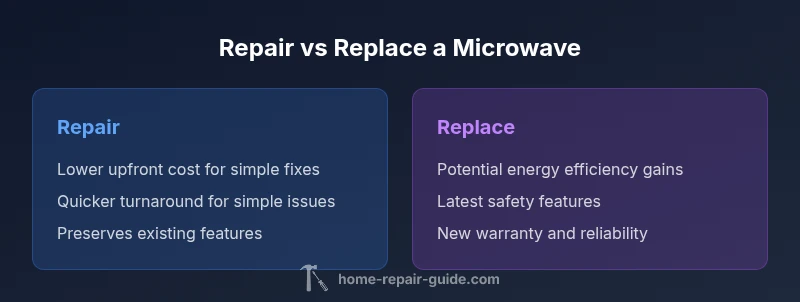
Comparison
| Feature | Repair a Microwave | Replace Microwave |
|---|---|---|
| Typical cost to resolve issue | Lower for simple fixes | Higher upfront cost of a new unit |
| Time to complete | Shorter lead times for common fixes | Potential delays due to availability of parts or delivery |
| Energy efficiency impact | Can be unchanged if repair preserves the current model | Often improved with a newer model |
| Warranty status | Repair may preserve existing warranty if still active | New unit comes with fresh warranty |
| Disposal considerations | Repair retains unit potentially, with recycled parts | Replacement triggers proper disposal for old unit |
| Best for | Minor faults on a relatively new unit | Older models or major faults with safety concerns |
Upsides
- Potentially lower upfront cost for minor fixes
- Preserves familiar features and layout
- Less waste if the repair is feasible
- Faster turnaround for simple repairs
- Avoids the impulse to replace immediately
Disadvantages
- Repair may be unreliable or temporary
- Some repairs require professional equipment and safety protocols
- Hidden issues may surface after repair
- Older models may be less energy-efficient and safe
Repair if the fault is minor and the unit is reasonably modern; replace for major faults or when safety/efficiency justify a newer model
A cautious repair is best for small issues on recent units. For aged microwaves or high-cost repairs, replacement offers long-term reliability and safety.
FAQ
What factors should I consider when choosing repair vs replacement for a microwave?
Key factors include the appliance's age, repair cost relative to replacement price, safety concerns, and potential energy efficiency gains. When in doubt, a certified technician assessment helps inform the decision.
Think about age, cost, safety, and energy efficiency when deciding. A pro assessment can tip the scales.
Can I perform microwave repairs myself?
For safety, avoid DIY fixes that involve high-voltage components or the magnetron. Simple cleaning or door-latch checks can be safe, but most repairs should be handled by a licensed appliance technician.
DIY fixes can be risky; leave high-voltage parts to a pro.
What safety signs indicate I should replace instead of repair?
Frequent tripping breakers, sparking, unusual smells, or audible buzzing from the magnetron suggest you should consider replacement for safety.
If it sparks or smells burnt, replacement is often safer.
How long should a microwave last?
A microwave usually provides reliable service for several years, but performance declines can signal it’s time to replace.
Most microwaves last several years; decline in performance often means replacement is wiser.
Should energy efficiency influence repair vs replacement decisions?
Yes. Newer models tend to be more energy-efficient, which lowers operating costs and can justify replacement if the current unit is inefficient.
Energy efficiency matters; newer models save on running costs.
What should I ask a technician before repair?
Ask about the estimated repair cost, expected lifespan after repair, whether the repair comes with a warranty, and if the part is readily available for your model.
Ask about cost, lifespan, and warranty before work starts.
Key Takeaways
- Evaluate age and repair cost before deciding
- Safety and warranty status matter deeply
- Weigh total cost of ownership, not just upfront price
- Energy efficiency matters with a new model
- Plan for proper disposal or recycling of old units