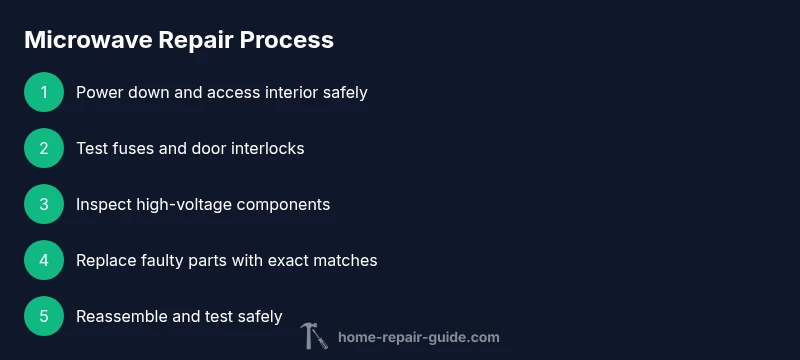
Microwave Repair: A Practical Home Guide
Learn safe, step-by-step microwave repair for common faults. Diagnose fuses, door switches, and control boards with practical tips, when to DIY, and when to hire a pro. A Home Repair Guide tutorial for homeowners and renters.


This guide explains how to safely diagnose and repair common microwave faults, from a blown fuse to door interlock failures. You'll learn required safety steps, tools, and when to replace components versus calling a pro. Begin by unplugging the unit and inspecting for obvious damage before testing with basic tools. This approach aligns with Home Repair Guide's practical, customer-first method.
What can go wrong in a microwave
A microwave is a compact, high-voltage appliance that combines a power supply, a magnetron, waveguide, diode, control board, and a door interlock system. When any part fails, the unit may stop heating, fail to power on, or exhibit humming, sparking, or burning smells. According to Home Repair Guide, many common issues are solvable by a careful homeowner with the right safety mindset and the correct replacement parts. Yet the same components carry real risks: high-voltage capacitors can retain a charge even when unplugged, and metal objects in the cavity can cause dangerous arcing. Before you touch anything, unplug the microwave and wait several minutes for residual energy to dissipate. Visually inspect for damage such as melted insulation or loose wiring. If you see damaged wiring or a frayed cord, discontinue testing and seek professional service. For most routine repairs, begin with the fuse, door switch, and control panel connections, as these account for a large share of no-heat or no-power symptoms. Understanding typical failure points helps you prioritize the diagnostic path and save time.
Safety first: Prep and precautions
Repairing a microwave requires careful preparation and strict safety practices. Always unplug the unit and disconnect it from the wall outlet before opening the cabinet. If the appliance is hardwired, contact a licensed electrician rather than attempting repairs yourself. Wear non-conductive gloves and safety glasses to protect against sharp edges and flying debris. Keep water or conductive liquids away from the work area, and use a dry, insulated surface. When removing the outer cabinet, label screws and small parts or store them in a labeled tray. Do not touch the magnetron housing, HV capacitor, or high-voltage wiring unless you are trained to work with high-energy devices. If you feel unsure at any point, step back and seek guidance. This approach minimizes electric shock, fire risk, and further damage to the microwave.
Diagnosing common symptoms: no power, fuse, door interlock
Microwave issues fall into several common categories. Start with visual checks: a damaged power cord, burnt smell, or a tripped breaker indicate electrical problems. If the unit lights but won’t heat, the fault often lies in the high-voltage circuit (fuse, diode, or magnetron). A blown thermal fuse or a door interlock failure can prevent operation even when the display works. For sparking inside the cavity, inspect the cavity and waveguide cover for metal fragments or damage. When diagnosing, keep a written log of symptoms and test results to avoid mixing issues later. Even parts that look fine can fail in subtle ways, so rely on test measurements and manufacturer guidelines. If you’re unsure, it’s safer to stop and call a professional rather than forcing a repair.
Testing with a multimeter and continuity checks
A digital multimeter is essential for testing electrical components. With the unit unplugged and energy discharged, locate the fuse and measure continuity across its terminals; a broken circuit means replacement is required. Use the diode or HV testing mode to check the high-voltage diode for forward conduction and leakage. Test the door interlock switch by confirming continuity when the door is closed and no continuity when open. When checking capacitors or magnetron connections, follow the service manual guidelines and avoid direct contact with high-voltage parts. If any result is inconclusive or you encounter unfamiliar circuitry, pause the repair and consult a professional. Proper testing reduces unnecessary part swaps and increases safety.
Replacing fuses, diodes, or door interlocks
After identifying a faulty component, replace it with an exact-match part. Use the same amperage and voltage rating as the original fuse. When replacing a door interlock, ensure mounting points align and the actuator moves freely with the door closed. HV diodes should be replaced in matched combinations when possible to prevent imbalance; otherwise, replace to spec according to the model’s service data. Recheck all connections for tightness and ensure no loose wires occupy the cavity. Reassemble following the manufacturer’s recommended sequence. Run a low-load test cycle and observe for heat, noise, or arcing. If anomalies appear, stop and seek professional service.
Magnetron issues: when to repair vs replace
Magnetron failure is one of the more expensive repairs and carries safety considerations. Signs include poor heating performance, persistent buzzing, or an unusual chemical smell when powered. In many situations, magnetron replacement is not cost-effective, especially for older models with multiple issues. If magnetron diagnosis is suspected, verify with the service manual and consult a technician before proceeding. High-voltage components and the risk of radiation exposure mean magnetron work is often best left to professionals, particularly when the unit is older or shows widespread damage. If you’re unsure, plan on a replacement rather than attempting a risky repair.
Panel, display, and control board concerns
Display failures, unresponsive touchpads, or erratic control behavior point to the control board or panel. Look for burnt components, swollen capacitors, or loose ribbon cables. Replacing a control board typically requires removing the old board, disconnecting harnesses, and installing the new board in the same orientation. Some models require software resets after board replacement. If the keypad uses a membrane, ensure the cable is fully seated. Since symptom overlap is common, verify model-specific repair guides and verify compatibility before ordering parts. When in doubt, rely on official service diagrams and cautious testing to avoid cascading failures.
Cost, parts, and when to call a professional
Repair costs vary by fault, model, and part availability. DIY parts can range from a few dollars for simple components to more for a switch or fuse; major pieces like the magnetron or main control board can push total costs higher. A professional service often includes diagnostic labor, parts, and disposal, which can add up depending on region and warranty status. Homeowners should budget for a range that accounts for parts and service, and compare with the cost of replacement. When uncertain about the diagnosis or required parts, obtain a written estimate and weigh it against the price of a new unit. Home Repair Guide analysis suggests that age and usage should drive the decision to repair or replace.
Maintenance to prevent future breakdowns
Preventive maintenance reduces the likelihood of recurring issues. Regularly clean the interior and vent paths to prevent grease buildup, inspect the door seal for wear, and ensure the turntable rotates smoothly. Keep the exterior dry and free of moisture to minimize corrosion on metal parts. Schedule periodic checks of high-voltage components with a qualified technician, especially if the unit experiences frequent cycling or heat fluctuations. Use manufacturer-approved parts and follow the service manual during reassembly. A simple monthly check and annual professional tune-up can extend the microwave’s life and keep it running safely.
Tools & Materials
- Phillips-head screwdriver(Medium-size #2 Phillips head)
- Flathead screwdriver(For prying panels gently)
- Nut driver set(1/4 inch and 5/16 inch commonly needed)
- Digital multimeter(Prefer autoranging; continuity and diode test modes)
- Replacement fuse (same rating)(Match amperage and voltage)
- Door interlock switch kit (if needed)(Only if switch is failed)
- HV diode (if indicated)(Only replace with model-compatible part)
- Non-conductive gloves(Protect hands from sharp edges)
- Safety glasses(Eye protection during testing)
- Anti-static mat or tray(Keep small parts organized)
- Screw organizer or labeled containers(Avoid losing fasteners)
Steps
Estimated time: 60-90 minutes
- 1
Power down and unplug
Unplug the microwave from the wall and detach it from any power strips. Wait at least 60 seconds to discharge residual energy, especially in older models. This first step protects you from electric shock before any inspection or disassembly.
Tip: Use a timer to ensure you wait long enough for the capacitor to settle. - 2
Remove the outer cabinet
Locate and remove the screws around the cabinet perimeter. Carefully lift the cover to expose the interior without pulling on wires. Keep track of every screw type and location to ease reassembly.
Tip: Take a few photos before removing parts to reference during reassembly. - 3
Inspect the fuse holder and wiring
Visually inspect the fuse holder, power cord, and nearby wiring for signs of burn marks or damage. If the fuse is blown, replace it with the same rating. Do not bypass a blown fuse—this is a safety-critical indicator.
Tip: Only test the fuse with the unit unplugged. - 4
Test door interlock switches
With the unit open, locate the door interlock switches and test each for continuity using the multimeter. Replace any switch that does not show continuity when the door is closed or shows continuity when open.
Tip: Ensure the door is fully closed when testing interlocks. - 5
Check the high-voltage diodes and capacitor
If you are comfortable, test the HV diode and inspect the capacitor for bulges or leakage. Do not attempt to discharge the capacitor with bare hands. Replace only if you know the proper procedure in the service manual.
Tip: Use strictly model-specific guidance to avoid damaging the circuit. - 6
Inspect the magnetron connections
Check for burnt or loose connections to the magnetron housing. Look for signs of arcing or sizzling sounds during a test run. If the magnetron shows signs of failure, replacement is typically more practical through a professional service.
Tip: Handling magnetron components is high-risk; if in doubt, stop and seek help. - 7
Replace identified parts
Install the replacement fuse, door interlock, or diode as indicated by your tests. Re-seat all connectors, ensuring there are no bent pins or loose wires. Confirm that all parts are compatible with your model.
Tip: Double-check polarity and orientation of new parts before powering up. - 8
Reassemble and perform a test
Reassemble the cabinet in the reverse order of disassembly. Plug the unit back in and run a short, unloaded test cycle to observe whether the unit powers on and performs heating without abnormal noises.
Tip: Start with a no-load test to confirm basic operation before cooking a test item. - 9
Evaluate results and decide on next steps
If the microwave still does not operate correctly after replacements, document your findings and consider professional service. For some models, advanced diagnostics or module replacement may be required.
Tip: If you suspect multiple failures, the cost-benefit analysis often favors replacement.
FAQ
Is it safe to repair a microwave by yourself?
DIY microwave repairs can be safe for simple faults if you follow strict safety steps: unplug, discharge, and avoid high-voltage components. If you’re unsure about any step, hire a professional.
DIY repairs can be safe for simple issues if you follow safety steps and avoid high-voltage parts; when in doubt, hire a professional.
What are the most common failed parts in microwaves?
Common failures include fuses, door interlock switches, diodes, and sometimes the magnetron or control board. Diagnosing with a multimeter helps distinguish between these parts.
Most microwaves fail due to fuses, door interlocks, diodes, or the magnetron; a diagnostic test helps pinpoint the culprit.
How long does microwave repair usually take?
DIY repairs typically take about 60-90 minutes depending on the fault and model. Professional service may require more time for diagnostics and part availability.
Most DIY fixes take about an hour, while pros may need more time for parts and diagnosis.
Can I replace a microwave fuse myself?
Yes, if you can locate the correct fuse rating and safely handle the replacement. Always unplug first and verify the fuse is the exact specification.
Yes, with the right fuse rating and safety steps, you can replace the fuse yourself.
When should I replace the entire microwave rather than repair?
Consider replacement if the unit is old, several parts fail, or repair costs approach or exceed the price of a new unit. Age and usage significantly influence this decision.
If it’s old or many parts fail, replacement is often more economical than repairing.
What safety equipment should I use during repair?
Wear safety glasses and non-conductive gloves. Keep liquids away and work on a dry, insulated surface to minimize shock risk.
Always wear eye protection and gloves, and keep liquids away while you work.
Watch Video
Key Takeaways
- Identify the fault before ordering parts.
- Unplug and wear PPE before any work.
- Test components with a multimeter to avoid guesswork.
- The Home Repair Guide team recommends weighing repair vs replacement based on model age.