When to Repair vs Replace Windshield: A Practical Guide
A thorough, evidence-based guide to deciding between windshield repair and replacement. Learn damage thresholds, repair limits, insurance implications, and a practical decision framework for homeowners and renters.


The decision between repairing or replacing a windshield hinges on damage size, location, and safety impact. In general, small chips or cracks outside the driver’s line of sight can often be repaired, saving time and money. Larger cracks, spreading breaks, or damage near the edge usually require replacement for safety and long-term durability.
Why this decision matters for safety and cost
According to Home Repair Guide, the choice between repair and replacement hinges on safety, long-term durability, and cost, and it starts with a careful damage assessment. A windshield is a critical structural component that helps prevent roof collapse in a collision and provides an important airbag deployment pathway. Damaged glass can spread under temperature fluctuations, road vibration, or subsequent impacts, compromising visibility and integrity. The question of when to repair vs replace windshield isn’t just about aesthetics; it’s about maintaining the vehicle’s overall safety envelope, preserving resale value, and minimizing downtime for the vehicle. This section lays out the framework you’ll use as you evaluate damage, including damage type, location, and the feasibility of a reliable repair that restores strength and clarity. Throughout, the guidance mirrors what the Home Repair Guide team considers best practice for homeowners and renters navigating windshield repair decisions.
Why this decision matters for safety and cost
According to Home Repair Guide, the choice between repair and replacement hinges on safety, long-term durability, and cost, and it starts with a careful damage assessment. A windshield is a critical structural component that helps prevent roof collapse in a collision and provides an important airbag deployment pathway. Damaged glass can spread under temperature fluctuations, road vibration, or subsequent impacts, compromising visibility and integrity. The damaged area’s size and location determine whether a resin repair can restore strength and clarity or whether a full pane replacement is required for safety and reliability.
Why this decision matters for safety and cost
This first block is designed to hook the reader with a clear rationale and to establish the professional authority of Home Repair Guide. It sets the stage for the deeper, actionable guidance that follows—so readers understand why the repair-vs-replace decision is central to safety, function, and budget.
Comparison
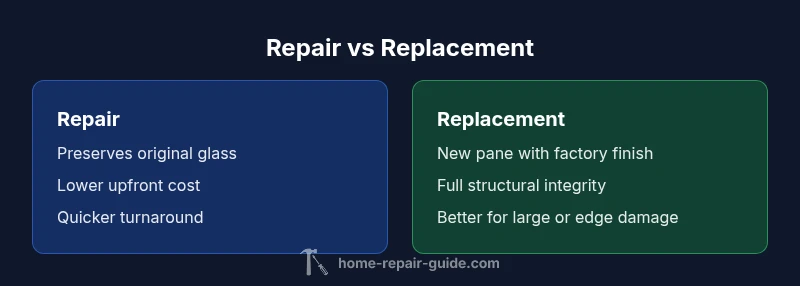
| Feature | Repair | Replacement |
|---|---|---|
| Typical outcome | Preserves most of the original windshield and fixes small defects | Provides a new pane with factory finish and full structural integrity |
| Turnaround time | Often same-day service for minor issues | Usually 1–2 days, depending on availability and vehicle type |
| Cost context | Generally lower upfront cost for minor damage | Generally higher upfront cost, but varies by make/model and accessibility |
| Aesthetics/visibility | Typically seamless if repair is successful; minor blemishes may remain | New windshield offers optimal visibility without residual blemishes |
| Warranty and insurance | Repair often covered with minimal out-of-pocket; warranty varies | Replacement usually includes installation warranty; coverage depends on policy |
| Best for | Small chips/cracks away from the driver’s line of sight | Large cracks, edge damage, or multiple cracks near the driver’s view |
| Safety impact | Maintains safety if damage is limited and properly repaired | Maximizes safety when replacement restores structural integrity |
Upsides
- Lower upfront cost for repair keeps immediate expenses down
- Quicker turnaround minimizes downtime
- Repair preserves original glass and can maintain resale value when successful
- Repair has a smaller environmental footprint than full replacement
- When feasible, repair maintains structural integrity without introducing a new pane
Disadvantages
- Not all damage is repairable; attempting a repair may later require replacement
- Repairs can leave minor blemishes or optical distortions if not done by a skilled tech
- Repair is sometimes treated as a temporary fix rather than a permanent solution
- Replacement may disrupt security features in some vehicle assemblies if not installed correctly
Repair is preferred for small, non-vision-threatening damage; replacement is advised for large or spreading cracks and edge damage.
Choose repair when damage is limited and not in the driver’s line of sight. If the crack is long, spreading, or near the edge, replacement provides safer, long-term performance.
FAQ
What counts as repairable windshield damage?
Repairable damage typically includes small chips and minor cracks that do not obstruct the driver’s line of sight and are not structurally compromising. A professional assessment can confirm if resin repair will restore strength and visibility without risking future splitting.
Repairable damage includes small chips away from your line of sight. A professional must confirm that a resin fix will restore strength and clarity without delaying a future replacement.
Will repairing a windshield affect safety or visibility?
If performed correctly by a trained technician, repairs can restore structural integrity and visibility. However, poor repairs may leave distortions or weak spots that affect long-term safety, so professional service is essential.
A proper repair by a trained tech can restore safety and visibility; bad repairs can leave distortions, so choose a reputable shop.
Does insurance usually cover windshield repair or replacement?
Many policies cover windshield repair with little or no deductible and may cover replacement if necessary. Coverage varies, so check your policy and file a claim if damage qualifies for repair instead of replacement.
Most policies cover repairs with minimal or no deductible; replacement coverage depends on your plan, so verify with your insurer.
Can a damaged windshield be repaired multiple times?
Sometimes a windshield can be repaired once or twice if the damage remains small and stable. Repeated repairs can compromise integrity or clarity, and many shops recommend replacement after multiple repairs.
A windshield may be repaired once or twice for small damage, but multiple repairs can weaken it and replacement is often recommended.
Is DIY windshield repair safe?
DIY repair kits exist, but improper application can worsen damage or create optical distortions. Professional repairs ensure resin depth, curing, and alignment are correct for safety.
DIY kits exist, but mistakes can worsen damage. Professional repairs ensure proper depth and curing for safety.
How long does windshield replacement take?
Replacement typically requires a few hours for removal, cleaning, and installation, plus any required calibration for advanced driver-assistance systems. Schedule a window for service and confirm cure times with the shop.
A windshield replacement usually takes a few hours, with some vehicles needing calibration afterward.
Key Takeaways
- Assess damage size and location before deciding
- Repair is usually faster and cheaper for small issues
- Replacement is safer for large, spreading cracks or edge damage
- Insurance coverage often favors repair when feasible
- Always prioritize safety and professional assessment over DIY fixes