Suspension Car Repair: A Practical Step-by-Step Guide
Learn how to inspect, diagnose, and safely repair common suspension problems in cars with practical, step-by-step guidance designed for homeowners and DIY enthusiasts who want to save time and money while maintaining safety.


In this guide you will learn how to inspect, diagnose, and safely repair common suspension problems on a typical passenger car. You’ll identify worn components, understand the tools required, and follow a clear step-by-step process to replace parts and restore ride quality. The steps include safety considerations, realistic time estimates, and how to test the vehicle after repairs.
Why Suspension Car Repair Matters
According to Home Repair Guide, the suspension system is central to vehicle safety, ride comfort, and tire wear. Worn shocks, springs, or bushings can cause unpredictable handling, reduced traction, and accelerated tire wear. This section explains why proactive maintenance pays off: it helps you detect issues early, plan repairs, and avoid surprise breakdowns that could leave you stranded. You’ll learn to distinguish between minor noises and serious faults, and how to decide when a professional assessment is warranted. The goal is to empower homeowners to understand the anatomy of the suspension, the common failure modes, and the practical steps for a safe, durable repair that keeps your vehicle performing as designed. A holistic approach also considers related components such as steering linkages and alignment, which influence how the suspension behaves under load.
Common Suspension Problems and Symptoms
Suspension components are subject to wear from road conditions, load, and miles driven. Typical symptoms include clunks or creaks when going over bumps, a tendency for the car to drift or pull to one side, nose-diving during braking, and excessive bouncing after bumps. Leaking shock absorbers or struts indicate degraded damping performance. Worn ball joints or control arms can cause uneven tire wear and misalignment. If ride height is uneven or the vehicle sags on one corner, inspect springs and related mounts. This block helps you connect symptoms to potential parts, so you can plan targeted inspections or repairs.
Tools, Safety, and Planning
Before touching the suspension, gather essential tools and review safety protocols. Always work on a flat, stable surface and use wheel chocks to prevent rollaway. A hydraulic floor jack, jack stands, and a lug wrench or impact wrench are core tools for lifting and removing wheels. Maintain good lighting, use penetrating oil for rusted fasteners, and wear eye protection and gloves. Create a quick plan: identify components to inspect, prepare replacement parts, and set a realistic timeline. The planning phase also includes checking service manuals for torque specs and safe lifting points to avoid frame damage.
Step-By-Step Diagnosis: Check Before Replacing Parts
To avoid unnecessary parts replacement, perform a structured diagnostic: 1) perform a visual inspection for leaks, cracks, or loose fasteners; 2) test ride the vehicle at low speed and note handling anomalies; 3) check for abnormal tire wear patterns; 4) use basic tension and play tests on joints where safe to do so. Document findings with photos for reference. This disciplined approach helps you confirm whether the problem is damping, spring support, or linkage wear, guiding you to the correct replacement path without surprises.
Replacing Shocks, Struts, and Ball Joints
Replacing damping components like shocks and struts is a common fix for poor ride quality. Start by removing the wheel, then the securing bolts, and carefully unbolt the old unit. Install the new part, torque fasteners to spec, and re-check clearance. Inspect ball joints and replace if there is visible play. A careful approach saves time and reduces the risk of damage to adjacent components. If you see signs of rust or seized fasteners, apply penetrating oil and allow extra time for loosening.
Replacing Bushings, Control Arms, and Springs
When bushings wear or control arms develop play, handling can feel soft or imprecise. Replace worn bushings in pairs to maintain balance. If springs sag or show cracks, replace them only with the proper OEM or high-quality aftermarket parts. Follow the vehicle manufacturer’s torque specs and use proper jack stands during the process. This section emphasizes methodical disassembly and reassembly, with checks to ensure proper alignment and even loading across wheels.
Reassembly, Alignment, and Road Testing
After installing parts, reassemble the suspension system, reinstall wheels, and lower the car with care. Perform a pre-test inspection for clearance and torque all fasteners to specification. A professional alignment is typically required after suspension work to ensure proper steering geometry and tire wear. Finally, conduct a cautious road test at moderate speed, listening for unusual noises or pulling and noting ride quality, steering feel, and brake response. This final step confirms that repairs held and the vehicle behaves as expected.
Authority Sources and Additional Resources
This guide references respected sources for vehicle maintenance practices, including the National Highway Traffic Safety Administration (nhtsa.gov), consumer safety guidance from the Federal Trade Commission (ftc.gov), and industry commentary from major publications (popularmechanics.com). For vehicle-specific procedures, always consult your factory service manual and a licensed technician if you are unsure about any step.
Tools & Materials
- Vehicle jack(Hydraulic floor jack rated for your vehicle weight)
- Jack stands(Place on a flat, solid surface)
- Wheel chocks(Use on wheels opposite the lift side)
- Lug wrench / impact wrench(For wheel removal)
- Socket set and wrenches(Metric and SAE sizes; include torque wrench)
- Torque wrench(To spec torque values)
- Pry bar / rubber mallet(For separating parts without damage)
- Penetrating oil(Loosen rusted fasteners; allow to soak)
- Safety gear (gloves, eye protection)(Personal protective equipment)
- Replacement parts (shocks/struts, control arms, bushings)(Only if worn or damaged)
- Spring compressor(Only if you are replacing coils; follow safety guidelines)
Steps
Estimated time: 2-5 hours
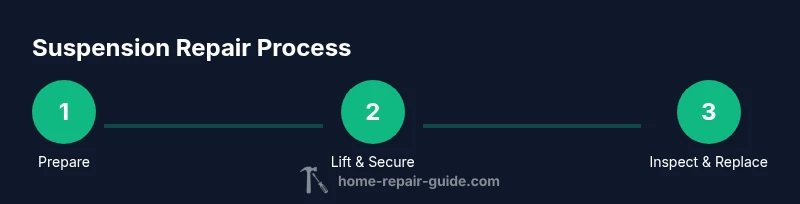
- 1
Prepare and secure the vehicle
Park on a flat surface; apply parking brake; wear safety gear. Loosen lug nuts slightly before lifting, then position wheel chocks. This reduces muscle strain and prevents rolling during the lift.
Tip: Take photos of fastener locations before removal. - 2
Lift vehicle and secure with stands
Use a floor jack to raise the vehicle at proper jacking points; set jack stands under solid supports. Never rely on the jack alone. Ensure the car is stable before removing wheels.
Tip: Try to have a second person assist for safety. - 3
Remove wheels for access
Loosen and remove lug nuts; take off the wheels to expose shocks, springs, and control arms. Inspect visible components for leaks, cracks, or wear. Keep track of fasteners and their locations.
Tip: Keep track of fasteners with labeled bags. - 4
Inspect suspension components
Check shocks/struts for leaks, springs for cracks, bushings for cracking, and joints for play. Move components gently to feel for looseness. This step helps you decide whether replacement is needed.
Tip: Use a pry bar carefully to test joint play. - 5
Replace worn parts if needed
Remove damaged parts and install new ones in the correct orientation. Torque to specification and re-check clearance. If replacing coil springs, use a spring compressor and follow safety protocols.
Tip: Replace worn components in pairs when applicable. - 6
Reassemble and recheck torque
Reinstall wheels, tighten lug nuts in a star sequence, and lower the car. Re-torque wheels after a short test drive, then check all fasteners again.
Tip: Double-check torque specs from the service manual. - 7
Align and road test
Have a professional alignment done if required; perform a controlled test drive to assess steering, braking, and ride quality. Look for abnormal noises or pulling during the test.
Tip: Drive slowly in a safe area to feel response.
FAQ
Do I need to remove the wheels to inspect the suspension?
Usually yes. Removing wheels provides full access to shocks, struts, ball joints, and control arms, enabling a thorough inspection.
Usually yes; removing the wheels lets you inspect all suspension components directly.
Can I fix suspension issues myself or should I hire a shop?
Basic inspections and some replacements are doable at home with proper tools, but complex tasks and accurate alignment may require professional service.
Basic tasks can be DIY, but complex repairs often need a pro.
What safety steps are essential when lifting a car?
Always use a hydraulic jack in combination with jack stands on a flat surface; apply wheel chocks and never rely on the jack alone.
Use jack stands and wheel chocks—never rely on the jack alone.
How do I test suspension after repairs?
Perform a controlled road test at moderate speed, listen for noises, and check for pull or uneven tire wear. Re-check fasteners after the drive.
Test for noises and alignment after repairs.
Which parts usually wear out first?
Shocks or struts and ball joints often wear fastest, depending on road conditions. Regular inspection helps catch issues early.
Shocks and ball joints often wear first.
Is an alignment required after suspension work?
Yes, alignment is commonly required after suspension repairs to restore steering geometry and tire wear patterns.
Usually yes, an alignment is needed after suspension work.
Watch Video
Key Takeaways
- Plan and safety-first mindset for lifts.
- Identify symptoms to target the right parts.
- Use proper tools and torque specs.
- Align after suspension work for best handling.
- Document steps for future repairs.