Difference Between Repair and Restoration: An Analytic Guide
Explore the difference between repair and restoration in home projects, with practical guidance on when to choose each and how to plan durable results.


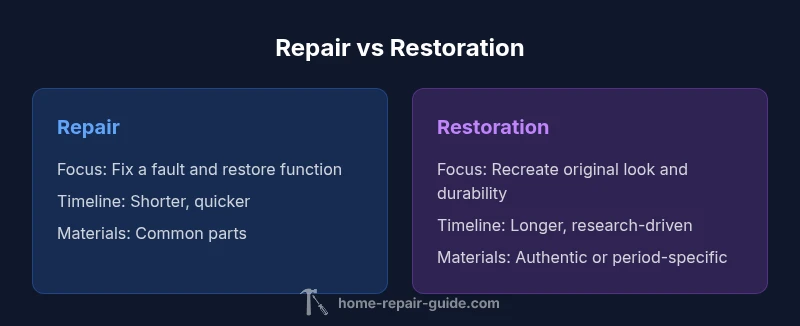
Repair and restoration describe two ways to fix or renew a home project. The difference between repair and restoration lies in scope and intent: repair fixes a specific fault to restore function and safety, while restoration seeks to recreate the original state or appearance. Use repair for quick fixes and safety concerns; choose restoration when long-term durability, authenticity, or historical accuracy are priorities.
What repair vs restoration means in practice
Repair and restoration are two distinct approaches to fixing or renewing a home project. According to Home Repair Guide, understanding the difference helps homeowners decide not only what is feasible but also how to budget and schedule work effectively. In practical terms, a repair is a targeted fix that returns function and safety to a system or component, while restoration aims to recreate a prior state or satisfy an aesthetic standard. This distinction matters from the first planning step, because it influences the level of effort, materials, subcontractors, and inspection needed. By framing projects as repairs or restorations from the outset, you can define success criteria, set realistic timelines, and communicate clearly with contractors or neighbors alike.
Definitions and scope
Definitions are the backbone of decision making. A repair is a corrective action applied to a specific fault or wear pattern to restore normal operation. It is usually constrained in time and space, addressing symptoms rather than root causes when appropriate. Common repair examples include replacing a faulty switch, sealing a leak, or patching a damaged drywall seam. Restoration, by contrast, seeks to return materials, surfaces, or structures to an earlier condition. It may involve matching historical finishes, reconstructing missing elements, or reinforcing a structure to meet original design intent. This approach often requires more planning, material research, and sometimes permissions or approvals from local authorities.
Scope examples and decision criteria
Deciding whether to repair or restore rests on three core criteria: purpose, durability, and historical or aesthetic value. If the goal is to regain immediate function with minimal disruption, a repair is typically the best choice. If the goal is to preserve or recreate a specific look or to extend the life of a feature beyond generic fixes, restoration makes more sense. For instance, fixing a leaky faucet or replacing a cracked tile is a repair task; restoring an 1800s fireplace surround or a historical wood panel requires restoration work. Home Repair Guide recommends asking yourself: Will this project affect safety? Will it impact the original material’s integrity? Is authenticity or long-term durability a priority? These questions help prevent scope creep and misaligned expectations.
Process and workflow differences
Repair projects usually follow a lean, iterative workflow. Start with a quick assessment, identify the fault, select a cost-effective fix, implement, and verify. Documentation is important for future maintenance but the emphasis stays on getting the system back to standard operation quickly. Restoration projects follow a more research-driven workflow. Start with archival or source material review, determine original materials and techniques, source compatible components, execute the renewal with attention to texture, color, and patina, and conduct a thorough verification. Both paths benefit from a written plan, clear milestones, and proactive communication with household members or tenants. The Home Repair Guide team notes that restoration often requires longer timelines and possible permits, depending on scope.
Materials, tools, and skills
Repair generally relies on readily available parts and common tools. You can often complete repairs with standard screwdrivers, sealants, patches, and replacement components. The skill set for repair emphasizes safe handling, basic carpentry or plumbing, and the ability to assess when a patch is sufficient. Restoration, however, calls for specialized materials and techniques to match texture, color, and aging characteristics. Practitioners may need historical materials, custom finishes, or replication methods. This often involves more advanced skills, research time, and sometimes collaboration with material suppliers or conservation specialists. For homeowners, the line between DIY and professional help can blur in restoration work, making early consultation prudent.
Timeline, budgeting, and risk management
Budgeting for repair is usually straightforward: estimate the cost of a part and the time to install it. Timelines are shorter and there is less risk of complex compliance requirements. Restoration projects tend to be longer and more expensive, driven by research, sourcing, and meticulous workmanship. Because restoration can affect structural elements or historical authenticity, permitting, code compliance, and inspections may come into play. Home Repair Guide recommends a contingency for unknowns in restoration, since hidden conditions (like concealed rot or prior poor repairs) can alter scope and cost significantly. Effective risk management includes documenting conditions before work, obtaining multiple quotes, and confirming warranties for materials and workmanship.
Maintenance and long-term planning
After any repair, set a simple maintenance routine to prevent recurrence and extend the life of the fix. For restoration work, maintenance can involve periodic checks to preserve finish and structural integrity, as well as ongoing documentation for future owners. The longevity of restored features often depends on the quality of original materials, compatibility with modern systems, and the availability of replacement components. Homeowners should plan for periodic reviews of restored elements, especially in climates with humidity, temperature swings, or heavy use. Regular inspection helps ensure that a restoration remains faithful to its intended appearance while keeping structural performance reliable.
Case studies: quick examples
Case study 1 (Repair): A resident notices a leaky faucet and replaces the worn washer and valve stem. The fix restores function and reduces water waste with minimal downtime and cost. Case study 2 (Restoration): A homeowner wants to bring back a historic tin ceiling’s luster. The project involves researching original finishes, sourcing compatible coatings, and reapplying textures to recreate the historic look. Both paths deliver value, but the degree of authenticity and future-proofing differs markedly.
Maintenance after repair vs restoration: practical tips
Regardless of path, keep records of fixes and maintenance intervals. Use a simple log to document part numbers, dates, and contractor notes. For repairs, schedule routine checks on components with wear potential, such as seals, gaskets, or joints. For restorations, establish a long-term maintenance plan focused on preserving texture, finish, and structural alignment. This practice helps preserve value and reduces the likelihood of repeating the same work prematurely.
How to talk to a contractor about repair vs restoration
When discussing projects with a contractor, use precise terms: describe the problem, desired outcome, and whether you want a repair or a restoration. Ask for a written scope that highlights the difference in anticipated timelines, materials, and inspections. Request examples of prior repairs and restorations to gauge the contractor’s experience. Finally, clarify warranty terms and post-project maintenance expectations to ensure ongoing reliability.
Comparison
| Feature | Repair | Restoration |
|---|---|---|
| Scope and intent | Fix a specific fault to restore function | Recreate original state/appearance and durability |
| Typical outcomes | Restore operation with minimal changes to structure or aesthetics | Return to near-original look and long-term resilience |
| Timeline | Shorter, faster to complete | Longer, research-driven and phased |
| Materials/techniques | Standard parts and common finishes | Authentic materials and historically informed finishes |
| Permits and approvals | Usually none or simple permits if required for safety | May require permits, reviews, or documentation |
| Cost considerations | Lower upfront cost, predictable expenditure | Higher upfront cost, potential for longer-term savings |
| Maintenance focus | Regular checks and straightforward maintenance | Ongoing preservation and periodic restoration validation |
| Best for | Immediate functionality, safety, and budget-conscious goals | Historical accuracy, durability, and long-term fidelity |
Upsides
- Clear paths to return function quickly (repair)
- Lower initial cost and disruption (repair)
- Possibility to preserve or improve efficiency with targeted fixes (repair)
- Restoration can extend lifespan of historic or high-value features (restoration)
Disadvantages
- Repair may be a short-term solution requiring later work
- Restoration can be costly and time-intensive
- Restoration may involve sourcing rare materials and specialists
- Repair fixes can mask underlying issues if not properly diagnosed
Both repair and restoration have value; choose based on scope, durability goals, and historical or aesthetic importance
Opt for repair to regain function quickly. Choose restoration when authenticity and long-term resilience justify the effort and cost.
FAQ
What is the difference between repair and restoration?
Repair fixes a fault to restore function and safety with a narrow scope. Restoration aims to recreate the original condition or appearance, often requiring more research and specialized materials. Understanding this helps set expectations and plan resources accurately.
Repair fixes a specific problem now; restoration recreates the original look and durability, often needing more planning.
When should I repair instead of restore?
Choose repair for urgent function or safety concerns with minimal disruption. If preserving historical value or achieving long-term durability is important, restoration may be the better path.
Repair when you need a quick fix; restoration when authenticity and longevity matter.
Do restoration projects require permits?
Permits depend on the scope and local regulations. Minor repairs usually don’t require permits, while restoration involving structural changes or historic features may.
Permits depend on the scope and local rules; check with your building department.
Can a damaged structure be restored to its original condition?
In many cases, you can restore the appearance and function to closely resemble the original. Some limits exist due to modern codes, material availability, and structural integrity.
Often yes, but practical limits may apply due to codes and materials.
How do costs compare for repair vs restoration?
Repairs typically cost less upfront and finish faster. Restorations require more time and specialized materials, potentially increasing overall expense but offering longer-term value.
Repairs are usually cheaper upfront; restorations cost more but can last longer.
Is restoration always the best choice?
Not always. Restoration is ideal when authenticity and longevity are priorities. For quick fixes or limited budgets, repair is often more practical.
Restoration isn’t always best; weigh authenticity and cost against quick fixes.
Key Takeaways
- Define project goals as either repair or restoration early
- Repair focuses on function; restoration on fidelity and durability
- Plan for permits or materials research more often with restoration
- Communicate clearly with contractors using precise language