Difference Between Repair and Maintenance: A Practical Guide
Explore the difference between repair and maintenance with clear definitions, decision criteria, and practical steps to protect home systems and extend their lifespan.


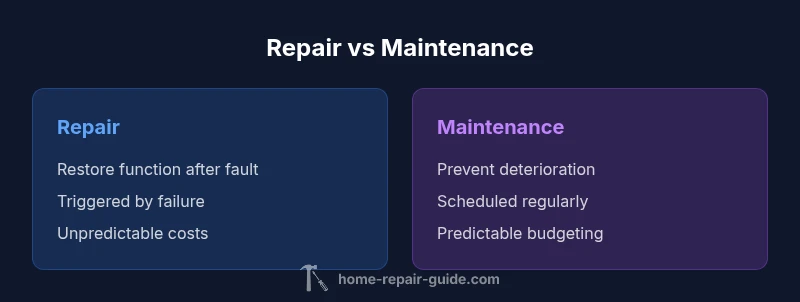
TL;DR: The difference between repair and maintenance is about purpose and timing. Repair fixes a fault to restore function after a failure, while maintenance involves planned care to prevent failures. Maintenance is proactive and generally reduces emergencies, while repairs are reactive and can be unpredictable. A smart home plan uses both for durable results.
Difference Between Repair and Maintenance
The term difference between repair and maintenance frames how homeowners approach routine home care. Understanding this distinction helps you allocate time, budget, and attention more effectively. The Home Repair Guide team emphasizes that proactive maintenance is not a substitute for timely repairs, nor is a single repair a substitute for ongoing upkeep. Balancing both strategies minimizes downtime and extends the life of critical systems in your home. For many households, misclassifying tasks leads to wasted resources and higher long-term costs. This guide explains the core ideas and provides practical steps to integrate both approaches into a coherent plan. According to Home Repair Guide, maintaining a proactive stance reduces the likelihood of reactive crises, especially in high-use areas such as kitchens, bathrooms, and mechanical closets.
Core Concepts: Repair vs Maintenance
Repair and maintenance are distinct activities with different goals. A repair is a corrective action aimed at restoring a component or system to its intended function after a fault or breakdown. Maintenance, by contrast, is preventive work performed on a schedule to sustain performance and reduce the chance of future faults. In practice, the boundary between the two can blur—some tasks deliver both preventive and corrective benefits. The key is to categorize tasks by intent: repair responds to a fault, maintenance prevents faults. Keeping a consistent log helps homeowners see how often each activity occurs and evaluates the overall health of systems. This distinction matters for warranties, service contracts, and long-term budgeting, and it is a core focus of practical home repair guidance.
When to Repair vs Maintenance: Decision Framework
A practical decision framework helps determine when to repair and when to maintain. If a component presents a safety risk or has failed to perform essential functions, a repair is necessary to restore safe operation. If symptoms are signs of wear or gradual degradation, preventive maintenance should be scheduled before a full failure occurs. Consider the replacement horizon: if a part is nearing end-of-life or replacement proves more economical than ongoing fixes, plan a targeted maintenance cycle plus an eventual replacement. In rental properties, balancing repairs and maintenance supports tenant safety and reduces vacancy downtime. The approach should be proactive, not reactive, prioritizing predictable maintenance cycles while reserving resources for inevitable repairs.
Cost and Scheduling Implications: Planning with Confidence
Cost planning for repair versus maintenance differs in predictability. Repairs are reactive and can spike unexpectedly, especially after unforeseen events like leaks or mechanical failures. Maintenance costs are more predictable when you define a routine: inspections, cleaning, lubrication, filter changes, and calibration at regular intervals. A structured maintenance calendar helps spread costs over time and reduces emergency expenditures. The Home Repair Guide analysis indicates that a solid maintenance schedule can lower the frequency of major repairs, especially for appliances, plumbing, and HVAC components. It also supports warranty compliance by adhering to recommended service intervals.
Practical Examples Across Systems: Appliances, Plumbing, and Structures
Consider common home systems to illustrate the repair vs maintenance distinction. For appliances, maintenance includes cleaning lint traps, descaling, and checking seals to prevent breakdowns; repairs cover replacing a broken pump or faulty motor. In plumbing, maintenance involves inspecting for leaks, testing pressure, and cleaning traps to prevent clogs, while repairs address a burst pipe or a significant leak. For structures and fixtures, maintenance could be resealing windows or lubricating door hinges, while repairs involve fixing a warped frame or water intrusion. Across HVAC, maintenance includes filter changes, refrigerant level checks, and coil cleaning, while repairs target compressor failure or faulty wiring. The intent remains clear: maintenance preserves performance, repairs restore function after faults, and both approaches should be integrated into a coherent home care plan.
How to Build a Simple Maintenance Plan: Step-by-Step
Start with an inventory of all major systems and components. Assign priorities based on usage, risk, and age, then establish regular inspection and care intervals. Create checklists for each system (air quality, seals, leaks, lubrication, and cleanliness) and designate who is responsible for each task. Schedule tasks on a calendar, set reminders, and track outcomes to identify trends. Invest in basic tools and inexpensive parts for routine upkeep to avoid delays. Finally, review the plan annually and adjust based on system performance and any new manufacturer guidance. A clear maintenance plan reduces surprises and supports reliable operation of household systems.
Debunking Myths and Misconceptions
Many homeowners believe maintenance is optional and repairs are a sign of poor care. In reality, preventive maintenance is a foundational practice that protects safety and preserves value. Another myth is that maintenance fixes all problems; latent defects can still exist, so inspections should be thorough and informed by professional guidance when needed. A common misconception is that all maintenance tasks require expert skills; many routine tasks can be performed safely by homeowners with proper instruction and proper safety gear. Addressing these myths helps you distinguish between actions that preserve integrity and those that address actual faults.
Measuring Success: Longevity, Reliability, and Safety
Successful differentiation and execution of repair and maintenance improves longevity and reliability of home systems. Key indicators include reduced downtime, fewer emergency repairs, and consistent performance in critical areas like climate control, water supply, and electrical safety. Safety remains a priority, so routine checks should emphasize fault detection, moisture management, and correct wiring practices. While not every issue is preventable, a disciplined approach that combines maintenance with timely repairs typically yields safer, more efficient, and longer-lasting homes.
Comparison
| Feature | Repair | Maintenance |
|---|---|---|
| Purpose | Restore function after a fault or failure | Prevent deterioration and sustain performance |
| Timing | Triggered by a fault or breakdown | Scheduled regularly to prevent issues |
| Cost Pattern | Unpredictable and can spike during failures | Predictable budgeting through routine tasks |
| Impact on Longevity | Depends on fault; repair quality matters | Typically extends life when preventive care is followed |
| Examples | Replacing a broken pump, fixing a leak | Cleaning filters, lubricating moving parts |
| Required Expertise | Often requires a skilled technician | Many tasks can be DIY or performed by a handy homeowner |
| Planning/Logistics | Reactive, urgent when needed | Proactive, schedule-friendly |
Upsides
- Repair restores function quickly after a fault
- Maintenance reduces the chance of unexpected failures
- Structured maintenance improves budgeting and reliability
- Following protocols can protect warranties and safety
Disadvantages
- Repairs can be disruptive and costly when failures are severe
- Maintenance requires ongoing time and discipline
- Maintenance may reveal latent defects requiring professional assessment
Balanced maintenance plus timely repairs yields the best long-term results
A practical home plan blends preventive care with prompt repairs. This approach minimizes downtime, protects safety, and extends the life of major systems.
FAQ
What is the difference between repair and maintenance?
Repair addresses a fault to restore function, while maintenance focuses on preventing faults through regular care. Together, they form a comprehensive strategy for home systems.
Repair fixes a defect; maintenance prevents defects. The two work best when combined in a planned home-care routine.
Can maintenance completely prevent repairs?
Maintenance reduces the likelihood of surprises, but no plan eliminates all repairs. Regular upkeep lowers risk and can delay major failures.
Routine upkeep lowers risk, but some repairs will still be necessary over time.
How often should I perform maintenance on major home systems?
Maintain on a regular schedule based on usage, environment, and manufacturer guidance. Use a simple calendar to track inspections and tasks.
Maintain on a regular schedule and adjust as needed.
Is maintenance cheaper than repair in the long run?
Preventive maintenance generally reduces unexpected failures and can lower total costs over time, though some repairs may still be needed.
Preventive care often lowers total costs, even if some repairs are still required.
How can a renter implement a maintenance plan?
Renters can focus on essential systems, perform basic checks, and coordinate with landlords for professional maintenance visits. Create a simple checklist and track tasks.
Keep a simple checklist and coordinate with your landlord for major tasks.
Where should I start building a maintenance plan today?
Begin with an inventory of systems, set priorities, and establish a recurring schedule for inspections and essential care tasks. Document outcomes for future improvements.
Start with an inventory and a simple schedule, then build from there.
Key Takeaways
- Define maintenance tasks and repair triggers
- Schedule regular preventive care for key systems
- Log tasks to track health and costs
- Budget for both routine upkeep and occasional repairs
- Apply this framework to appliances, plumbing, and climate systems