How Much Repair Car Scratch Costs: A Practical Guide
Discover how much repair car scratch typically costs, from DIY fixes to professional repainting, with factors, timelines, and budgeting tips.


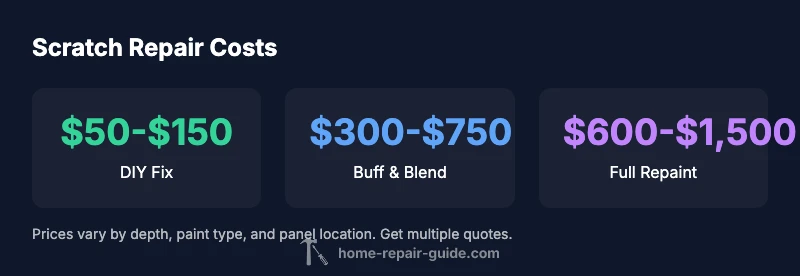
The cost to repair a car scratch varies widely, but light surface marks can often be fixed for $50-$150 if you DIY or hire a pro, while deeper scratches needing blending or repainting commonly run $300-$1,500. Location on the car, color matching, and the panel affected all influence price. For planning, expect a spread and consider whether you want a temporary fix or a long‑lasting finish.
Why car scratch repair costs vary
Car scratch repair costs are not fixed; they depend on depth, location, paint type, vehicle age, and labor rates. According to Home Repair Guide, even similar scratches can have very different price tags if they appear on a curved panel, near a door handle, or on a metallic/pearl finish that requires precise color matching. The first step in budgeting is to classify the scratch: cosmetic (top clear coat only), or deep (penetrating primer). Small scuffs on common colors may be tackled with do-it-yourself techniques or quick color touch-ups, while more complex cases demand professional services. Regional labor rates also matter; urban shops tend to charge more than rural ones. Finally, adding a warranty or color match guarantee can raise the upfront price but reduce risk if repainting is needed later.
Assessing scratch depth: cosmetic, clear coat, deeper
To estimate the depth, run your fingernail gently over the mark. If you feel a catch, it’s likely deeper than the surface and may involve the clear coat or base color. Light cosmetic scratches affect only the clear coat and can often be buffed or filled with a touch-up pen. A deeper scratch may require color matching and blending, which professional shops handle with specialized tools and custom blends. Always inspect adjacent panels and lights for hidden damage. Use a flashlight to spot uneven reflections that hint at deeper issues. Depth assessment guides your budgeting decisions and helps you decide between DIY steps or professional service. Remember, color matching accuracy is a major cost driver, especially on metallic or pearl finishes, where shade differences are more noticeable.
Repair paths and typical price ranges
Repair approaches range from inexpensive DIY fixes to full panel repainting. For minor cosmetic scratches, a polishing compound or touch-up pen can resolve the mark at low cost. A moderate scratch may require buffing with color blending and a clear-coat application, often costing hundreds. Deep scratches that extend into the base coat demand more extensive work, potentially including repaint and blending across adjacent panels. In those cases, costs escalate and can approach professional repaint ranges. Always obtain multiple quotes and confirm the use of color-matched paints and a warranty for the finish.
Factors that influence price beyond depth
Beyond scratch depth, price is influenced by color type (solid vs metallic/pearl), vehicle location (door edge, bumper, or curved panel), paint age, and the required number of layers for a seamless blend. Metallic or pearl paints require precise color matching, often increasing labor time and palette costs. Labor rates vary by region and shop, with urban centers typically charging more. The car’s age and existing paint condition can also impact adhesion, curing times, and the likelihood of needing a repaint for long-term durability.
DIY checks and risks
If you’re considering a DIY approach, start with a small inconspicuous area to test products like rubbing compound and color-milling touch-up pens. Mask surrounding areas to prevent overspray, and follow manufacturer's instructions to avoid clear coat damage. The risk of DIY fixes includes miscoloration, uneven gloss, and paint runs. If you’re uncertain, seek a professional’s opinion before applying solvent-based products over a large area. DIY can save money for shallow scratches, but it can backfire on deeper, color-sensitive finishes.
How to estimate your repair cost: a practical worksheet
- Identify depth and panel location; 2) Decide if DIY options cover the mark or if professional blending is needed; 3) Gather at least 2-3 quotes that include color matching; 4) Factor in color code availability and potential warranty; 5) Add a contingency for curing time and possible repaint across adjacent panels. Use the paint code to ensure precise color matching, and consider whether a shorter timeline is worth a higher price.
When to escalate to insurance or a body shop
If the scratch occurred during a collision or vandalism, or covers a large area on a high-contrast panel, a body shop may be the best option for a consistent finish. Leasing agreements sometimes require verified color matching. If the cost seems excessive relative to the car’s value or if color matching proves difficult, opt for a professional appraisal to compare options and ensure your chosen path preserves the vehicle’s resale value.
Comparison of repair paths by depth
| Repair Path | Estimated Cost | Typical Time | Notes |
|---|---|---|---|
| Cosmetic scratch (DIY polish, touch-up pen) | 50-150 | 1-3 hours | Best for minor marks with compatible color |
| Moderate scratch (buff & blend) | 150-450 | 2-5 hours | Requires skills or guidance |
| Deep scratch (repaint or panel blend) | 300-1000 | 1-2 days | Color matching critical |
| Deep scratch with repaint (full panel) | 800-1500 | 2-4 days | OEM color match recommended |
FAQ
What defines a cosmetic scratch?
A cosmetic scratch affects only the clear coat or top layer and usually doesn't penetrate primer. These are commonly fixable with polishing or touch-up.
A cosmetic scratch is a surface mark affecting only the finish and can often be fixed with polishing.
Can DIY fixes work on all colors and finishes?
DIY methods work best for shallow scratches on solid color finishes. Metallic or pearl paints require more careful color matching.
DIY fixes work best for shallow scratches on solid colors; for metallics, you may need a pro.
How long does repair typically take?
Most cosmetic touch-ups can be completed in a few hours; full repaint may take 1–2 days including curing time.
Touch-ups can take a few hours; repaint jobs may stretch to a couple of days.
Will insurance cover car scratch repair?
Damage from a collision or vandalism is covered if you have comprehensive or collision coverage; cosmetic repairs without an incident are rarely covered.
Insurance usually covers collision-related scratches, not cosmetic scrapes.
How can I minimize repair costs?
Shop around for quotes, consider DIY for small marks, and keep a consistent color match by providing paint code.
Get several quotes, DIY small scratches if you can, and use the paint code for color matching.
“The cost to repair a car scratch depends on depth, location, and color matching; professional blending or repainting can restore factory finish when done correctly.”
Key Takeaways
- Compare quotes across local shops before committing
- Assess depth before budgeting to pick the right path
- Color matching drives most costs
- DIY fixes work for minor scratches when feasible