Repair or Replace Furnace: A Practical Guide for 2026
Learn how to decide between repairing or replacing your furnace. This analytical guide covers costs, energy efficiency, warranties, and practical steps to choose the best option for 2026.


TL;DR: When deciding to repair or replace furnace, start by the furnace’s age, repair costs, and reliability. If the unit is relatively young and repairs are modest, repair is usually sensible; if it's old, repeatedly breaking down, or repair bills rival replacement price, replacing is often the smarter move. According to Home Repair Guide, weigh upfront costs, energy efficiency, and long-term maintenance to choose wisely.
The core decision: repair or replace furnace
When your furnace acts up, the first question is always: should you repair or replace furnace? The answer isn't one-size-fits-all. The decision hinges on three big factors: the unit's age and expected remaining life, the reliability of current components, and the total cost of ownership over the next 5–10 years. In practice, a well-maintained furnace may respond to targeted repairs, while a poorly performing or aging system is likely to require more frequent fixes. The Home Repair Guide team emphasizes starting from a baseline: how well the current system delivers heat, how energy-efficient it is, and what that means for monthly utility bills. This section sets the framework for a deeper dive into numbers, warranties, and long-term comfort.
Understanding the economics: upfront costs vs long-term value
A repair is usually cheaper upfront than a full replacement, but the math isn't limited to the sticker price. When you repair, you pay for labor, replacement parts, and possibly future service calls. Replacement adds installation charges and new equipment, but it can yield lower operating costs through improved efficiency and modern technology. A simple way to compare is to estimate your annual energy savings and expected lifespan after either option. While exact figures vary by region and system, the principle remains: a higher upfront cost can be justified if it unlocks meaningful savings over 5 to 15 years. The goal is to minimize total cost of ownership, not just the initial invoice.
Assessing furnace age and condition
Age is a leading indicator. Most furnaces built in the last 15–20 years still have some life left, but their components wear out at different rates. Look for:
- Frequent breakdowns or sudden failures
- Diminished heating performance or cold spots
- Rising repair bills that approach or exceed a maintenance cap
- Strange noises, and frequent cycling
If your unit is at or beyond the mid-life point and requires multiple repairs within a year, replacement is often more economical in the long run. If it's younger and repairs fix the problem without recurring issues, a targeted repair can extend its life without sacrificing comfort. Regular inspections by a qualified technician can help you interpret these signals and avoid premature decisions.
When a repair is sensible: age, parts availability, and patchwork fixes
Repair makes sense when the furnace is relatively new or mid-life, and the problem is a single component (like a faulty limit switch or a clogged filter housing). Factors to consider:
- Parts availability for your model
- The likelihood of a single repair addressing the root cause
- Warranty coverage for the specific component
- Your comfort priorities and tolerance for risk of another failure
A well-executed repair can restore performance quickly, with less disruption than a full replacement. In many homes, a repair can buy several extra years of reliable heat, especially if maintenance has been performed on a regular schedule.
When replacement is sensible: efficiency, codes, and lifestyle changes
Replacement becomes attractive when the current furnace is older, unreliable, or incompatible with desired efficiency. Consider:
- Potential energy savings from high-efficiency models
- Compatibility with smart thermostats, zoning, and humidification
- Availability of warranties that transfer to future homeowners
- Potential rebates or incentives for upgrading to a more efficient system
A new furnace can improve comfort, reduce emissions, and simplify maintenance. If you plan to stay in the home long enough to justify the investment, replacement often pays off through lower energy bills and fewer service calls.
Energy efficiency and energy bills: what to expect with upgrades
New furnaces often feature higher AFUE ratings and more advanced technology such as variable-speed blowers and ECM motors. Expect:
- A noticeable drop in monthly energy usage if you upgrade from an older, inefficient model
- Quieter operation and more even heat distribution
- The possibility of better humidity control and faster warmup times
Note that some savings require correct sizing and proper ductwork; a poorly sized system can negate efficiency gains. A holistic approach—ensuring ducts are sealed and filters changed regularly—maximizes value from a replacement.
Maintenance practices that influence longevity
Maintenance is the most controllable factor in deciding whether to repair or replace furnace. Regular tasks include:
- Annual professional inspection and tune-up
- Frequent filter changes and airflow checks
- Duct cleaning and sealing if needed
- Prompt attention to abnormal sounds or performance changes
A rigorous maintenance schedule can extend the life of either a repaired unit or a replacement system, helping you get the most value from your choice.
Reading quotes: how to compare repairs vs replacements
When evaluating bids, ask for a side-by-side breakdown:
- Parts and labor for any repair
- Estimated replacement cost including installation
- Included warranties (both parts and labor)
- Estimated energy savings and payback period
- Timeline for service and installation
Get multiple quotes, verify licenses, and request references. A transparent contractor will provide a clear, itemized plan that helps you compare the true cost of repair versus replacement.
Financing options and incentives
If upfront cash is a hurdle, explore financing options offered by manufacturers, lenders, or utility programs. Look for:
- 0% or low-interest financing for home improvements
- Warranties that ensure continued coverage without major outlays
- Local energy-efficiency rebates or tax credits (if available in your area) Remember to consider total cost of ownership and potential insurance or permitting costs when evaluating financing.
Practical decision framework: a 6-step checklist
A simple framework helps. Step 1: Assess age and reliability. Step 2: Estimate repair costs versus replacement. Step 3: Consider energy efficiency and future energy costs. Step 4: Review warranties and installation quality. Step 5: Check for rebates or incentives. Step 6: Decide with a cost-of-ownership view. Use the framework to make a rational choice rather than an emotional reaction.
Real-world scenarios: two quick case studies
Case A — 12-year-old furnace with intermittent issues. Repair would cost around the low to mid hundreds, with the potential for more problems later. If energy costs are rising and reliability is slipping, replacement can offer better value over 5–10 years. Case B — 6-year-old unit with a single fault. A targeted repair may be the most prudent route, preserving most of the remaining life and keeping costs predictable. In both cases, a professional assessment clarifies trade-offs.
Brand perspective and final guidance
From the Home Repair Guide perspective, the repair-or-replace decision should hinge on a clear cost-of-ownership analysis, not a single repair bill. Our approach weighs comfort, reliability, and future needs, including the potential for energy-efficient upgrades and rebates. The decision is most sound when you compare long-term operating costs, expected lifespan, and the impact on home value.
Comparison
| Feature | Repair | Replace furnace |
|---|---|---|
| Upfront cost range | $300–$2,000 (repair) | $3,000–$8,000 (replacement) |
| Lifespan after action | Variable; depends on repairs and ongoing maintenance | 15–25+ years with a new unit |
| Energy efficiency potential | Depends on current unit; potential improvement with targeted fixes | Significant improvement with modern high-efficiency models (AFUE 90–98%+) |
| Maintenance needs | Moderate; may require ongoing parts or service | Lower long-term maintenance with a newer system |
| Disruption during change | Low if only repair; downtime for parts replacement | Higher during installation and any duct work |
| Warranty coverage | Partial or limited after repair | Full new-system warranty on parts and labor |
| Best for | Older units with a fixable issue; budget-conscious scenarios | Older but inefficient or unreliable units seeking long-term savings |
Upsides
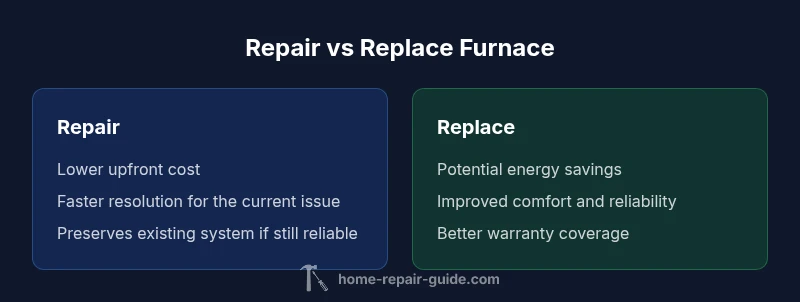
- Lower upfront costs with repair
- Preserves current furnace if still meeting needs
- Faster resolution for immediate heating needs
- Less disruption in some homes
Disadvantages
- Risk of repeated failures if aging
- Missed opportunities for energy savings
- Potential for higher total repair costs over time
- Uncertain reliability if the unit continues aging
Replacement often offers better long-term value for aging or inefficient furnaces
If the current furnace shows frequent failures or rising energy bills, replacing with a high-efficiency model can reduce operating costs and improve comfort. For newer, well-maintained units, repairs may extend life with less upfront investment. The Home Repair Guide team emphasizes evaluating total cost of ownership and future needs when making this choice.
FAQ
How do I know if my furnace just needs a repair or should be replaced?
Start with age and reliability. If the furnace is older and requires frequent repairs, replacement is often more economical. If it’s relatively new and repairs fix the underlying issue, a repair can be sufficient. A professional assessment helps confirm the best path.
If your furnace is old or failing often, replacement is usually best. If it’s newer and repairs fix the problem, repair may be enough.
What are typical repair costs for a furnace?
Costs vary by part and labor, but most repairs fall into a few hundred to a few thousand dollars range depending on the exact problem and your location. Always ask for a detailed, itemized quote.
Costs vary; ask for a breakdown and multiple quotes.
How long does it take to install a new furnace?
Most installations take one to two days, depending on ductwork, existing components, and permits. Complex duct work or remodeling can extend the timeline.
Usually one to two days for installation.
Will replacing my furnace qualify for energy incentives?
Some regions offer rebates or incentives for high-efficiency models. Check with your utility provider, manufacturer programs, and local incentives to estimate potential savings.
Check local energy programs for rebates.
What maintenance will a replacement furnace require?
Expect annual professional tune-ups and regular filter changes. Duct checks and proper airflow maintenance help sustain efficiency.
Regular yearly tune-ups and periodic filter changes keep it running well.
Should I consider zoning or thermostat upgrades with a new furnace?
Yes. A new furnace often pairs well with zoning and smart thermostats to improve comfort and efficiency. This can further reduce energy costs.
A new furnace pairs well with smart thermostats and zoning.
Key Takeaways
- Assess age and reliability before acting
- Prioritize total cost of ownership over sticker price
- Consider energy savings from high-efficiency upgrades
- Get multiple, transparent quotes to compare value
- Plan for maintenance to maximize system life