What Is Wrong with Verizon Service Today: A Troubleshooting Guide
Verizon service acting up today? This urgent, step-by-step guide helps homeowners and renters diagnose outages, distinguish between regional problems and device faults, and restore connectivity quickly.


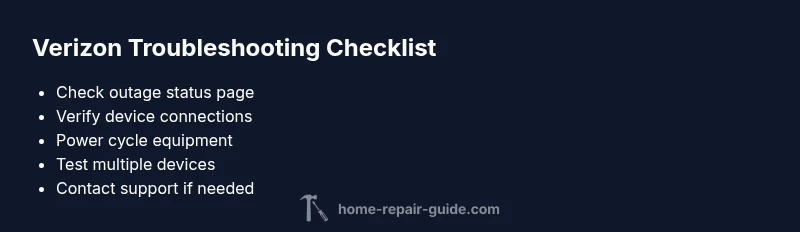
Verizon service today is most likely affected by a regional outage, network maintenance, or a faulty modem or SIM misconfiguration. Start by checking Verizon's outage page and your account status, then perform quick device resets: reboot your phone or router, toggle airplane mode, and reinsert the SIM. If service remains down, use the diagnostic flow below to guide every step.
Why Verizon Service Might Be Experiencing Issues Today
According to Home Repair Guide, when you experience service issues today, the most common culprits are outages, maintenance, or local network congestion. Outages can affect voice, data, or both, and they can hit urban centers or rural pockets differently. Verizon operates a large, multi-layer network; when a single segment is degraded, hundreds or thousands of customers may see slower speeds or complete drops. If you rely on FiOS for internet, you may notice router indicators flicker or show a blinking light, which often signals upstream trouble rather than a personal device problem. In many cases, the root cause lies outside your home or device, but symptoms can mimic local faults. Reading official status pages and credible third-party monitors helps separate truth from rumor, ensuring you don't chase non-existent issues or perform unnecessary resets. The key is to verify whether the outage is nationwide or region-specific, whether it’s scheduled maintenance, and whether there are known incidents affecting towers or fiber backhaul in your area. This quick understanding helps you prioritize steps and minimize wasted time.
Home Repair Guide Analysis, 2026 indicates outages are sometimes concentrated during peak usage periods and major weather events, so understanding regional patterns can save you hours of frustration.
What to Check First
- Check Verizon's outage status page and official social posts for any regional alerts or scheduled maintenance. If a broad outage is listed, your best course is to wait for Verizon to restore service.
- Verify your account status and billing: service could be temporarily stalled if there are billing holds or plan changes.
- For mobile users: ensure the SIM is seated correctly, restart the device, and check data roaming and APN settings. Update the device if a software patch is available.
- For FiOS users: inspect the router and ONT (optical network terminal). Verify coax connections, power supply, and the status LEDs. If you have a backup battery, ensure it is charged.
- Perform quick device resets: power cycle your modem/router and devices for 30–60 seconds, then reconnect. If you use a mesh network, test with a single router first to isolate issues.
- If you recently changed service or installed new equipment, temporarily remove new hardware to see if the original configuration restores service.
- Document the exact symptoms (down, intermittent, slow), time of onset, and affected devices to help support agents diagnose faster.
Diagnostic Flow Overview
A systematic approach helps distinguish between a Verizon-wide problem and a local fault. Start with external checks (status pages, regional alerts, third-party outage trackers) before diving into device troubleshooting. If the outage is confirmed, you’ll focus on stabilization actions and alternatives. If there’s no outage, the issue is more likely on your end, and you’ll move to device and network-level diagnostics. This flow minimizes wasted effort and speeds recovery.
Remember to keep notes of what you test and the results, as this accelerates support calls and improves your chances of a quick fix.
Step-by-Step Troubleshooting for the Most Common Cause: Regional Outage
- Confirm outage on Verizon’s official status page and cross-check with third-party monitors.
- Compare with neighbor reports or community forums to verify if the disruption is region-wide.
- If confirmed, document onset time and monitor status updates from Verizon. Do not perform aggressive resets that could disrupt recovery signals.
- From your side, ensure all devices are on the latest firmware and that you’re not in a location with known degraded service (e.g., building interference, elevator placement, or basement living).
- Maintain power to critical networking gear and consider minimal usage until service is restored. If you require connectivity for essential tasks, consider a temporary backup (e.g., cellular hotspot) while awaiting restoration.
- If the outage persists beyond a reasonable time, contact Verizon support with your diagnostic notes. They can escalate region-specific issues and provide ETA guidance.
Pro tip: Keep a small local outage log for your area to spot recurring windows of disruption and to help with future planning.
Step-by-Step Troubleshooting for Local Issues (If Not Outage)
- Power cycle all network equipment (modem, router, and any mesh nodes) for at least 30 seconds, then reboot connected devices.
- Run a speed test across multiple devices to confirm whether the problem affects all devices or only one. If only one device is slow, the issue is likely device-specific.
- Check home wiring and equipment: ensure cables are firmly connected, replace damaged cables, and consider temporarily bypassing a router to test a direct modem connection.
- Verify Wi‑Fi settings and channel interference. Change the SSID and password to isolate interference, and test on a wired connection if possible.
- If you use a VPN or security appliance, temporarily disable them to see if performance improves.
- For fiber customers, confirm the ONT is functioning and the coax is intact. If you suspect a line fault, avoid DIY electrical work and contact support.
If you cannot isolate the issue to local equipment, proceed to contact Verizon for deeper diagnostics.
When to Contact Verizon and What Information to Have
- If your tests point to a regional outage or you cannot restore service after steps above, contact Verizon via the official support page, chat, or phone. Provide your account number, service type (mobile or FiOS), device model, approximate onset time, and a list of steps you already tried.
- Note any error codes shown on devices or the status LEDs on your modem/ONT. Screenshots or logs help technical agents assess and escalate quickly.
- If you rely on a business line or essential services, request priority treatment and an outage ETA. Ask about any temporary fixes or recommended workarounds for critical needs during the outage.
- Record your interactions: when you called, who you spoke to, and suggested remedies. This helps with follow-ups and ensures you’re not duplicating diagnostics.
Signals you should not ignore: persistent drops in service after regional issues are resolved, or recurring outages at the same time of day. In these cases, it may indicate an under-maintained network segment or a line fault requiring engineering attention.
Preventive Tips to Reduce Future Outages
- Enable outage alerts on your Verizon account so you receive real-time updates about regional issues and ETA changes.
- Maintain a basic contingency plan for essential services, such as a mobile hotspot or alternate internet source, during outages.
- Regularly update your devices, routers, and network gear to ensure compatibility with network updates and security patches.
- Periodically test your home network equipment and reconfigure security settings to minimize interference and avoid over-dependence on a single device.
- Consider a service-level plan that provides prioritized support for business-critical connectivity if you rely on reliable internet for work or schooling.
- Keep a simple outage log for your area and neighborhood to detect patterns and advocate for faster repairs with your provider when needed.
Steps
Estimated time: 40-60 minutes
- 1
Start with the outage check
Begin by visiting Verizon’s official status page and credible outage monitors to confirm whether a regional problem is underway. If you see a live outage, document the region and ETA. If no outage is listed, proceed to local checks.
Tip: Document the outage status page time and any screenshots for reference. - 2
Assess local equipment
Inspect your router, ONT, and cables. Ensure all power indicators are steady, connections are tight, and there is no visible damage. If you have a backup battery, confirm it’s charged and connected.
Tip: Don’t skip basic physical checks; many outages are caused by loose cables. - 3
Reset and reconfigure
Power cycle your modem/router for 30–60 seconds, reboot devices, and reinsert SIMs for mobile data. If you’re on FiOS, temporarily bypass the router with a direct Ethernet connection to test the fiber link.
Tip: A clean reboot often resolves software glitches after updates. - 4
Test connectivity on multiple devices
Check speed and connection on a phone, tablet, and wired PC. If one device is affected while others work, focus on that device’s settings.
Tip: Rule out device-specific issues before escalating. - 5
Check for account-related blocks
Log into your Verizon account to confirm service status, billing holds, or plan changes that could temporarily suspend service. If needed, contact support to resolve account blocks.
Tip: Billing holds can unexpectedly interrupt service; resolve them first. - 6
Plan for outages and escalate if needed
If the outage is regional and expected to last, use a temporary alternative (hotspot) and set expectations with your household. If the problem persists beyond the ETA, reach out to Verizon with your diagnostics.
Tip: Keep other critical devices powered and connected during outages.
Diagnosis: User reports service disruption (internet or mobile) today
Possible Causes
- highNationwide or regional outage in Verizon network
- mediumLocal network congestion or maintenance
- lowDevice configuration or SIM issue
Fixes
- easyCheck Verizon status page and third-party outage monitors; wait if outage confirmed
- easyPower cycle modem/router and devices; reseat SIM; toggle airplane mode
- mediumContact Verizon support for account or service-specific issues; escalate to technical support
FAQ
What should I check first if Verizon service is down today?
Begin with the official outage page, status alerts, and your own account status. Then try power cycling your modem/router and reseating your SIM to rule out simple hardware issues.
Start with the outage page and a quick device reset to rule out obvious causes.
How can I tell if the outage is regional or just my home network?
Compare your symptoms across multiple devices and check if neighbors report similar issues. If several homes in your area are affected, it’s likely regional. Otherwise, focus on home equipment.
If neighbors have the same issue, it’s probably regional; otherwise, investigate your home network.
What information should I have when contacting Verizon support?
Have your account number, service type (mobile or FiOS), device model, onset time, and a list of steps you already tried. Screenshots and error messages help speed up the process.
Be ready with your account details and what you’ve already tried to help support diagnose faster.
If I’m on a limited data plan and service is interrupted, what can I do?
Use a backup connection like a mobile hotspot if available, and monitor your data usage. Support can suggest temporary workarounds or plan adjustments.
You can use a backup connection while you wait for the main service to come back.
When should I escalate to technical support?
Escalate if the outage is regional and ongoing beyond the estimated restoration time, or if you’ve tried all standard troubleshooting steps without improvement.
If it’s not getting better and it’s affecting essential tasks, contact technical support.
Watch Video
Key Takeaways
- Verify whether a regional outage exists before troubleshooting.
- Start with simple resets and status checks to save time.
- Document symptoms and actions for faster support.
- Have a backup plan for essential connectivity during outages.