Is It Safe to Repair a Cracked Rim? A Practical Troubleshooting Guide
Learn why cracking a wheel rim is a safety concern and when replacement is necessary. This Home Repair Guide troubleshooting article covers steps, diagnostics, and professional options for rims.


Is it safe to repair a cracked rim? In most cases, no. A rim crack indicates compromised structural integrity, which can fail suddenly. The safest course is to stop riding, avoid DIY fixes, and replace the rim or wheel. Seek a professional assessment; if repair is ever considered, it must be performed by a qualified technician and followed by a thorough inspection.
Why is a cracked rim a safety-critical issue and is it safe to repair a cracked rim
A cracked rim is more than a cosmetic blemish—it can be a concealed failure point that propagates under load. When you ask, is it safe to repair a cracked rim, the honest answer is that most rims should not be repaired by a DIY process or a casual shop fix. Rim integrity directly affects how the wheel sustains impact, keeps tire bead seal, and transfers loads to the hub and spokes. A small crack near a spoke hole or bead seat can grow with every rotation and under lateral forces, increasing the risk of sudden tire deflation, wheel collapse, or loss of control. For homeowners and renters maintaining a bike or car, prioritizing safety over a cheap temporary fix is essential. The Home Repair Guide team emphasizes that steering you toward replacement or professional evaluation is the smarter choice for long-term reliability and personal safety.
Could there be any exceptions to the rule? In rare cases, some rims may be salvageable under strict professional control, but such repairs are uncommon and not universally safe. Steel rims in professional settings might be considered for certain repair approaches, yet most modern rims—especially aluminum or carbon-fiber variants—do not lend themselves to reliable, long-term fixes after cracking. Even when a professional approves a repair, it should be followed by a comprehensive inspection and possibly wheel trueing or re-lacing. For most users, replacing the rim or wheel is the safer path and aligns with best-practice guidance from Home Repair Guide.
How to think about the risk before riding again
If you discover a crack, treat it as a signal that the wheel has fatigued. Riding on an compromised rim can alter spoke tension, create imbalances, and increase the risk of bead failure at speed. Before attempting any fix, perform a quick safety check: verify tire pressure, inspect for additional cracks around spokes and bead area, and ensure the wheel spins true without wobble. If you notice any wobble, unusual sounds, or hard edge on the crack, do not ride. Instead, evacuate the bike to a safe location and arrange professional evaluation as soon as possible.
What a safety-focused professional assessment typically includes
When a mechanic or wheel specialist evaluates a cracked rim, they perform a careful visual inspection and may use non-destructive testing to assess crack propagation. They check spoke tension, rim bed integrity, bead seat, and the condition of the tire. Depending on findings, the professional may recommend rim replacement, wheel rebuild, or, in very rare cases, a controlled repair. The assessment is guided by industry standards and the rim material type. Home Repair Guide recommends consulting a qualified technician rather than attempting a repair with makeshift methods.
Bottom line for homeowners and renters
In most everyday repair scenarios, a cracked rim should be treated as a non-repairable component. The cost of replacement, while not cheap, is justified by stronger safety margins and reliability. If you still consider repair options, ensure you are working with a certified wheel specialist who can certify the repair under applicable standards. Always test the wheel in a controlled environment after any fix and do not exceed low-speed limits until you have a complete inspection from a professional.
Steps
Estimated time: 60-120 minutes
- 1
Stop riding and secure the bike
As soon as you notice a crack, bring the bike to a safe area and stop using it. Do not ride with a suspicious rim crack, even if it seems minor. Secure the bike so it won't roll away.
Tip: Place the bike on a stable stand or lean it against a solid surface to prevent falls. - 2
Remove the wheel from the bike
Loosen quick-release or axle nuts and carefully detach the wheel. Keep the wheel flat to avoid aggravating any cracks. Remove the tire only after the wheel is safely supported.
Tip: Take photos of the rim and crack location before disassembly to document the damage for a shop. - 3
Deflate and remove the tire and tube
Fully deflate the tire and pry the tire bead away from the rim to remove the tire and inner tube. Inspect the bead area for additional signs of damage while the tire is off.
Tip: Use tire levers gently to avoid creating new scratches on the rim. - 4
Inspect the rim thoroughly
Look for cracks, flaking metal, or signs of elongation near spoke holes and along the bead seat. Check for rim bed distortion and any wobble when you spin the rim by hand.
Tip: If you see a crack that deepens when flexed, assume it’s a failure risk. - 5
Decide on repair vs. replacement with a professional
Bring the wheel to a certified wheel technician for evaluation. They will determine if a repair is permissible or if rim replacement is the only safe option.
Tip: Do not rely on home repairs or cheap fixes for structural cracks. - 6
If replacement is recommended, choose a safe option
Select a rim or wheel compatible with your bike. Ensure correct diameter, width, and spoke count. If offered, request a wheel rebuild service for integrity.
Tip: Ask about spoke tensioning and wheel true after installation. - 7
Reassemble with care
Install the new rim or wheel, re-torque spokes as recommended, re-seat the tire and tube, and reinstall the wheel on the bike. Check tire inflation and bead seating.
Tip: Follow the manufacturer torque specs and re-check after a short test ride. - 8
Test ride at low speed and inspect again
Take a short test ride in a controlled area to verify stability. Listen for unusual noises and monitor wheel feel. Re-inspect for any new crack development after the ride.
Tip: If anything feels off, stop and return to the shop for a re-check.
Diagnosis: Rim shows a visible crack after a hard impact.
Possible Causes
- highImpact damage from potholes, curbs, or heavy loads
- mediumFatigue from continued use after minor cracks
- lowManufacturing defect or flaw
Fixes
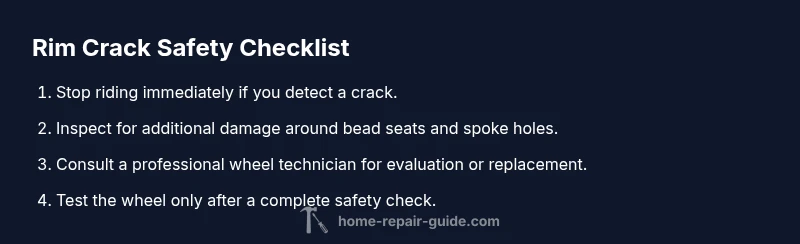
- easyStop riding immediately and inspect for additional damage around bead seat and spoke holes
- easyRemove tire and assess rim for cracks or elongation; do not attempt a fix on a compromised rim
- mediumConsult a professional wheel technician for replacement or wheel rebuild
FAQ
Is it ever safe to repair a cracked rim?
Most rim cracks are not safely repairable. A professional assessment is required, and replacement is usually the safer option. Only in rare, highly controlled scenarios might a repair be considered, and it should be followed by a comprehensive inspection.
Most cracks aren’t safely repairable. Seek a professional assessment and expect replacement for safety.
How can I tell if a rim is structurally compromised?
Look for visible cracks, flaked metal, distortions around spoke holes, and rim bed deformation. If there is any wobble or crack propagation with light probing, treat it as unsafe.
Check for cracks, wobble, and deformation around spokes and bead seats. If in doubt, consult a pro.
Can I continue riding after noticing a crack if I ride gently?
No. Even small cracks can rapidly worsen under load. Continuing to ride increases the risk of tire blowouts or wheel failure.
No—cracks worsen under load and can cause a sudden wheel failure.
Should I replace the rim or the entire wheel?
In most cases, replacing the rim or wheel is safer than attempting a repair. A wheel rebuild by a qualified technician may be necessary if the rim can be salvaged.
Usually you should replace the rim or wheel; a professional will decide if a rebuild is possible.
What immediate steps should I take after noticing a crack?
Stop riding, inspect for further damage, remove the tire and tube, and consult a professional as soon as possible. Do not attempt home fixes on a cracked rim.
Stop riding and get a professional inspection as soon as you notice a crack.
Are there safety differences between bike rims and car rims?
The underlying principle is the same: cracks weaken the wheel system. However, the inspection methods and repair options differ, and professional service is strongly recommended for both bikes and cars.
Both bike and car rims should be professionally evaluated; don’t DIY a fix.
Watch Video
Key Takeaways
- Do not ride on a cracked rim.
- Replacement is generally safer than repair.
- Professional assessment is essential.
- Prioritize wheel integrity and safety for future rides.