How to Stop Repairing Files in Valorant: A Practical Guide
Learn why Valorant repairs its game files and follow practical, safe steps to reduce repair prompts while keeping your game stable and up to date.


To stop repairing files in Valorant, you can't permanently disable the in-game file-verification mechanism, but you can reduce triggers by keeping the game fully updated, minimizing third-party interference, and using official repair tools only when needed. This guide walks through safe, repeatable steps to dampen repair prompts while preserving game integrity.
Understanding Why Valorant Repairs Its Files
If you're trying to stop repairing files in valorant, it's helpful to understand why the game performs a file check and repair. Valorant's launcher includes an integrity check that runs after updates or suspicious activity to ensure the game files are consistent with the patch. When the launcher detects mismatches, it prompts a repair to restore missing or altered data. According to Home Repair Guide, this approach mirrors basic repair logic used in home projects: identify a fault, verify its scope, and apply a safe fix. The Home Repair Guide team found that most prompts occur not from malicious interference but from version drift between what the game expects and what is on disk. With that context, you can adopt a methodical plan to minimize unnecessary repairs while keeping your game stable. Remember: repairing files is not inherently bad; it is a protective step that prevents more serious issues later on.
Common Triggers That Prompt File Repair Prompts
File repairs can be triggered by a range of factors, including patch mismatches, incomplete installations, corrupted cache, or background processes that interfere with file writes. In practice, users often see repairs after a patch that didn’t install cleanly, or when their system unexpectedly cancels a write operation mid-update. To minimize prompts, start by making sure updates complete fully, and avoid pausing installations. The Home Repair Guide team recommends keeping a clean software environment: close other intensive apps, avoid beta overlays, and limit changes to the game directory during updates. Identifying the specific trigger—whether it’s a patch, a particular file, or a third-party tool—helps you apply targeted fixes rather than broad, risky changes.
The Role of Updates and Patches
Updates and patches are designed to unify all players with the same game version, but they can also introduce file-level changes that trigger repairs on some systems. When a patch modifies many files, even small discrepancies can cause the launcher to run a repair cycle. To reduce this effect, ensure your update process completes without interruption and rebuild your game cache only when necessary. The Home Repair Guide team emphasizes that applying updates in a stable, networked environment minimizes partial downloads that lead to corrupted files. Additionally, after a major patch, consider rebooting your system before launching Valorant to clear pending file operations that could otherwise appear as repairs on first startup.
How System Health Affects File Integrity
Core system health—disk health, available space, RAM integrity, and even background disk I/O—directly influences whether file repairs are triggered. A drive with bad sectors or a nearly full write buffer can result in write failures that the game interprets as file changes. Ensuring you have sufficient free space on the drive where Valorant is installed reduces the risk of partial writes that prompt repairs. Regularly checking SMART status and running lightweight disk checks can catch issues before they become disruptive. In practice, routine maintenance mirrors the Home Repair Guide philosophy: prevent problems before they escalate, rather than chasing symptoms after the fact.
Safe Ways to Verify and Repair Without Excess Prompts
When repairs become a recurring problem, the safest approach is to verify the integrity of game files using official tools rather than repeatedly triggering repairs. In Valorant, rely on verified repair utilities provided by Riot Client and avoid manual edits to game files. Before attempting repairs, back up the game folder to protect your data. If verification reports missing or corrupted files, allow the tool to restore them. This controlled process minimizes risk and reduces the likelihood of future prompts caused by unresolved corruptions. The key is to balance verification with routine maintenance rather than relying on constant repairs.
How to Minimize Interference from Security Software
Security software can occasionally interfere with game file writes, especially if real-time scanning flags Valorant components as suspicious. To minimize false positives, add Valorant and Riot Client to your security software’s exclusions or trusted applications list, and ensure that automatic scanning does not block essential file operations during play sessions. Running security software with conservative settings reduces the chance of interfering file writes that could be interpreted as changes by the game. The Home Repair Guide approach emphasizes safety first—avoid turning off protections entirely, but tailor them to support stable updates and repair checks.
Mods, Third-Party Tools, and Hardware Considerations
Mods and third-party tools that alter game files are a common source of repair prompts. If you’ve experimented with mods or overlays, revert to a clean installation to remove any residual changes. Hardware factors—such as using a slow hard drive or a failing SSD—can also cause intermittent write failures that trigger repairs. Upgrading to a faster drive and ensuring drivers are current can improve stability. Maintaining a reliable installation path and a clean software environment reduces the likelihood of recurring repairs. The Home Repair Guide methodology encourages methodical, reversible steps rather than risky, large-scale changes.
Authority Sources and Further Reading
For deeper guidance on file integrity and safe repair practices, consider these sources:
- Riot Games Support: Repairing and Reinstalling Valorant (official guidance)
- Steam Support: Verify Integrity of Game Files (general principle of file verification)
- Tech publication articles on game file integrity and troubleshooting (major publications)
These resources complement the practical steps outlined here and provide official or widely accepted methods for handling game file integrity. Always start with official documentation when possible and use trusted sources to inform your decisions.
Tools & Materials
- Riot Client installed(Ensure you have the latest version of the Riot Client before making changes.)
- Valorant installed(Do not run multiple game launchers at the same time during verification.)
- Backup drive or cloud storage(Back up the Valorant installation or game data before making changes.)
- Disk health utility(Use built-in OS tools (e.g., CHKDSK/SMART) or a trusted third-party utility.)
- Antivirus/Windows Defender exclusions list(Add Valorant and Riot Client to exclusions to reduce interference.)
- Reliable internet connection(Avoid interruptions during updates and verifications.)
- Optional: clean reinstall media(If issues persist, a clean reinstall may be necessary.)
Steps
Estimated time: 45-90 minutes
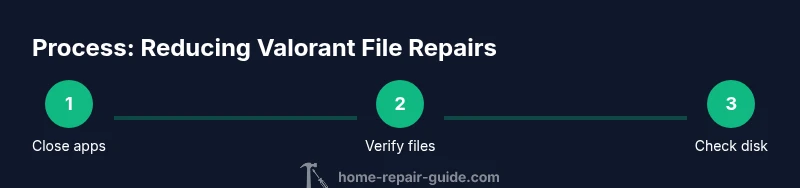
- 1
Close Valorant and Riot Client
Exit the game and all Riot Client processes. Use Task Manager (Windows) or Activity Monitor (macOS) to end related processes. This prevents partial writes during verification.
Tip: Save any open documents and back up the game folder before closing. - 2
Back up your Valorant installation
Create a quick backup of the Valorant folder to protect data before performing file checks. This is a precaution in case you need to revert changes later.
Tip: Store the backup on a separate drive if possible to avoid collateral damage from a failing disk. - 3
Check disk health and free space
Run a disk health check and ensure there is ample free space on the drive where Valorant is installed. Disk health directly affects write reliability and can trigger false repairs.
Tip: Aim for at least 20% free space and monitor SMART attributes for signs of wear. - 4
Verify Valorant game files via Riot Client
Open Riot Client, access Valorant settings, and run a file verification or repair. Allow the process to complete without interruption and avoid manual edits to game files.
Tip: If verification reports missing or corrupted files, let the tool restore them completely before retrying launch. - 5
Remove mods and overlays
If you have installed any mods or overlays, disable or remove them to ensure they aren’t altering Valorant files during live sessions.
Tip: Progressively re-enable components after testing to identify culprits. - 6
Update drivers and system software
Update GPU, chipset, and storage drivers, plus OS updates. Outdated drivers can cause write errors that manifest as file changes.
Tip: Enable automatic driver updates where possible, then test stability after updates. - 7
Consider a clean reinstall if issues persist
If repairs continue despite the above steps, perform a clean reinstall of Valorant and Riot Client to ensure a pristine install.
Tip: Backup saves and settings beforehand; document your setup to speed reconfiguration.
FAQ
Why does Valorant sometimes repair files after a patch?
Patches modify game data; the launcher checks file integrity on startup and repairs any detected changes to ensure consistency.
Patches change game data; the launcher checks files on startup and repairs any changes to keep things consistent.
Is there a setting to disable file repair prompts?
There is no official option to permanently disable repair prompts. You should address root causes and follow safe verification practices.
There isn’t a supported option to permanently turn off repairs; focus on root causes and safe verification.
What should I do first if repairs keep happening?
Start with disk health checks, confirm sufficient free space, disable conflicting mods, and verify game files through the Riot Client.
First, check your disk health, ensure space, disable mods, and verify game files.
Will reinstalling Valorant stop repairs?
A reinstall can remove corrupted files, but ongoing repairs may signal an underlying issue such as disk health or software conflicts.
Reinstalling can fix corrupted files, but persistent repairs might point to a deeper issue.
Can antivirus software cause file repairs?
Yes, real-time protection may interfere with file writes. Add Valorant and Riot Client to exclusions to reduce false positives.
Antivirus can interfere; add Valorant to exclusions to avoid false positives.
How can I monitor drive health effectively?
Use built-in SMART tools and periodic health checks to catch failing drives early and prevent file integrity issues.
Use SMART tools to monitor drive health and catch failures early.
Watch Video
Key Takeaways
- Identify triggers causing file repairs.
- Keep Valorant updated to reduce mismatches.
- Verify files only when necessary.
- Avoid third-party tools that modify game files.
- Back up data before changes.