How to Get Out of Repairing Disk Errors: A Practical Guide
Learn safe steps to exit disk repair loops, back up data, verify health, and prevent future disk errors with practical techniques from Home Repair Guide.


How to get out of repairing disk errors? This quick guide explains how to safely stop ongoing repair loops and regain access to your data. You’ll learn practical steps to back up important files, exit repair modes without causing damage, and prevent future disk problems with simple maintenance. Before you begin, ensure you have a backup drive, admin access, and a known health status for the affected drive.
Understanding disk repair prompts and why you might want to get out of repairing disk errors
According to Home Repair Guide, disk-repair prompts are designed to protect data but can trap users in repair cycles. If you’re asking how to get out of repairing disk errors, you’re not alone; this guide explains safe exit strategies and the trade-offs involved. Before taking any action, recognize that stopping repairs can carry risks such as data loss or corrupted files if the disk is failing. The goal is to balance data safety with practical downtime. In this section, we explore why these prompts appear, how the repair workflow is typically structured, and how to recognize when it’s appropriate to step out and investigate other options. Disk repair tools often run in stages: initial quick checks, deeper surface scans, and then automated attempts to fix detected problems. Each stage has implications for performance, data integrity, and future reliability. The phrase how to get out of repairing disk errors is not about abandoning maintenance; it’s about choosing a safer path when the disk health report becomes inconclusive or if the repair process seems to stall or degrade. If you decide to step away, you should have a clear plan for data protection and a path to re-engage if necessary. In short, exit strategies are a skill, not a failure, and they protect both your files and your time.
A practical assessment: disk health, data risk, and decision points
Assessing disk health begins with symptom observation: slow system response, frequent freezes, or unusual noises can indicate hardware wear or corrupted sectors. SMART status flags and vendor utilities provide numeric indicators; however, they are not perfect predictors. The key is to correlate symptoms with health indicators and your data risk tolerance. Ask yourself: Are critical files at stake? Do you have a reliable backup? Is the drive still under warranty? If the disk shows recurring errors despite repairs, or if a reallocated sector count increases, it may be wiser to plan for replacement rather than chasing further repairs. The Home Repair Guide team emphasizes conservative decision-making: if you’re uncertain, assume the risk of data loss and prioritize data protection first. While repair prompts can be helpful, they can also lock you into cycles that give a false sense of progress. Document symptoms and log any changes in drive behavior. Finally, consider whether your current system’s value justifies the time and potential risk involved in continuing repairs rather than migrating to a safer storage solution. Home Repair Guide analysis shows that following a structured exit plan reduces data loss risk when encountering ambiguous disk health reports.
Data backup strategies before making changes
Backing up before attempting any exit or repair is essential. Create a full image backup of the disk if possible, not just file-level copies. Use a separate, reliable storage device to prevent the original disk from being overwritten by a failed repair. If a full image isn’t feasible due to severe sector damage, prioritize exporting the most critical files first and then continuing with a sector-by-sector clone if supported by your tools. Verify backups by performing a separate restore test on a different machine or environment. For laptops or devices with limited ports, consider USB-C hubs and multiple backups. When selecting backup software, choose reputable, well-supported options and confirm that they can handle problematic disks without introducing additional writes to the disk. Remember, a well-executed backup is your best defense when exiting repair loops.
Exiting repair mode: practical steps and checks
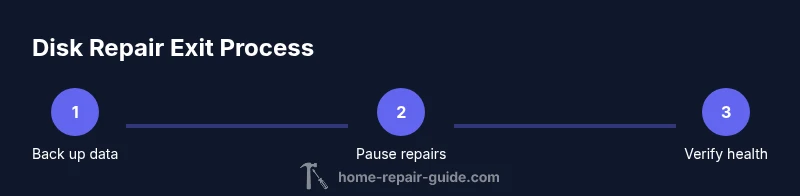
To exit repair mode safely, pause automated repair tasks and prevent automatic restarts from triggering again. Power down any ongoing repair utilities if safe to do so, then disconnect the disk if necessary and use a clone or image to preserve current data. Next, assess the disk health using SMART data and cross-check with vendor tools; if the health indicators are uncertain or the drive exhibits bad sectors, proceed to data migration rather than repair. If you must continue with repairs, limit automatic repairs to non-destructive checks, and document each action for later review. Ensure you have restored power stability and avoided sudden shutdowns, which can worsen data corruption. Finally, evaluate whether to replace or repurpose the disk. Exit decisions should be described in a clear plan, including contingency steps if data loss occurs.
Verifying results after exiting repair mode
After stepping out of the repair loop, run a focused health check to verify that the drive remains readable and that no new errors have appeared. Validate the integrity of important files by attempting selective restores or by reading test files from the backup image. If you chose to migrate data, confirm that all critical items are accessible on the new storage. Monitor the system for a few days to catch intermittent failures that may not be immediately evident. If any signs of instability recur, escalate to a hardware replacement plan rather than retrying repairs. The goal of this phase is to ensure you have a stable, recoverable environment and a clear record of decisions.
Preventive maintenance to reduce disk errors
Routine preventive maintenance reduces the likelihood of future disk errors. Schedule regular health checks, enable SMART monitoring alerts, and keep firmware and drivers up to date. Maintain a robust backup strategy and test restores periodically. Practice safe shutdowns and avoid heavy disk activity on unstable power supplies. Use a cooling solution for laptops and desktops to help the drive operate within recommended temperatures. Finally, create a simple maintenance checklist that your household can follow, so you’re not caught off-guard by a deteriorating storage device.
Authority sources and further reading
Foundational guidance on data integrity and storage health can be found in reputable sources. For readers who want to dive deeper, see the following references: • NIST (nist.gov) provides general guidelines for data integrity and storage reliability. • MIT (mit.edu) offers insights into hardware reliability and diagnostics. • CMU (cmu.edu) discusses general best practices for maintaining digital storage and ensuring safe data handling.
Tools & Materials
- External backup drive(At least 1 TB, USB 3.0 or USB-C)
- SATA-to-USB adapter or dock(To connect internal drives externally if needed)
- Compatible computer with admin access(Administrator privileges for run diagnostics)
- Disk health utilities (SMART tools)(CrystalDiskInfo, smartmontool, or vendor utility)
- Disk cloning software(Optional if you need a clone image)
- Anti-static wrist strap(Keep to prevent ESD when handling drives)
- Phillips screwdriver set(Only if your model requires opening a drive or enclosure)
Steps
Estimated time: 60-90 minutes
- 1
Assess the current state
Identify the exact symptoms, review recent changes, and note any ongoing repair prompts or error codes. This step sets a safe boundary for what you can and cannot repair. A clear assessment helps you decide whether to exit now or continue with caution.
Tip: Document initial symptoms and save screenshots or logs for reference. - 2
Back up critical data
Create a full image backup if possible, or at least copy essential files to a separate drive. Prioritize irreplaceable items and test the backup by attempting a restore on a different device if you can.
Tip: Use read-only modes when possible to avoid altering the source disk. - 3
Pause automation and isolate the disk
Temporarily halt automatic repair tasks and disconnect the disk if safe to do so. Isolating the drive prevents further writes during exit and protects your backup.
Tip: If you must keep it connected, turn off automatic repairs in the software settings. - 4
Run health checks and interpret results
Use SMART data and vendor utilities to gauge health. Look for reallocated sectors, pending sectors, and changes since the last check. Correlate findings with backup status to decide next steps.
Tip: Cross-check results with at least two different tools for consistency. - 5
Decide to exit or continue repairs
Based on health data and data protection status, decide whether to exit repair loops or proceed with limited, non-destructive repairs. Document the rationale for future reference.
Tip: When in doubt, prioritize data preservation and plan a controlled exit. - 6
Exit repair mode safely
If you choose to exit, close all repair utilities gracefully, and ensure the system remains powered during the exit to avoid corruption. Reconnect to monitor behavior.
Tip: Avoid abrupt power-offs; they can worsen data integrity. - 7
Verify data integrity and monitor
After exiting, perform targeted file checks and observe for any new errors. Schedule ongoing health monitoring to catch intermittent issues early.
Tip: Set SMART alerts and a routine check cadence. - 8
Document and plan next steps
Record decisions, backup status, and health results. Decide whether to replace, repurpose, or continue with maintenance based on risk tolerance.
Tip: Create a monthly maintenance checklist to reduce future surprises.
FAQ
What does disk repair actually do, and why might it stall?
Disk repair tools try to fix logical issues and bad sectors, but they can stall when the drive is failing. When this happens, it’s safer to back up, assess health, and consider migration rather than forcing repairs.
Disk repair attempts to fix problems, but stalling means you should back up and re-evaluate before proceeding.
Is it safe to unplug a drive during repair?
Unplugging a drive mid-repair can cause data corruption. If you must pause, use the software to safely pause tasks and power down the device gracefully.
Avoid unplugging during repair. Pause tasks and shut down gracefully if needed.
How do I back up if the drive is failing?
Use cloning or imaging tools that can handle bad sectors. If a full clone isn’t possible, back up the most critical files first and test the backup.
If the drive is failing, clone what you can and restore tests later.
What is SMART and should I trust it?
SMART gives indicators of drive health but isn’t foolproof. Use SMART data with other checks and consider manufacturer tools for confirmation.
SMART helps gauge health, but use it alongside other checks.
When should I replace the drive instead of repairing?
If SMART shows ongoing degradation, reallocation, or frequent errors despite attempts, plan a replacement to avoid data loss.
Replace if health keeps deteriorating; repairs may just be delaying the inevitable.
Can I repair disk errors myself without help?
Basic diagnostics and backups can be done by most homeowners, but complex failures often require professional service to avoid data loss.
You can do basic checks, but for serious issues, consider professional help.
Watch Video
Key Takeaways
- Back up data before exiting repair loops
- Pause automated repairs to assess health safely
- Use multiple health checks to verify disk status
- Migrate data when disk health is questionable
- Document all steps for accountability and future planning