Can You Repair Run-Flat Tires? A Practical, Safe Guide
Discover if run-flat tires can be repaired, when replacement is safer, and how to assess damage. This Home Repair Guide tutorial covers guidelines, safety, and cost considerations for motorists.


You generally cannot safely repair a run-flat tire once it's damaged; most auto manufacturers and tire shops recommend replacing the tire. Some punctures in the tread area might be repaired by a trained tech following strict guidelines, but this is less common and depends on tire model and damage.
What run-flat tires are and how they work
Run-flat tires are designed to let you continue driving after a puncture by supporting the vehicle's weight with reinforced sidewalls or an internal support ring. Depending on design, some can run for a limited distance at low speeds, while others require immediate service. This feature offers temporary mobility but comes with trade-offs: stiffer ride, higher replacement cost, and sometimes limited repair options. Understanding the basics can help homeowners decide when to pursue an in-depth assessment or a straight replacement. According to Home Repair Guide, understanding the core design helps you decide whether a repair is worth pursuing. The Home Repair Guide team found that run-flat tires vary by model and manufacturer, and not all damage qualifies for repair. In practice, many drivers view run-flats as a temporary solution that reduces the risk of a roadside change, but the way the tire behaves after a puncture matters for safety and future performance.
Can you repair run-flat tires? What the rules say
The short answer is: it depends, but safety chiefs and manufacturers lean toward replacement as the safer default. Car makers often avoid encouraging repairs to the run-flat structure due to the risk of undetected internal damage, patch failures, or compromised tire integrity. Reputable repair shops may perform a tread-only repair if the puncture is in the center of the tread and the sidewall remains undamaged, but this is not universally allowed. If a puncture is located on the sidewall or shoulder, or if there is any visible bulge, crack, or excessive wear, repair is not recommended. Always verify with the tire manufacturer and vehicle owner’s manual. The takeaway for homeowners is to err on the side of caution and plan for a replacement if any doubt remains. This conservative approach helps preserve safety, vehicle handling, and insurance considerations.
Damage assessment: puncture, sidewall, and tread considerations
Before deciding, perform a careful visual inspection and temperature check after a drive. Punctures in the tread area may be candidates for repair if there is no damage to the outer belt or sidewall, and the object that caused the puncture is removed. Sidewall damage, bulges, or a red flag like nylon cords showing through require tire replacement. Also look at tread depth; if it is below the recommended minimum (usually around 2/32 inch), replacement is safer regardless of puncture location. Checking the tire's history through the vehicle’s maintenance log can reveal prior repairs that may affect current options. Remember, run-flat tires may have a different warranty or replacement policy than conventional tires, so consult the manual and dealer if you’re unsure.
Repair feasibility: when, where, and how repairs are considered
If a repair is considered feasible, a trained technician at a certified shop will typically perform a tread repair under strict guidelines: they inspect for damage depth, repair within the design limits, and use approved techniques such as pressure testing and patching. The repair must not be on a damaged belt or crown, and the tire must be within the repairable distance from the puncture. The manufacturer may prohibit repairs on run-flat tires in some models, in which case the technician will refuse the repair and recommend replacement. Always prioritize the vehicle’s safety and manufacturer guidelines when making decisions.
Replacement vs repair: cost, safety, and vehicle policy
From a cost perspective, replacing a run-flat tire is a common outcome; prices vary by model, and many vehicles require a full set to maintain balanced handling. Safety often outweighs cost; even if a single tire seems repairable, manufacturers may require tire replacement to maintain warranty coverage or road-hazard protection. Vehicle policy can also influence decision; some insurers require intact tires for coverage. For homeowners, the decision should factor in long-term performance, suspension wear, and resale value. While repairs may lower upfront costs, the long-term reliability and safety of a repaired run-flat tire can be a deciding factor.
DIY vs professional service: what you can and cannot do
It is not recommended for typical homeowners to attempt in-depth repairs on run-flat tires. Dismantling tires or performing self-patch repair without proper equipment can cause hazardous failures. If you plan to try a patch, use only manufacturer-approved repair kits and avoid DIY shortcuts that compromise the tire’s designed safety features. Always schedule a professional inspection if you notice abnormal vibrations, noise, or steering pull. The safest path for most homeowners is to rely on a certified tire shop with experience in run-flat technologies.
Manufacturer policy and insurance implications
Manufacturers explicitly state run-flat tires are intended to be used as designed and repaired only under specified conditions. When in doubt, consult dealer guidelines and warranty documents. Insurance implications may include reduced coverage if repairs are performed improperly or if a non-compliant tire is used. Having documented professional assessments helps preserve coverage and demonstration of due care. For peace of mind, verify both the vehicle warranty and your insurer’s stance before proceeding with any repair or replacement.
What to do if you have a flat with run-flat on the road
If you experience a puncture while driving, gradually reduce speed, avoid hard braking, and use the vehicle's recommended driving distance and speed. Pull to a safe location, check the tire quickly, and call for roadside assistance if you cannot safely proceed. Carrying a spare or having a plan for professional service is crucial; do not attempt risky repairs on the roadside. If your manufacturer permits a temporary repair, schedule a repair as soon as possible to prevent further damage and ensure safe vehicle operation.
Authority sources
- NHTSA (National Highway Traffic Safety Administration): tire safety and inspection guidelines. https://www.nhtsa.gov
- Consumer Reports tire buying and safety guidance. https://www.consumerreports.org
- FTC consumer information on product safety and vehicle maintenance. https://www.ftc.gov
Tools & Materials
- Tire pressure gauge(Accurate pressure check before and after any service)
- Owner's manual(Refer to model-specific run-flat guidelines)
- Lug wrench(For removing the wheel if needed)
- Car jack(Stable support for wheel removal)
- Torque wrench(Ensure correct lug torque on reinstallation)
- Tire repair kit (approved for run-flats)(Only use manufacturer-approved kits)
- Safety gloves(Protect hands during inspection)
- Flashlight(Inspect tread depth and sidewalls in low light)
- Wheel chocks(Prevent rolling when jacking)
Steps
Estimated time: 60-180 minutes
- 1
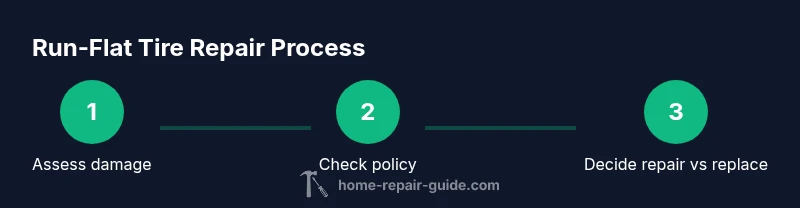
Assess the damage safely
Park on a level surface and turn on hazard lights. Check for visible punctures, bulges, or sidewall damage without touching hot components. This initial check helps decide if a roadside repair is even possible.
Tip: If you suspect sidewall damage, do not attempt to drive farther; call for assistance. - 2
Check the puncture location and severity
Inspect the tread area for a penetrating object and measure the depth of the puncture. If the damage is near the sidewall or exceeds certain depth thresholds, repairs are unlikely to be approved.
Tip: Note the puncture size and location for the shop; photos can help with quick assessment. - 3
Consult manufacturer guidelines
Refer to the vehicle’s manual or the tire manufacturer’s policy. Some run-flat models expressly prohibit repairs, while others may allow tread-only repairs under strict conditions.
Tip: If in doubt, contact the dealer or a certified tire technician before proceeding. - 4
Decide on repair vs replacement
Based on damage assessment and guidelines, decide if a repair is feasible. If not, plan for a full replacement to maintain safety and warranty coverage.
Tip: Prioritize safety over saving money when damage is uncertain. - 5
Visit a certified tire shop
Bring the tire to a shop that has experience with run-flat technology. They will perform a professional inspection and, if approved, a standardized repair.
Tip: Ask for a written assessment and the repair method used. - 6
Have the repair or replacement completed
If a repair is approved, ensure it is performed with approved materials and tested for leaks. If replacement is required, replace in full or as advised by the manufacturer.
Tip: Keep a maintenance receipt for warranty and insurance records. - 7
Document the outcome
Update vehicle maintenance records to reflect the tire repair or replacement. This helps future maintenance and warranty claims.
Tip: photographed documentation can be useful for insurance claims. - 8
Plan for the future
If you replaced a tire, check the remaining tires for wear and rotate per the vehicle’s schedule. Consider upgrading all tires for even wear and consistent handling.
Tip: Avoid mixed-tire setups with different wear levels.
FAQ
Can run-flat tires be repaired after a puncture?
Repair feasibility depends on puncture location and tire model. Sidewall damage generally requires replacement; tread-only repairs may be possible in rare cases with manufacturer approval. Always defer to a certified technician.
Repair depends on where the puncture is and the tire model. Sidewall damage usually means replacement; tread repairs are sometimes allowed with approval. Always consult a professional.
What factors determine if a run-flat tire can be repaired?
Damage location (tread vs sidewall), depth of puncture, tire model, and whether the repair complies with manufacturer guidelines all determine repair viability.
Repair viability depends on where the damage is, how deep it is, and the tire model per the manufacturer.
Are repairs on run-flat tires risky?
Yes. Repairs can hide internal damage, compromise structural integrity, or invalidate warranties if not done correctly. Professional assessment is essential.
Repairing run-flats can be risky if not done properly. Get a professional assessment to avoid hidden damage.
What should I do if I’m unsure about repair viability?
If uncertainty remains, replace the tire and consult your dealer or tire maker for guidance. A professional inspection can prevent unsafe driving.
If you're unsure, replacement is safer. Get a professional opinion before driving further.
Does insurance cover run-flat tire replacement?
Insurance coverage varies by policy. Documentation of professional assessment helps support claims; check with your provider for specifics.
Insurance depends on the policy; keep documentation from a professional assessment.
When should I replace all run-flat tires?
If one tire is damaged beyond repair, replacement of the affected tire is common, and you may need to replace the others to maintain balanced handling.
If one tire can't be repaired, often you replace the affected tire and consider the others for balance.
Watch Video
Key Takeaways
- Run-flat tires require careful assessment after damage.
- Repair feasibility depends on location and model; replacement is common.
- Always consult a certified shop and manufacturer guidelines.
- Document maintenance actions for warranties and insurance.