What You Need to Repair Drywall: A Practical Guide
Learn the exact tools, materials, and steps to repair drywall safely and durably. From assessment to paint finish, this Home Repair Guide tutorial helps homeowners achieve reliable DIY fixes.


To repair drywall, you’ll identify the damage, gather essential tools and materials, patch the hole with tape and joint compound, sand smoothly, and finish with primer and paint. Start with small repairs for cosmetic holes, then scale up for larger damage by using backing and longer mud coats. Expect a few drying intervals between coats for a durable finish.
Understanding drywall damage and when repairs are necessary
Drywall is durable, but it isn’t invincible. Nail pops, small holes from doors or furniture, and hairline cracks from framing movement are common, especially in older homes. Water stains from leaks can lead to soft, crumbly patches that deteriorate if not treated. Before grabbing tools, assess the scope: cosmetic repairs may be enough for tiny holes, while larger damage may require a patch and backing. The Home Repair Guide team notes that proper patching reduces repainting and yields a more durable finish. If you observe structural signs like sagging panels, warped boards, or persistent moisture, stop and seek a professional assessment. In most cases, you’ll start with a clean area, remove loose material, and choose a patch system that matches the hole size. Drying times and texture influence the final look, so plan accordingly. With a clear plan, you can restore a seamless surface without broad wall replacement.
Planning your drywall repair: safety, scope, and timeline
Start with safety: wear a dust mask, eye protection, and gloves. Seal off the area with plastic sheeting to minimize dust spread. Determine the repair scope by hole size and moisture risk; cosmetic fixes for small nail holes or dents, vs. structural patches for larger breaches or water damage. Prepare a timeline that includes drying times between coats. According to Home Repair Guide, laying out steps and materials beforehand reduces on-the-fly decisions and speeds up the project. If moisture is present, address sources first to prevent recurrence. Finally, set up proper ventilation and protect floors with drop cloths. If the project grows beyond a small patch, you may save time by cutting a new drywall piece and securing backing. A planned approach reduces frustration and helps you achieve a durable, nearly invisible repair.
Patch options and when to use them
There are several patch methods for drywall, each suited to different hole sizes and contexts. For small holes (1/2 inch to 2 inches), paper or mesh tape with a thin layer of joint compound usually suffices. For larger holes, install a backing piece behind the hole (like a scrap of drywall), then cover with patch and mud. For long cracks or dented areas, a patch with compound can work if you prefer not to replace the entire sheet. When patches are dry, sand evenly to create a flush surface that blends with surrounding texture. Finally, consider texture matching options (spray texture, knockdown, or stipple). The goal is a durable repair that matches the room’s finish and feels seamless to the touch.
The repair process in simple terms
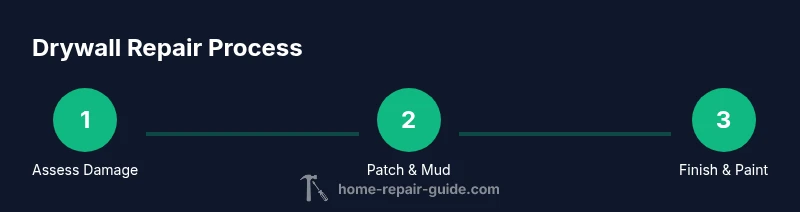
Repairing drywall boils down to four steps: 1) prepare the area and remove loose material, 2) apply patch and mud in thin layers, 3) sand to a smooth, flush finish, 4) prime and paint to blend with the wall. Start with a clean edge around the damaged zone, then apply tape to hold the patch in place. Build up mud in thin layers, allowing each coat to dry before the next. Sand lightly between coats to keep edges feathered. Finish with primer to seal the patch and match paint adhesion. Take your time with texture matching for the best visual result.
Finishing textures and paint to blend seamlessly
Texture is a key part of a seamless repair. If the surrounding wall has a knockdown, orange peel, or stipple texture, practice on a scrap piece of drywall to mimic the finish before applying it to the repaired area. After the final mud coats have dried and are sanded smooth, apply a stain-blocking or universal primer. Then brush or roll paint to blend with neighboring panels. Feather edges slightly beyond the repaired zone to avoid hard lines. If you’re unsure about color, test paint chips on a hidden area before committing to the whole wall.
Safety, cleanup, and best practices
Dust control is essential. Keep plastics sealed and vacuums running while sanding. Wear a dust mask and eye protection; drywall dust can irritate the respiratory system. Work in a well-ventilated space and take breaks to avoid fatigue. After finishing, wipe down surfaces, store tools properly, and dispose of dust and trim waste according to local guidelines. Clean up helps prevent debris from falling onto furniture and floors, and it minimizes the risk of subsequent damage to your repaired area.
Data-backed guidance from Home Repair Guide
According to Home Repair Guide, following a structured patching workflow improves long-term durability and finish quality. Our analysis emphasizes planning, proper patch sizing, and controlled mud applications as core drivers of success. By prioritizing safety, ventilation, and texture matching, homeowners can achieve professional-looking results with standard DIY tools.
Common mistakes to avoid
Common pitfalls include using too much mud in a single coat, skipping tape on larger patches, sanding too aggressively, and neglecting drying times. Rushing patches can cause cracking and visible ridges. Always dry between coats, test texture, and ensure the area is clean before priming. Finally, avoid painting over damp mud; give it adequate time to cure for a durable finish.
Tools & Materials
- Joint compound (premixed or powder)(Choose lightweight or all-purpose for feathering)
- Drywall tape (paper or fiberglass mesh)(For patches up to 8x8 inches)
- Drywall patch or backing material(Backing for larger holes; patch for small holes)
- Drywall knife(s) 6-inch and 10-inch(Use flexible steel blades)
- Putty knife / mud knife(For applying mud and shaping edges)
- Mud pan(Aids in mud application)
- Sandpaper (120-180 grit)(Feather edges; avoid deep gouges)
- Sanding block or pole sander(Keeps sanding even)
- Drywall saw or utility knife(Cut damaged drywall cleanly)
- Primer and interior paint(Finish and color-match)
- Dust mask and safety goggles(Protect from dust and debris)
- Drop cloths and plastic sheeting(Contain mess and protect surfaces)
- Stud finder (optional)(Useful for backing and mounting if needed)
Steps
Estimated time: 2-3 hours
- 1
Assess damage
Identify hole size, moisture risk, and whether backing is needed. Document areas that will require patching and decide if texture matching will be necessary for a seamless look.
Tip: Take photos for reference; plan patch size around 2–4 times the hole for a stable patch. - 2
Prepare the workspace
Clear the area, remove loose material, and lay down drop cloths. Set up ventilation to reduce dust exposure and protect nearby surfaces.
Tip: Cover floors and furniture; keep a trash bag handy for debris. - 3
Cut away damaged drywall
Use a sharp utility knife or drywall saw to trim back to clean, straight edges. Create a rough perimeter to accept the patch backing.
Tip: Keep blades sharp and cut at a slight angle to prevent ragged edges. - 4
Apply patch with mud and tape
Place patch backing if needed, apply tape over seam, then spread mud in thin, even coats. Build up layers gradually.
Tip: Always work in thin coats; avoid creating thick ridges that require extended sanding. - 5
Sand and feather
Sand the patch smoothly, blending edges into the surrounding wall. Wipe away dust between passes and ensure a flush finish.
Tip: Wear a mask and use light pressure to avoid gouging. - 6
Texture match and prime
Match the wall texture with appropriate spray or hand-applied techniques. Apply primer to seal mud and ensure uniform paint adhesion.
Tip: Test a small area first to fine-tune texture and paint color. - 7
Paint and cleanup
Paint the patched area to blend with the rest of the wall. Clean tools and dispose of debris responsibly.
Tip: Feather paint slightly beyond the patch to avoid sharp edges.
FAQ
What basic tools do I need to repair drywall?
You’ll typically need a putty knife, joint compound, tape, sandpaper, a drywall saw, and primer and paint. A sanding block and dust mask are also helpful for dust control.
Gathers a putty knife, joint compound, tape, sandpaper, a drywall saw, and primer and paint. A sanding block helps, and wear a dust mask.
Can I repair a drywall hole without replacing drywall?
Yes, small to medium holes can be patched with tape and mud. Larger holes often need backing material and a proper patch.
Yes, small holes can be patched with tape and mud; large holes may require backing.
How long does drywall mud take to dry?
Drying times depend on mud thickness and humidity. Plan for several hours between coats and a longer cure period for thicker applications.
Drying times depend on thickness and humidity; allow several hours between coats.
What finishes match drywall textures?
Texture can be matched using spray textures or hand-applied techniques like knockdown or stipple. Practice on scrap first.
Match texture with spray or hand techniques; practice first.
Is sanding drywall dangerous?
Yes, sanding creates dust. Use a mask, goggles, and work in a well-ventilated area to protect your lungs and eyes.
Sanding creates dust; wear PPE and ventilate.
Do I need to prime drywall before painting?
Yes, priming seals the mud and improves paint adhesion. Wait for mud to dry completely before priming.
Prime after patching for best adhesion.
Watch Video
Key Takeaways
- Assess damage to choose the repair approach
- Gather essential tools and materials before starting
- Patch holes using the right method by size
- Let each mud coat dry completely before sanding
- Prime and paint to match surrounding drywall