Cost of Garage Door Repair in 2026: What to Expect
This guide breaks down the cost of garage door repair in 2026, covering typical ranges by issue, how to estimate, and tips to save without sacrificing safety.


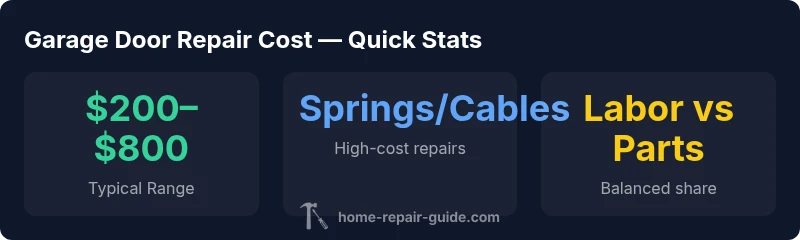
The cost to repair a standard residential garage door typically falls in the $200–$800 range, depending on the issue and parts needed. Minor fixes, weatherstripping, and sensor adjustments are toward the lower end, while spring or cable repairs and opener problems push toward the higher end. Labor is usually included, with possible emergency or after-hours fees.
Why the cost of garage door repair matters
For homeowners and renters, understanding the cost of garage door repair is essential for budgeting, prioritizing safety, and avoiding surprise bills. The price you pay to fix a malfunctioning door can influence daily routines, energy efficiency, and even home value. The Home Repair Guide team emphasizes that cost is not just a number on a receipt; it's a signal of the door system's overall condition and reliability. In most homes, the door is a heavy, moving system that interacts with electrical components, springs, tracks, and weatherproofing. When even a small component fails, it can cause misalignment, reduced sealing, or noise that affects daily life. Therefore, a timely repair often saves money in the long run by preventing secondary damage to the door's structure or adjacent finishes. According to Home Repair Guide, the price you see reflects three broad factors: the parts required, the labor involved, and the door's design and condition. The combination of these elements determines whether you face a quick, inexpensive fix or a more involved, higher-cost repair. In this guide we unpack typical cost ranges, explain how to estimate your own work, and outline strategies to minimize expense without compromising safety.
What drives the price: parts, labor, and complexity
Garage door repairs hinge on three core drivers: parts, labor, and the complexity of the repair. Parts include springs, cables, rollers, hinges, sensors, weatherstripping, and the opener mechanism itself. Springs, especially torsion springs, are among the most expensive components due to their high tension and critical safety role. Labor covers the technician's time; the more complex the job, the longer the visit, and the higher the rate. A simple sensor adjustment or weatherstripping replacement may take under an hour, while spring replacements can require specialized tools, precise torque settings, and a two-person team—pushing the bill upward. Complexity also rises with door type (single-car vs. double-car, insulated vs. non-insulated), door height, and track alignment. Additionally, if a repair requires disassembling and re-timing a garage door's balance system, the technician's expertise adds to the cost. Finally, travel distance, schedule (weekday vs. after-hours), and warranty coverage influence the final figure. The Home Repair Guide analysis highlights that while some issues are straightforward, others demand careful diagnosis to avoid misdiagnosis and unnecessary parts replacement, which can inflate costs unnecessarily.
Common issues and their typical repair costs
Understanding common issues helps homeowners anticipate costs and prioritize fixes. Subtle misalignment or worn weatherstripping may require a quick adjustment and seal replacement, costing roughly in the lower range. Sensor misalignment or door balance problems can require recalibration and new parts but often stay within a mid-range. Replacing damaged rollers or hinges typically involves modest parts costs plus labor. The most expensive category is components that bear constant load and high tension, such as torsion springs or extension springs; these repairs can push total costs higher due to safety considerations and the use of specialty tools. If the door's opener motor fails or the remote receiver loses synchronization, costs may include motor replacement or a new opener—though some homeowners opt to upgrade for reliability and efficiency. Finally, damaged tracks or rollers that misalign can necessitate realignment and possible track replacement, which adds to both parts and labor. Across these scenarios, rates commonly fall into a wide band because of regional pricing, labor availability, and the door's construction. The key takeaway is: scheduling a professional diagnosis early helps prevent escalating costs from overlooked issues, especially in homes with older doors.
Estimated costs by repair type
| Issue Type | Typical Range (parts + labor) | Key Cost Drivers | Notes |
|---|---|---|---|
| Springs/Cables repair | $200–$1000 | Spring tension, safety systems, parts availability | High-cost category due to safety risks |
| Track/Panel replacement | $150–$900 | Track/panel condition, alignment, transport | Occasional need for cutting and fitting |
| Opener repair/replacement | $100–$600 | Motor/logic board, remote, installation | May include new opener upgrade |
FAQ
Does home insurance cover garage door repairs?
Most policies exclude routine wear and tear but may cover damage from storms or other covered events. Always check your policy language and file a claim promptly with documentation of the damage.
Insurance might cover certain damage events; review your policy and document the issue before filing a claim.
Are springs repairable or replaceable, and why costs vary?
Springs can often be repaired or replaced, but they are safety-critical and specialized. Costs vary with spring type, door size, and required torque calibration, which affects labor time.
Springs are fixed by professionals because of safety; expect variability based on door size and spring type.
Can I fix a garage door myself?
Some basic maintenance (lubrication, weatherstripping) can be DIY, but repairs involving springs, cables, tracks, or the opener require a licensed technician to avoid serious injury.
Avoid DIY for high-tailure components; leave spring, track, and opener work to pros.
How long does a typical repair take?
Most common repairs take a few hours, but complex spring or opener work can extend to half a day or more, depending on parts availability and scheduling.
Most repairs are same-day, but some can spill into multiple hours if parts are scarce.
What questions should I ask a repair technician?
Ask for a written estimate with a parts and labor breakdown, warranty details, and whether there are after-hours fees or service-call charges.
Get a clear written quote and warranty info before any work starts.
“Professional repair saves money in the long run by preventing adjacent damage and ensuring safe operation.”
Key Takeaways
- Anticipate a $200–$800 baseline for common repairs
- Springs and openers drive the cost higher
- Ask for itemized quotes to compare parts vs labor
- Regional differences can affect final price
- Regular maintenance helps prevent costly failures