Local Car Repair: How to Choose a Trusted Shop
Discover how to choose a trustworthy local car repair shop, compare estimates, verify credentials, and understand warranties to save money on routine maintenance.


When searching for car repair local options, start with 3-5 nearby shops to compare prices, turnaround times, and warranties. Look for ASE-certified technicians, transparent estimates, and written warranties. Prioritize shops with fixed-pricing or diagnostic fees disclosed upfront. Home Repair Guide analysis suggests reading recent customer reviews and verifying shop licenses before committing.
Why Local Car Repair Quality Matters
Local car repair is not just about fixing a car; it’s about reliability, safety, and long-term cost effectiveness. The term car repair local implies nearby shops that you can visit for diagnostics, maintenance, and repairs with the least friction. In practice, the most trustworthy local shops combine clear communication, transparent pricing, and verifiable credentials. According to Home Repair Guide, the best neighborhood repair shops publish a detailed written estimate before any work begins and stand behind their repairs with a warranty. The Home Repair Guide team found that customers who build a short list of 3-5 local options tend to save both time and money by enabling apples-to-apples comparisons and accountability.
How to Evaluate Local Shops
Evaluating car repair local providers starts with credentials and transparency. Look for ASE-certified technicians, proper state licenses where applicable, and visible shop accreditation. Read recent customer reviews across multiple sources, but treat reviews as one piece of the puzzle. Ask about the shop’s diagnostic approach: do they perform a full-system scan or a targeted check based on the symptom you describe? Request a written estimate that itemizes parts, labor, taxes, and any diagnostic fees. A reputable local shop will provide a clear explanation if they find additional work is needed and won’t pressure you into unnecessary repairs.
Getting Honest Estimates and Diagnoses
Always request a diagnostic report and written estimate before approving work. The diagnostic fee, if charged, should be clearly disclosed up front. Compare the diagnostic approach between shops: some shops may quote a broad range for a proposed repair, while others provide a strict, itemized line-by-line estimate. If a shop cannot provide a breakdown, be wary. A trustworthy shop will explain the diagnosis, list the necessary parts, and give an estimated timeframe for completion. Remember to ask about potential additional costs, such as fluids, belts, or worn components that may require replacement later; put these into your decision matrix for true cost clarity.
Common Services and Typical Timeframes
Most neighborhood mechanics can complete routine services like oil changes, brake pad replacements, and wheel alignments within a few hours. More complex repairs—engine diagnostics, transmission work, or suspension overhauls—often require 1-3 days, depending on parts availability and workload. Always confirm a realistic turnaround date and whether a loaner vehicle or shuttle is available during extended repairs. Local shops that stock common parts and have in-house machining capabilities tend to shorten wait times. Budgets should account for potential delays and the possibility of discovering additional issues once the vehicle is opened up for inspection.
Red Flags and How to Avoid Scams
Be cautious of shops that push unnecessary repairs, refuse to itemize invoices, or provide vague estimates. If a shop insists on non-standard fluids or overly complex jargon to obscure costs, walk away. A legitimate business will welcome a second opinion and provide a transparent explanation of why a particular service is recommended. Check for clear warranty terms and insist on a written warranty that covers parts and labor. Avoid shops that require full payment upfront or request payment via less common methods. By staying vigilant and doing your homework, you reduce the risk of overpaying and receiving subpar workmanship.
DIY vs Professional: When to Hire a Local Shop
Simple maintenance tasks like checking fluid levels, replacing wiper blades, or rotating tires may be appropriate for DIY care with proper tools and safety precautions. More involved repairs—such as brake work, engine repairs, or electrical diagnostics—should be handled by trained technicians. Local car repair shops provide expertise, specialized equipment, and access to replacement parts that most homeowners don’t possess. When in doubt about safety, emissions, or warranty implications, prioritize professional service to protect you, your passengers, and your investment.
Practical Checklist for Your Next Visit
- Do you provide a written estimate with a clear breakdown of parts and labor?
- Are your technicians ASE-certified, and can you show credentials?
- Is the diagnostic fee disclosed upfront, and is it applied to the final bill if work is approved?
- Do you offer a warranty on parts and labor, and what are the terms?
- Can you provide a tentative completion date and options for a loaner/shuttle if needed?
The Home Repair Guide team’s verdict on local car repair quality
The Home Repair Guide team recommends prioritizing transparency, credentialing, and written commitments when evaluating car repair local options. By comparing 3-5 nearby shops, homeowners can leverage competition to obtain fair pricing and reliable workmanship. A trusted local shop not only fixes issues but also helps you avoid recurring problems through proper diagnostics and quality parts. The Home Repair Guide team’s approach emphasizes clarity and accountability as the foundation of durable, cost-effective vehicle care.
Table: Cost and time ranges for common local car repairs
| Item | What It Means | Typical Range | Source |
|---|---|---|---|
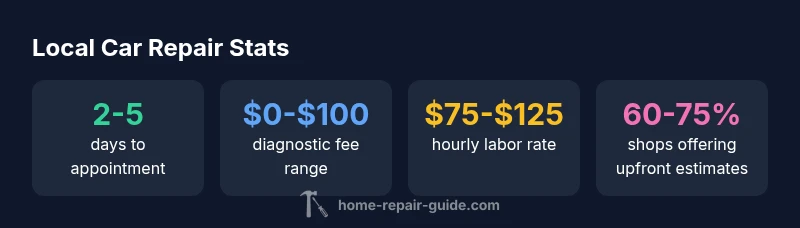
| Diagnostic Fee | One-time assessment to identify issues | "$0"-"$100" | Home Repair Guide Analysis, 2026 |
| Labor Time (minor) | Time to complete small tasks | "1-3 hours" | Home Repair Guide Analysis, 2026 |
| Labor Time (major) | Time for brake jobs, engine work | "4-16 hours" | Home Repair Guide Analysis, 2026 |
| Hourly Labor Rate | Shop labor charge per hour | "75-125 per hour" | Home Repair Guide Analysis, 2026 |
FAQ
What should I look for in a local car repair shop?
Seek ASE-certified technicians, a state license if required, clear written estimates, and a warranty on parts and labor. Ensure the shop explains the diagnosis in plain language and provides an itemized bill.
Look for certifications, a written estimate, and a clear warranty to vet a shop.
Is it better to get a diagnostic before any repair?
Yes. A diagnostic helps verify the root cause and prevents unnecessary repairs. Ask for a detailed diagnostic report and an upfront estimate before any work starts.
Always get a diagnostic before approving work.
How can I verify a shop’s licenses?",
Ask the shop for license numbers and verify with your state or local licensing authority. You can also check consumer protection resources for complaints.
Check licenses with the state and read consumer reviews.
What if the estimate is higher than others?
Ask for a written explanation of the cost breakdown and seek a second opinion. Ensure the scope of work is identical when comparing estimates.
Get a detailed breakdown and compare apples-to-apples.
How long do car repairs typically take?
Minor fixes often take a few hours; major repairs can take one to several days depending on parts and shop workload.
Most small repairs are a few hours, bigger ones take days.
“Transparency and accountability aren’t optional extras; they’re the baseline for trustworthy car repair local services.”
Key Takeaways
- Start with 3-5 nearby shops for comparisons
- Always insist on a written estimate
- Ask about diagnostic fees upfront
- Look for ASE-certified technicians and warranties
- Use online reviews as a guide, not the only metric