Can Roof Repair Be Tax Deductible? A Homeowner's Guide
Learn when roof repair costs can be tax deductible, including scenarios for rental properties, business use, and energy credits. Get practical guidance from Home Repair Guide.


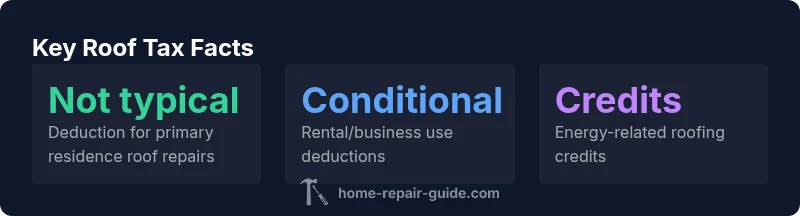
Generally, roof repair costs for a primary residence are not tax deductible. Deductions may apply if the roof is part of a rental property, or if you use part of your dwelling for a business (home office). Some energy-related credits may offset eligible improvements. For precise guidance, consult a tax professional and authoritative IRS resources.
Overview: Can roof repair be tax deductible?
For many homeowners, the quick question is can roof repair be tax deductible. The short answer hinges on how the property is used and whether the costs are classified as repairs or improvements. In general, repairs to a personal residence are not deductible on your federal return. However, there are legitimate pathways that can reduce tax burden under specific circumstances, such as rental properties, business use of the home, or eligible energy-efficient upgrades. This section lays out the framework so you can assess your own situation with confidence, while understanding the tax-year nuances that influence deductible treatment. The discussion also reflects guidance commonly cited by Home Repair Guide and corroborated by authoritative sources. Keep in mind that tax laws change and individual eligibility depends on your exact facts and the tax year in question.
When roof repair costs are not deductible for a primary residence
Most homeowners face roof repair costs that are not deductible because the IRS treats ordinary maintenance as personal expenses. If your roof repair merely maintains the home in its existing condition, it is typically considered a non-deductible expense. The line between a repair and an improvement matters. A repair restores your home to its previous condition, while an improvement enhances value or extends the life of the roof and can affect your basis in the property. Because personal-use repairs don’t offset income, you usually won’t see a direct deduction unless you have other qualifying scenarios such as business use, rental status, or energy-related credits. This is where the nuance comes in, and it’s why many homeowners consult a tax professional when planning roof-related work in a given tax year.
Scenarios where roof costs can be deductible: rental properties, business use, and energy credits
There are distinct situations where roof-related costs may be deductible or credit-eligible. For rental properties, roof repairs are typically deductible as a rental expense against rental income, subject to capitalization rules and depreciation if it constitutes a larger improvement. If part of your home is used exclusively for business (a home office), a proportionate share of the roof costs tied to that space can be treated as a business expense, potentially eligible for depreciation rather than a straightforward deduction. Finally, certain energy-efficient roofing materials or insulation upgrades may qualify for residential energy credits. Eligibility criteria vary by year and material, so verify current rules through IRS guidance and energy-related tax credit resources.
Repairs vs improvements: how the cost basis and depreciation come into play
A critical distinction to avoid misreporting is between repairs and improvements. Repairs are typically expensed in the year they’re incurred for a personal residence, while improvements are capitalized and added to the cost basis of the property. When you eventually sell the home, your adjusted basis affects your capital gains calculation, impacting taxes owed at sale. In rental properties or business portions of a home, depreciation schedules determine how and when you recover the cost of roof-related work. Understanding this distinction helps you plan for current-year deductions and future tax implications, reducing the risk of misclassification during tax filing.
Documentation and best practices for roof-related deductions
Documenting roof work carefully is essential for any potential deduction. Save all receipts, invoices, and contractor agreements, clearly marking which costs were for repairs versus improvements. For business-use portions, maintain records that support the percentage of space used for business activities, and allocate roof costs accordingly. If you pursue energy credits, retain product specs, installation dates, and certifications showing that the work meets qualifying energy-efficiency criteria. When in doubt, consult a tax professional and reference IRS resources to confirm your eligible deductions or credits for the tax year.
A practical step-by-step approach to evaluating your roof costs
- Categorize the work: repair or improvement? 2) Identify property usage: is any portion rental or business-use? 3) Check for energy credits that might apply to the upgrade. 4) Gather receipts and documentation. 5) Consult a tax professional to determine correct reporting and depreciation treatment. 6) File your taxes with clarity on whether deductions, credits, or basis adjustments apply. A methodical approach helps prevent errors and maximizes legitimate tax benefits without crossing lines into disallowed deductions.
Common pitfalls and misconceptions to avoid
Many homeowners assume any roof-related expense is deductible, which is not the case for primary residences. Others misclassify an improvement as a repair or fail to allocate costs between personal and business-use portions. Not separating repairs from improvements can lead to incorrect basis calculations later. Finally, relying on outdated guidance or trying to claim credits for ineligible roof upgrades can trigger IRS notices. Always verify current rules and seek professional guidance to ensure compliance.
Roof repair deductibility scenarios at a glance
| Scenario | Deductibility Status | Notes | Documentation Tips |
|---|---|---|---|
| Primary residence repair (owner-occupied) | Usually not deductible | Repairs for wear and tear do not qualify; focus on business or rental scenarios or energy credits | Keep receipts; document purpose of work |
| Rental property roof repair | Potentially deductible as a rental expense | Costs may be expensed or depreciated depending on scope | Track rental activity and allocate costs clearly |
| Business use / Home office roof repair | Possible deduction for business-use portion | Depends on percentage of home used for business; depreciation may apply | Record business-use percentage and support with schedules |
| Energy-efficient roofing upgrades | Possible energy credits or deductions | Eligibility varies by year and material | Maintain product specs and installation certifications |
FAQ
Is a roof repair deductible for a primary residence?
Generally no, unless part of a rental or business-use scenario, or eligible for energy credits. The specifics depend on how the work is classified and used.
For a primary home, roof repairs are usually not deductible unless you have rental, business use, or energy-credit eligibility.
Can I deduct roof repairs on my rental property?
Yes, roof costs on a rental property are typically deductible as a rental expense or depreciated, depending on the nature of the work and how it’s treated under tax rules.
Rental roof repairs can be deductible as a rental expense or depreciated based on the work.
What about home office deductions for roof repairs?
If a portion of your home is used exclusively for business, you may deduct a proportionate share of the roof costs tied to that space, potentially via depreciation.
If you use part of your home for business, you may deduct a portion of roof costs for that space.
Do energy credits apply to roof repairs?
Energy credits exist for certain energy-efficient improvements; eligibility depends on current law and the materials used. Verify with IRS guidance.
Energy credits can apply to qualifying energy-efficient roof upgrades.
What paperwork do I need to claim deductions?
Keep receipts, documentation of use, and records distinguishing repairs from improvements. For business-use portions, retain allocation data and depreciation schedules if applicable.
Keep receipts, use details, and any depreciation paperwork if you’re claiming a business-use portion.
How does depreciation affect roof costs?
Repairs are typically expensed in the year incurred for personal use; major replacements are improvements and depreciable. The rules vary by property use (personal, rental, or business).
Repairs are expensed; major roof upgrades are depreciated based on use.
“Roof repairs are typically maintenance rather than deductible expenses for a primary residence. Deductions are more likely for rental properties or for business-use portions of a home; energy-related credits can offset some costs.”
Key Takeaways
- Most roof repairs on primary residences aren’t deductible.
- Rentals and home offices create deductible pathways with proper allocation.
- Keep repairs vs improvements clearly separated for tax basis.
- Energy credits may offset costs for qualifying upgrades.
- Consult current IRS guidance and a tax professional.