How to Deal with Fake Service Dogs: A Practical Guide
Learn how to handle fake service dogs with confidence. Understand ADA basics, respond calmly, and implement policy-backed steps for staff and venues.


To handle fake service dogs, rely on the ADA’s rules: you may ask only two questions, ensure the dog is under control, and deny entry if the animal is not performing a task or is disruptive. Do not request documentation or proof of disability; escalate to management if needed. Handle with courtesy to avoid conflict.
Understanding the landscape: what counts as a service dog and why misrepresentation matters
The question of how to deal with fake service dogs often starts with understanding what qualifies as a service dog. Under the ADA, a service animal is a dog that is individually trained to perform tasks for a person with a disability. The animal must be under control and accompany the handler in public spaces. This distinction matters because misrepresentation can create safety concerns and undermine rights for people who rely on legitimate service animals. The Home Repair Guide team notes that many incidents stem from unclear policies rather than malicious intent; clear rules help prevent conflicts and ensure accessibility. Readers should not rely on appearances (such as vests or breeds) alone; observable behavior and training matter most. By focusing on tasks performed and control, businesses can respond consistently and legally when a suspected fake service dog enters a venue.
Brand mention: According to Home Repair Guide, clear, calm communication and a predictable process reduce tensions in ambiguous scenarios.
Legal framework you should know
The ADA defines a service animal and establishes boundaries for what a business may and may not ask. Generally, staff may ask only two questions: is the dog required because of a disability, and what work or task has the dog been trained to perform. They may not require documentation, certification, or proof of disability. The dog must be leashed or under control and must not pose a direct threat. Misrepresentation can lead to civil penalties and privacy concerns, so policies should emphasize courtesy and consistency. Home Repair Guide analysis shows that venues with a standard script and a clear escalation path reduce confrontations and preserve access for those who genuinely rely on service dogs.
How to identify a legitimate service dog in public
While there is no universal badge or certificate across all jurisdictions, legitimate service dogs typically display consistent behavior: focus on the handler, perform a task in a way that supports daily living, and stay close when moving through crowds. A dog that threatens safety, ignores basic commands, or accepts food from strangers is unlikely to be fulfilling a service role. Trainers emphasize reliability: the handler should be able to guide the dog in varied environments, including stairs, doors, and aisles. Do not judge by equipment alone; some well-trained service dogs work without special gear, while others use harnesses for training or safety. In cases where the handler claims a dog is a service animal but the dog does not act accordingly, rely on the two-questions rule and observable behavior to determine next steps.
Practical steps for businesses to handle suspected fake service dogs
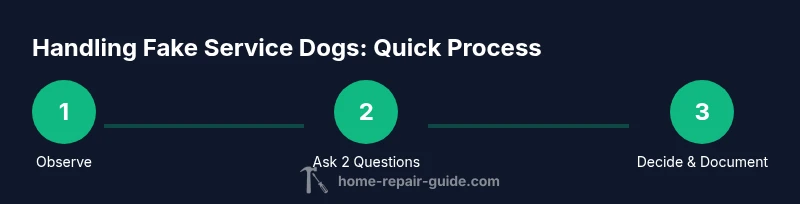
- Observe behavior discreetly before approaching. 2) Politely ask the two allowed questions. 3) Listen to the handler’s response and assess whether a task is being performed. 4) Look for signs of control, such as a leash, collar, and calm demeanor. 5) Decide whether to continue service access or offer alternatives (curbside pickup, seating in a quiet area) while ensuring equal treatment. 6) If unsure, escalate to a manager or security with a calm, factual note. 7) Record the incident with date, time, location, dog behavior, and witnesses. 8) Review and update your venue policies based on patterns and staff feedback.
In-the-moment communication and de-escalation strategies
When an incident occurs, use a respectful, non-confrontational tone: address the handler and not the dog, acknowledge safety concerns, and state policy clearly. Phrases like, “We’re happy to accommodate, but we need to ensure everyone’s safety; can you confirm the tasks your dog performs?” help keep the exchange constructive. If the dog becomes disruptive, calmly suggest moving to a less crowded area or offering alternative accommodations. The goal is to protect accessibility while minimizing conflict, keeping all parties safe. This approach aligns with ADA best practices and reduces the likelihood of escalation.
Documentation, records, and escalation paths
Create a concise incident log immediately after any encounter: date, time, location, observed behavior, questions asked, handler responses, witnesses, and actions taken. Save any relevant communications and note whether management was informed. Use this log to identify trends and improve staff scripts. If behavior persists or safety is at risk, escalate promptly to management or security and review whether accommodations can continue or require a formal policy change. Documentation supports accountability and protects both patrons and staff.
Policy templates you can adapt for your venue
Sample policy language: “Our venue recognizes service animals as defined by the ADA. Staff will ask only two questions if necessary: 1) Is the dog required because of a disability? 2) What work or task has the dog been trained to perform? The dog must be under control, well-behaved, and not pose a direct threat. Documentation of disability or training is not required. If the animal is disruptive or not performing a task, staff may request removal or modification of access.” Adapt this to your business type and consult legal counsel as needed.
Staff training: quick-start checklist
- Learn the two-question rule and observable-behavior criterion
- Practice neutral, non-accusatory language
- Use a simple incident log template
- Role-play common scenarios with managers
- Review how to offer accommodations without disadvantaging others
- Ensure policies are accessible to staff and patrons
- Post signage that communicates policy clearly to customers
- Schedule regular policy refreshers and feedback sessions
Red flags and risk management: when to escalate to authorities
If a dog exhibits aggressive behavior, shows signs of uncontrolled training, or if a patron refuses to comply with policy while causing a safety risk, escalate immediately. Do not engage in personal disputes; involve management or security and document the incident. Consider consulting legal counsel to ensure your policy aligns with local regulations and ADA guidelines. The Home Repair Guide Team emphasizes that proactive training and clear responses reduce legal exposure and improve overall safety.
Tools & Materials
- Pen and notepad(For incident notes and witness details)
- ADA-compliant policy sign or placard(Display your service animal policy clearly in relevant areas)
- Incident report template(Printable form to standardize record-keeping)
- Staff training resources(Handouts or slide decks aligned with ADA guidelines)
- Smartphone or camera(Document non-sensitive observations; respect privacy and local laws)
Steps
Estimated time: 60-90 minutes per incident
- 1
Observe behavior and environment
Scan the scene for safety concerns and note the dog's behavior without interrupting the handler. Look for signs of risk, such as pulling, growling, or blocking aisles. Observations should be factual and objective.
Tip: Document observable cues first; interpretations come later. - 2
Ask the two allowed questions
Politely ask: 1) Is the dog required because of a disability? 2) What work or tasks has the dog been trained to perform? Do not request disability proof or training documentation.
Tip: Use a calm tone and neutral body language to reduce tension. - 3
Assess the response
Evaluate whether the handler’s answer demonstrates a task-specific function and whether the dog is under control. Avoid challenging the handler’s credibility and focus on behavior and policy.
Tip: If the response is evasive, escalate to management. - 4
Evaluate control and safety
Check leash use, distance from other patrons, and whether the dog’s actions pose a direct threat. A well-controlled dog performing a task is typically allowed access.
Tip: If in doubt, offer a safer alternative for staff and patrons. - 5
Offer appropriate accommodations
Provide options like seating away from crowded areas or curbside service while maintaining respect for rights. If access must be limited, explain the reason briefly and professionally.
Tip: Document the accommodation offered and patron response. - 6
Document the incident
Record date, time, location, behavior, questions asked, responses, witnesses, and actions taken. Save communications and update incident logs.
Tip: Consistency in documentation reduces future disputes. - 7
Escalate when necessary
If safety is at risk or policy is repeatedly violated, involve a manager or security. Do not attempt to enforce policy alone in a volatile situation.
Tip: Follow your escalation protocol to protect everyone. - 8
Review and update policy
After incidents, review what worked and what didn’t. Update scripts, training materials, and signage to reflect lessons learned.
Tip: Use recurring training to reinforce best practices.
FAQ
What defines a service animal under the ADA?
Under the ADA, a service animal is a dog trained to perform a task for a person with a disability. Businesses may ask two questions and must assess the dog’s control and behavior; they cannot require disability proof or training documents.
The ADA defines service animals as dogs trained to perform tasks for a person with a disability, and businesses may ask two questions about the dog and its tasks.
Can businesses require proof of training or disability?
No. Businesses may not require certification, documentation, or proof of disability. They can ask only whether the dog is required because of a disability and what work the dog performs.
No, you can't require proof of disability or training for a service dog.
What should I do if a dog is disruptive but claims to be a service animal?
Assess the dog’s control and the behavior. If safety is at risk or the dog is not performing a task, you may limit access or request removal while offering appropriate accommodations.
If the dog disrupts safety or isn’t performing a task, you can limit access and provide accommodations.
Are emotional support animals treated the same as service animals?
No. Emotional support animals do not have the same access rights as service animals under the ADA in most public places. Policies may vary for housing or travel.
No, emotional support animals aren’t treated the same as service animals in most public settings.
What penalties exist for misrepresenting a service animal?
Penalties vary by jurisdiction and context, but intentional misrepresentation can lead to civil penalties and policy enforcement actions. Always follow local laws and your policy.
Penalties depend on local laws and the context, but misrepresentation can lead to penalties and enforcement actions.
How should staff interact with service animals and handlers?
Speak calmly, address the handler, and avoid distracting the dog. Use the two-question rule and defer to management when unsure.
Talk to the handler calmly, don’t disturb the dog, and involve management if unsure.
Watch Video
Key Takeaways
- Know the two-question rule and observable behavior.
- Do not request disability proof or training documents.
- Document incidents consistently for accountability.
- Escalate safely when behavior or policy is in doubt.