How to Check for Repairable Write-Offs: A Homeowner's Guide
Learn how to check if a damaged item qualifies as a repairable write-off, gather evidence, compare repair vs replacement costs, and navigate insurer criteria with practical steps for homeowners and renters.


This guide helps you determine whether a damaged item is a repairable write-off by an insurer, and what to do next. You’ll learn how insurers define repairable, what documents you’ll need (photos, quotes, proof of ownership), and practical steps to assess repair costs versus replacement value so you can decide confidently to repair or replace.
What is a repairable write-off?
In insurance terms, a write-off is a loss where the cost to repair would be non-economic given the item's value. A repairable write-off is a category where damage is severe enough that the insurer may classify it as a write-off, yet the item can be repaired and brought back into service, often with salvage options. The exact thresholds depend on policy language, jurisdiction, and whether the item is a vehicle, appliance, or structural component. According to Home Repair Guide, understanding how insurers define repairability helps you anticipate outcomes, plan your next steps, and document the claim effectively.
How insurers determine repairability
Insurers assess repairability using a mix of quantitative and qualitative criteria. The primary metric is the cost-to-value ratio: if repair costs approach or exceed a threshold of the item's insured value, the insurer may classify the loss as not worth repairing. Other factors include the extent and location of damage (structural components, safety-critical systems), the item's age and condition prior to loss, and the availability of replacement parts. Many policies also consider salvage value—the amount the damaged item could fetch on the open market—and whether a repair would restore the item to a safe, reliable state. Because rules vary by policy and jurisdiction, read your policy language and consult your insurer for the exact criteria. This is where a clear understanding helps homeowners and renters avoid surprises.
Collecting evidence: documents, photos, and quotes
Prepare a file that makes the insurer's job easier: clear photographs from multiple angles, close-ups of the most damaged areas, a dated sequence showing progression, and any relevant context (location, use, and environment). Gather ownership documents (receipt, serial numbers, or VIN if applicable), the original purchase price, and your policy details. Obtain written repair quotes from licensed professionals and, if relevant, salvage dealer quotes for any items that could be sold as-is. Keep copies of all communications with the insurer and your contractor. Organize everything by item and date so you can reference it quickly during review.
A practical cost comparison: repair vs replacement
Your decision often hinges on a cost comparison. Start by identifying the item’s current cash value or replacement cost under your policy, then estimate the total repair costs, including parts, labor, and any required ancillary work (disassembly, structural checks, or safety certifications). Compare these costs to the value of replacing the item today. Don’t forget non-financial costs: downtime, inconvenience, and potential safety implications if the repair is delayed. If repair costs are materially lower than replacement value and the item can be restored to safe operation, repair may be the practical choice. If the repair would approach replacement value or leave lingering reliability concerns, replacement may be wiser. Use independent estimates to corroborate insurer quotes, and consider salvage options where allowed.
Steps to take when a loss is suspected
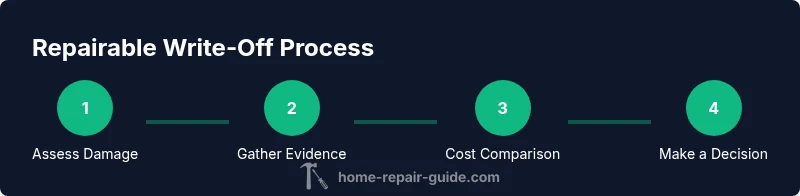
- Contact your insurer promptly to report the loss and confirm coverage for assessment. 2) Collect and submit all evidence (photos, quotes, ownership docs) per their instructions. 3) Do not begin repairs or alter the damaged item before an official decision is issued. 4) Request a written decision that explains how the repairability determination was made. 5) If needed, seek an independent appraisal or second opinion.
When to challenge a decision or seek a second opinion
If you disagree with the insurer's determination, request a detailed written justification and time to review. You can escalate to a supervisor, file a complaint with your state department of insurance (or equivalent), or obtain an independent appraisal. Having independent quotes and a professional opinion increases the likelihood of a fair reconsideration. Remember to document all communications and maintain a calm, factual tone throughout.
Tools & Materials
- Insurance policy documents(Policy number, insurer name, coverage type)
- Recent damaged item photos(Clear, multiple angles, date-stamped)
- Repair quotes(Written estimates from licensed professionals)
- Salvage value assessment(If salvage is possible, gather salvage dealer quotes)
- Ownership proof(Purchase receipt or serial number / VIN)
- Notebook and calculator(For cost calculations and notes)
- Smartphone with camera(For timestamped photos and quick uploads)
Steps
Estimated time: Total time: 2-7 days (depending on insurer response and document readiness)
- 1
Gather essential documents and evidence
Collect policy details, ownership proof, purchase receipts, and any existing damage reports. Take clear, dated photos from multiple angles and organize them by item. This provides a solid evidentiary foundation for claims discussions.
Tip: Label files by item and date; keep originals and backups. - 2
Identify insurer criteria for repairability
Review your policy language or talk to a claims adjuster to understand the thresholds used to classify repairs as repairable vs. unrecoverable. Note any jurisdictional nuances that may affect decisions.
Tip: Ask for the insurer’s written criteria and keep a copy for reference. - 3
Estimate repair costs and compare to replacement value
Obtain formal repair estimates and, if possible, independent quotes. Compare total repair costs to the item’s replacement cost or insured value, considering depreciation where applicable.
Tip: Get at least two quotes to benchmark and avoid single-source bias. - 4
Check salvage options and restrictions
Ascertain whether salvage is permitted under your policy and if selling the damaged item affects eligibility. Gather salvage dealer quotes if salvage is likely.
Tip: Clarify salvage terms in writing to prevent later disputes. - 5
Submit evidence and request a formal decision
Provide all gathered documents to the insurer as instructed and request a written decision that explains how the repairability determination was made.
Tip: Ask for a timeline for the decision and a contact for follow-up. - 6
Review decision and plan next steps
If the decision favors repair, confirm repair plans and warranty terms. If not, consider alternatives like replacement, a second opinion, or dispute resolution.
Tip: Document every communication and keep decision records handy.
FAQ
What qualifies as a repairable write-off?
A repairable write-off is a loss where damage is significant but repairable, with the final decision depending on policy language and jurisdiction. It often involves evaluating repair costs, replacement value, and salvage options.
A repairable write-off is a loss that can be repaired but may be classified as a write-off depending on policy terms. The final call depends on cost and salvage terms.
How do insurers decide if repair is worth it?
Insurers weigh repair costs against the item's insured value or replacement cost, along with safety, age, and salvage value. Thresholds vary by policy and jurisdiction.
They compare repair costs to the item's value and consider safety and salvage rules. Thresholds vary by policy.
What documents are needed to check repairability?
Collect photos, repair quotes, ownership proof, policy details, and any prior claims or maintenance records relevant to the item.
Gather photos, quotes, ownership proof, and your policy details.
Can I appeal an insurer's decision?
Yes. Request a written justification, consider a supervisor review, and obtain independent appraisals if needed. Documentation strengthens your appeal.
Yes, you can appeal by asking for a written reason and seeking a supervisor review with independent estimates if possible.
How does salvage value affect the decision?
Salvage value can reduce the net cost of repair or replacement. If salvage is allowed, it may influence the classification and settlement amount.
Salvage value can lower the repair or replacement cost and influence the insurer's decision.
Watch Video
Key Takeaways
- Assess damage early and document thoroughly
- Understand your insurer's repairability criteria
- Collect photos, quotes, and ownership records
- Do a careful cost comparison before deciding