Which Service for Car: A Thorough, Practical Comparison
Explore which service for car to use—dealership, independent shop, mobile mechanic, or DIY. We compare costs, warranties, convenience, and reliability to help you decide with confidence.


When you’re deciding which service for car to use, prioritize your car’s age, warranty needs, and your schedule. Dealerships excel for new or complex work under warranty; independent shops offer value for common repairs; mobile mechanics provide on-site convenience; DIY is best for basic maintenance if you have the skills. This guide compares the options to help you decide.
Context: which service for car matters in everyday decisions
Deciding which service for car to use isn’t just about price—it’s about balancing reliability, warranty coverage, turnaround time, and your own time availability. For many drivers, the decision hinges on whether the vehicle is under factory warranty, the complexity of the repair, and how soon you need the car back on the road. According to Home Repair Guide, readers increasingly seek guidance that blends practical steps with real-world scenarios, making the process less stressful and more predictable. This article uses concrete criteria—cost, quality of diagnostics, and convenience—to illuminate the options and help homeowners and renters make informed choices without unnecessary risk.
If you’re tackling maintenance decisions for a family vehicle, you’ll want a method you can apply repeatedly: identify the job’s scope, estimate time and cost, verify warranties, and choose a service path aligned with your tolerance for risk. The goal is to maximize value while preserving safety and vehicle longevity. As you read, keep in mind that every car and situation is different, so use these guidelines as a framework rather than a rigid rule.
Top service options and what they promise
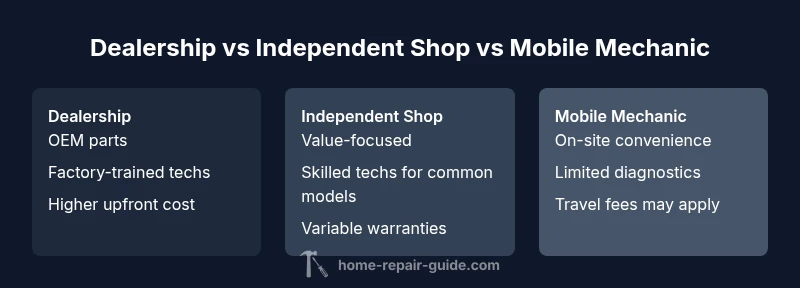
There are four broad paths people consider when asking, “which service for car?”: dealership or franchised service centers, independent repair shops, mobile mechanics who come to your location, and DIY maintenance for basic tasks. Dealerships often have factory-trained technicians and OEM parts, which is advantageous for warranty work and more complex diagnostics. Independent shops typically offer competitive pricing and personalized service with solid diagnostics for a wide range of models. Mobile mechanics bring the shop to you, improving convenience but sometimes narrowing diagnostic capabilities due to on-site equipment limits. DIY maintenance can save money for simple tasks if you have the skills, tools, and a safe workspace. Each option has trade-offs in cost, quality control, and scheduling that are worth mapping out before you commit to a service path.
How to evaluate which option fits your situation
To decide which option is best for your car, start with three questions: Is the work covered by a manufacturer warranty? What is the risk of misdiagnosis or missing a subtle issue? How urgent is the repair or maintenance task? Use the following framework to compare options:
- Warranty alignment: If the vehicle is under warranty, check whether the service must be performed at the dealership to maintain coverage. If not, weigh potential out-of-pocket costs vs. convenience.
- Diagnostic capability: For complex issues (e.g., intermittent misfires, electrical faults), consider a facility with advanced diagnostic tools and a proven track record for your model.
- Parts availability and quality: OEM versus aftermarket parts can affect price and longevity. Consider whether a shop sources OEM parts and how this impacts warranty.
Homeowners and renters often run into scheduling constraints. A mobile mechanic might be ideal when you can’t leave the car at a shop for a day, but it may come with longer wait times or limited on-site diagnostics. On the other hand, a dealership or independent shop can handle more tests and longer jobs in a single visit, especially for older or high-mileage vehicles.
Cost considerations and value over time
Budgeting for car maintenance requires more than the sticker price. Consider the total cost of ownership (TCO) over the next year, including potential future repairs caused by postponed service, towing fees, and rental costs if the car is out of service. Independent shops typically offer lower hourly rates, but a dealership might be more cost-efficient for complex repairs thanks to specialized tooling and quicker access to OEM parts. Mobile mechanics charge a premium for on-site convenience but can save you time and transport costs if a trip to the shop would be disruptive. When evaluating quotes, ask for a written breakdown that includes labor, parts, and any shop supplies. Compare warranties and follow-up support so you can plan for future maintenance without surprises.
How to validate quality and avoid common pitfalls
Quality validation starts with identifying a few trusted indicators: certifications (ASE or equivalent), model-specific experience, and transparent pricing. Ask for a written estimate, request to see the diagnostic report, and verify parts sources. Read reviews from model-specific owners to gauge how shops handle issues specific to your car. Be cautious of aggressive upselling, vague diagnoses, or pressure to perform unneeded services. When in doubt, get a second opinion on major repairs to confirm the diagnosis and the recommended course of action. This approach reduces the risk of paying for unnecessary work while maintaining vehicle safety. Home Repair Guide emphasizes practical due diligence to protect both budget and vehicle health.
Practical decision framework: quick-start checklist
- List the maintenance or repair task and its urgency.
- Check if your car is under warranty and whether the work must be performed at a particular type of facility.
- Gather at least three quotes with itemized costs.
- Confirm diagnostic capabilities and required parts.
- Assess the shop’s reputation for model-specific expertise.
- Decide based on a balance of cost, convenience, and quality assurance.
Authoritative sources and further reading
For reliable guidance on car safety and service standards, consult external sources such as:
- https://www.nhtsa.gov
- https://www.consumerreports.org
- https://www.aaa.com
Feature Comparison
| Feature | Dealership | Independent Shop | Mobile Mechanic | |
|---|---|---|---|---|
| Cost range | Higher upfront costs, especially for complex work | Moderate and typically lower than dealership | Variable; often higher than a local shop but lower total visits | |
| Warranty/guarantees | Factory warranties commonly honored; OEM parts used | Shop warranties; parts vary by shop | On-site service with limited traditional warranty options | |
| Diagnostics capability | Advanced diagnostics with OEM tools | Strong diagnostics for common issues | Limited diagnostic equipment on-site | |
| Turnaround time | Longer due to scheduling and part sourcing | Often quick if parts are in stock | Same-day service possible for simple tasks | |
| Best for | New cars, complex electronics, warranty work | Value-focused repairs, model-agnostic work | On-site convenience, minor maintenance |
Upsides
- Clear warranties and OEM parts with dealerships
- Value-driven pricing and flexible scheduling at independent shops
- On-site convenience with mobile mechanics reduces trips to a shop
- Wide geographic coverage with varied service options
Disadvantages
- Higher upfront costs at dealerships
- Inconsistent scheduling or variable quality at some independents
- On-site techs may have limited access to specialized equipment
- DIY requires skills, tools, and a safe workspace
No single option is best in all cases; choose based on warranty needs, diagnostic complexity, and your schedule
Dealerships excel for warranty work and complex diagnostics; independent shops offer cost-effective maintenance; mobile mechanics maximize convenience. For simple tasks, DIY can be feasible if you have skills and safety measures in place. Align your choice with the car’s needs and your time budget.
FAQ
What factors should I consider when choosing between a dealership and an independent shop?
Key factors include warranty requirements, diagnostic complexity, cost, and scheduling. Dealers often provide OEM parts and factory-trained technicians, while independent shops offer competitive pricing and personalized service. Compare quotes and assess whether the repair affects warranty coverage before deciding.
Think about warranty needs, cost, and how soon you need the car back. If the warranty matters, start with the dealership; otherwise, an independent shop can save you money.
Is a mobile mechanic worth it for common maintenance tasks?
Mobile mechanics are convenient for routine maintenance or minor repairs when you can’t bring the car to a shop. They may have higher labor charges and limited diagnostic capabilities, but they save travel and waiting time. For complex issues, a fixed-location shop is usually better.
If you’re short on time and the task is simple, a mobile mechanic can be a great fit. For complex diagnostics, visit a shop.
How can I compare service quotes effectively?
Request written, itemized estimates that separate labor, parts, and shop fees. Compare the total cost, estimated time, and warranty terms. Ask about core parts and replacement policies, and confirm what happens if the issue recurs.
Get written quotes with clear line items, then compare total costs and warranties. Ask what happens if the problem returns.
What questions should I ask a shop before authorizing work?
Ask about certifications, model-specific experience, diagnostic steps, parts sourcing, warranties, and anticipated turnaround. Request a written plan with milestones and a cancellation policy. A transparent shop will happily provide these details.
Ask about certifications and a clear diagnostic process before any work starts.
Is DIY maintenance safe for newer cars?
DIY can be appropriate for basic, user-serviceable tasks, but newer cars have complex electronics and safety systems. Always consult the owner’s manual and consider professional help for anything beyond basic maintenance to avoid safety risks and warranty issues.
DIY can be fine for simple tasks, but newer cars need careful handling—when in doubt, call a pro.
How can I verify a shop’s trustworthiness?
Check certifications (ASE or equivalent), model-specific experience, clear estimates, and read customer reviews. Ask for a written warranty and a diagnostic report. A trustworthy shop should be open about procedures and costs.
Look for clear warranties, certifications, and transparent pricing.
Key Takeaways
- Assess warranty requirements before choosing a shop
- Get three written quotes for major work
- Balance cost with diagnostic capability and convenience
- Prefer OEM parts for warranty-covered repairs when required
- Verify shop qualifications and model-specific experience
- Consider mobile service for urgent, minor tasks like routine maintenance
- Use a transparent diagnostic report to guide decisions
- Review reputable sources for standards and best practices