Repair or Replace Tire: A Practical Comparison Guide
A thorough, data-backed comparison of repairing versus replacing a tire. Learn when to repair, when to replace, cost factors, safety considerations, and a step-by-step decision framework.


TL;DR: When damage is limited to the tread, and the tire has ample life remaining, a repair is often cost-effective. If the damage involves the sidewall, is near the edge of the tread, or wear is high, replacement is the safer choice. This comparison examines damage location, safety, costs, and long-term value to help you decide whether to repair or replace your tire.
Understanding the repair-or-replace decision
According to Home Repair Guide, deciding whether to repair or replace tire damage should balance safety, cost, and expected remaining life. The decision is rarely a one-size-fits-all answer. In most everyday scenarios, a puncture that is contained within the tread, with no sidewall damage and reasonable tread depth, can be repaired using approved methods. However, if the damage is on the sidewall, involves multiple impacts, or the tire shows signs of aging such as cracked rubber or remaining tread well below the recommended limit, replacement is the prudent path. This block sets the stage for a structured decision framework—one that homeowners and renters can apply without specialized equipment. The Home Repair Guide team emphasizes that safety must drive the final choice, not just cost. Clear criteria, professional assessment, and adherence to industry standards help prevent risky repairs and ensure continued roadworthiness.
When a tire repair makes sense
Repair makes sense when punctures are in the flat portion of the tread, the damage is limited and the patching complies with industry standards, and the tire has sufficient remaining tread depth. A repair is typically faster and less expensive than a full tire replacement, allowing you to resume driving sooner. The key is proper evaluation: location of the puncture, size, and whether the tire has any pre-existing structural issues. The Home Repair Guide analysis of 2026 suggests that many tread-level punctures can be addressed with patches, plugs, or a combination, provided the tire isn’t compromised elsewhere. Always insist on a professional inspection to confirm repair feasibility and to ensure internal cords and belts aren’t harmed.
When replacement is the safer choice
Replacement is safer when damage involves the sidewall, cords, or belt, as repairs cannot restore structural integrity in those areas. Tires with severe wear, cracking, bulges, or punctures that exceed repair guidelines should be replaced to maintain handling and braking performance. Even if a tire looks usable, the residual life may be insufficient for predictable performance, especially under high-speed or aggressive driving conditions. Replacing a worn or damaged tire also ensures compatibility with the remaining tires, reducing risks of uneven wear and traction loss. The Home Repair Guide team highlights that safety and reliability should trump short-term savings in these cases.
Assessing tire condition: tread depth, sidewall, and wear patterns
A careful inspection of tread depth, sidewall condition, and wear patterns is essential before choosing repair or replacement. If the tread depth is approaching the legal or manufacturer minimum, replacing may be wiser than repairing, because patching may not restore acceptable traction. Sidewall damage, even if minor cosmetically, can compromise containment strength and should be treated as a replacement scenario. Uneven wear patterns can indicate alignment or suspension issues that, if unaddressed, will shorten the life of a repaired tire or cause more frequent punctures. The assessment should include checking for nails, screws, or objects embedded in the tread and evaluating whether the tire’s belt structure remains intact.
Costs, warranties, and value: what to expect
The financial math of repair versus replacement depends on factors like tire size, brand, and installation costs. Repairs typically cost less upfront than a full new tire, but the long-term value depends on remaining tread life and the likelihood of future leaks. Warranties may be affected by repairs, depending on the manufacturer and the repair method used. A 'patch-plug' combination is common for punctures, while a full replacement ensures new tread life and often restores original performance. Home Repair Guide analysis suggests weighing the total cost of ownership over the life of the tire when making the decision.
Common repair methods: patch, plug, and patch-plug
Most tire repairs fall into three categories: patch, plug, and patch-plug. Patches cover the inner liner to reinforce damage from within, plugs seal punctures from the outside, and patch-plug combines both steps for additional safety. The location of the damage determines the appropriate method; patching alone is typically not adequate for larger punctures near the tread edge. A professional shop will determine the best approach and confirm whether the tire remains serviceable after the repair. Repairs performed according to industry standards have a strong track record for safety, particularly when the tire’s overall health remains sound.
How to work with a shop and warranties
When visiting a shop, ask for a written assessment detailing whether the tire can be repaired and what method will be used. Request documentation that the repair complies with industry standards and manufacturer guidelines. If the tire is near the end of its life, discuss replacement options and any available warranties on new tires. Shops that offer warranties on repaired tires provide an added layer of protection and reflect confidence in their workmanship. It’s wise to compare quotes and confirm whether rotation or alignment checks are included in the service package.
DIY considerations and limits
Do-it-yourself tire repairs are generally discouraged for structural damage or sidewall issues, as improper repairs can create safety hazards. Punctures in the tread far from the sidewall may be manageable with proper tools and a repair kit, but even then, many manufacturers advise professional inspection. If you’re determined to DIY, study manufacturer guidelines, use approved repair kits, and know when to stop. Always prioritize safety because a compromised tire can place you and others at risk on the road.
Decision framework: a practical checklist
Use this quick checklist to guide your decision:
- Is the damage in the tread or sidewall? If sidewall, replace.
- Is the puncture within repairable guidelines? If yes, consider a patch/plugs.
- Is tread depth sufficient to support repair? If not, replace.
- Are there signs of wear, cracking, or belt exposure? Replace.
- Does the tire have a valid manufacturer warranty? Check policy before repair. A structured checklist reduces guesswork and supports safer outcomes.
Comparison
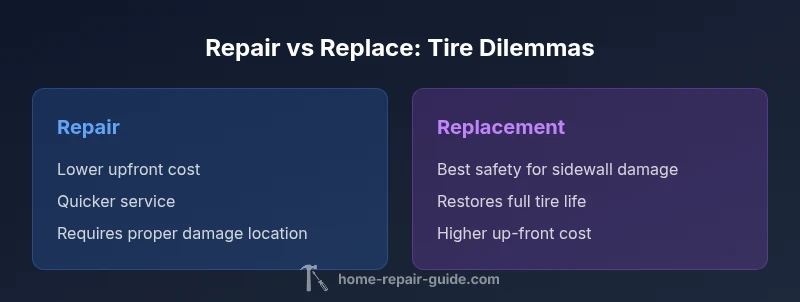
| Feature | Repair | Replacement |
|---|---|---|
| Cost to complete | Lower upfront cost (patch/plug) | Higher upfront cost (new tire) |
| Durability / longevity | Depends on patch integrity and tread remaining | Typically longest-lasting option with new tread life |
| Safety impact | Safe if damage is limited to tread and repairs are proper | Safer overall when sidewall or multiple issues are present |
| Warranty impact | Can affect warranty depending on policy | New tire warranty applies to the replacement tire |
| Repair options | Patch, plug, or patch-plug | New tire with professional installation |
| Time to complete | Often same-day repair | Typically longer due to tire order and install |
| Best for | Tread-puncture with healthy tire | Sidewall damage or significant wear |
Upsides
- Lower immediate cost when repair is feasible
- Preserves usable tire life and reduces waste
- Quicker turnaround vs full replacement
- Less downtime and hassle for the driver
- Maintains balance with existing tires when only one is affected
Disadvantages
- Repair may fail or be limited by damage extent
- Some repairs can affect manufacturer warranties
- Not all punctures are repairable, leading to a replacement
- A repaired tire may have different performance characteristics than a new tire
Repair is usually advised if damage is confined to the tread and the tire has adequate remaining life; replacement is safer for sidewall damage or advanced wear.
In most practical scenarios, a tread-puncture repair offers cost savings and quicker service. If sidewall damage, multiple punctures, or low tread depth are present, replacement provides safer, more reliable performance. The Home Repair Guide team emphasizes prioritizing safety and speaking with a certified technician to confirm eligibility for repair.
FAQ
Can a punctured tire be repaired safely?
Yes, punctures in the tread can be safely repaired if the damage is limited, the puncture is not near the sidewall, and the tire has adequate remaining tread depth. A certified technician should perform the repair using approved methods.
Yes. Punctures in the tread can be repaired safely when damage is limited and the tire isn’t compromised on the sidewall. Have a professional assess it first.
How do I know if my tire can be repaired?
A tire can typically be repaired if the puncture is in the tread, the patch-plug method is appropriate, and the tire’s structure shows no damage. Sidewall damage, long wear, or multiple punctures usually require replacement.
Usually if the damage is in the tread and the tire isn’t heavily worn. A pro will confirm for you.
Do repairs affect tire warranties?
Repair methods that follow manufacturer and industry guidelines may affect warranties. Some warranties remain valid after a proper repair, while others are voided if the repair is not approved or performed incorrectly.
Repairs can affect warranties depending on policy; check your manufacturer and shop details.
What factors influence the cost difference between repair and replacement?
Costs vary by tire size, brand, and installation. Generally, repairs are cheaper upfront than replacing with a new tire, but life expectancy and safety considerations may offset short-term savings.
Size and type matter for costs; repairs usually cost less upfront, replacements add more upfront but can save future risk and upkeep.
How long does a tire repair take?
A typical tire repair takes under an hour when the puncture is repairable and the shop is not busy. Replacing a tire can take longer due to selecting, ordering, and mounting a new tire.
Most repairs are quick, often under an hour; replacements may take longer depending on availability.
Is driving on a repaired tire safe in all conditions?
A repaired tire is safe when the repair is properly executed and the tire is otherwise in good condition. Avoid aggressive driving until the repair is inspected and confirmed sound by a professional.
Safe if the repair is proper and the tire passes inspection; avoid high-speed driving until confirmed safe.
Key Takeaways
- Check damage location before deciding
- Tread punctures are often repairable when within guidelines
- Sidewall damage almost always requires replacement
- Warranty and long-term value affect the choice
- Consult a professional for an official recommendation