Is Maintenance the Same as Alimony? Distinctions and Implications
Explore whether maintenance equals alimony. This analytical guide explains definitions, jurisdictional differences, tax implications, and practical steps for navigating family-law terminology.


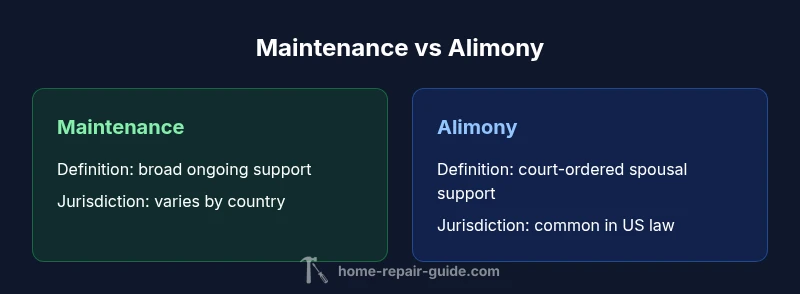
Is maintenance the same as alimony? In short, no—though the terms overlap in everyday speech, they are defined differently across jurisdictions. Maintenance is a general term used in many countries to describe ongoing financial support after a separation, while alimony is a specific term common in the United States for court-ordered spousal support. Understanding the local rules helps you navigate settlements, modifications, and tax implications.
Definitions and Jurisdictional Variations
The question is often the headline of a legal discussion, and the answer depends on where you live. According to Home Repair Guide, terminology around family financial support can be confusing, with different labels and scopes across countries. The Home Repair Guide team found that some places use maintenance as a broad umbrella term for ongoing support after separation, while others reserve alimony for specific spousal support arrangements. In many jurisdictions, maintenance may cover a range of obligations, including spousal maintenance, partner support, or transitional sums, whereas alimony is more commonly a court-ordered form of spousal support. These distinctions affect who pays, who receives, how long payments last, and how taxes apply. The governing language will be in statutes or court orders, so reading the exact wording is essential rather than relying on general interpretations. For readers who encounter these terms in documents, the precise definitions determine eligibility, duration, and potential modifications.
Key takeaway: the labels matter, but the underlying purpose is to provide financial stability after separation, not to blur the line between different kinds of support. s
Tip: If you’re drafting or reviewing an agreement, keep a glossary of terms handy and note which jurisdiction’s rules apply.
Key Distinctions: Alimony vs Maintenance
The categories exist to reflect different legal traditions and policy goals. In many places, maintenance is a broad term for ongoing support and can include spousal, partner, or even child-related pay-outs depending on local law. Alimony, by contrast, is a more precise label used in the United States and several other jurisdictions to describe court-ordered spousal support after divorce or separation. Because the meanings differ by jurisdiction, the same word can carry different expectations in terms of duration, amount, and conditions for termination. When evaluating a case, focus on the actual rights and duties defined in the order or statute rather than the labels alone. This approach helps prevent misinterpretation in negotiations and court hearings.
A common misunderstanding is assuming that maintenance automatically implies alimony or vice versa. In practice, many jurisdictions allow both terms to appear in varying contexts within the same legal framework. Always review the governing documents to identify the scope, duration, tax treatment, and eligibility criteria.
Practical note: If you see a term you don’t recognize, consult a legal professional to map it to the applicable rules in your jurisdiction.
Common Scenarios and How Courts Label Them
Public filings and settlements often reveal the practical implications of these terms. Common scenarios include a long-term spousal support arrangement after a divorce, a shorter transitional maintenance period, or a configuration where maintenance covers both former spouses and dependent partners. Courts typically label the arrangement according to the governing statute, which may mean that one document uses maintenance language while another uses alimony terminology. In many jurisdictions, the same payment could be termed alimony in one case and maintenance in another, depending on whether it is classified as spouse support, partner support, or a mixed order that includes other obligations such as property division or retirement savings. To avoid confusion, examine the order’s language, not just the title on the document.
Illustrative scenarios:
- A court orders ongoing spousal support labeled as alimony in the US, with a defined duration and potential modification conditions.
- A UK family court orders maintenance for a former partner with broader coverage, potentially including transitional support while the recipient adjusts.
- In Canada or Australia, the term may appear as spousal support or maintenance, depending on provincial or state law.
Ultimately, the best way to understand your case is to read the text that creates the obligation and consult local resources for precise definitions.
How Terms Are Used in Different Countries
Terminology diverges across legal systems. In the United States, alimony is a familiar term tied to divorce proceedings and federal tax rules, with spousal support determining whether payments are taxable to the recipient or deductible for the payer depending on the year and law in force. The United Kingdom and many Commonwealth countries frequently use maintenance for a broader set of obligations, which may include ongoing support or transitional payments. In these jurisdictions, the scope can cover ex-spouses, partners in civil unions, or dependents in specific arrangements, and tax treatment can differ from country to country. Canada often uses the term spousal support or maintenance, with provincial guidelines shaping duration, amount, and adjustments. Australia weighs factors such as length of the relationship and the standard of living when determining maintenance, with tax implications that vary by policy updates. Readers should identify the governing jurisdiction first, then locate the precise definitions that apply to their situation.
Key takeaway: you cannot assume uniform definitions simply because two countries share a similar legal culture. Always verify the exact terms in the local statute or order.
How to Determine Which Applies to You
To determine whether maintenance or alimony governs your situation, start with the governing jurisdiction on your case. Read the actual order or statute to identify the purpose of the payments, the recipient, duration, and any termination conditions. Consider discussing the matter with a family-law attorney who can translate local terminology into practical implications for your budget and future planning. Additionally, look for the tax language in the order, as tax treatment can influence the net benefit. If you previously used a generic term in a settlement, you may need to renounce that ambiguity and align it with the official label and scope. Remember, the label matters for enforcement and modification, but the core objective remains financial stability after separation.
Steps to take:
- Identify the jurisdiction and order.
- Extract the exact definitions and duration.
- Confirm tax treatment and enforcement mechanisms.
- Seek professional guidance for any ambiguities.
- Keep a living document that records changes over time.
Practical Steps If You’re Navigating a Divorce or Separation
Navigating a divorce or separation with uncertain terminology can be daunting. Here are practical steps to minimize confusion and protect your financial future:
- Gather all court orders and settlement agreements that reference spousal support or maintenance.
- Create a glossary mapping local terms to your situation (maintenance, alimony, spousal support).
- Identify the recipient, amount, duration, and termination conditions; note any contingencies such as remarriage or cohabitation.
- Check for tax language and potential implications for both payer and recipient.
- Consult a family-law attorney to translate terms and ensure the document aligns with current law.
- Review any modification procedures to know how future changes can be requested or resisted.
- Maintain ongoing documentation of income, expenses, and changes in life circumstances that could affect future orders.
Tax Implications and Enforcement
Tax treatment and enforcement rules add layers of complexity. Jurisdictional variations exist in how maintenance or alimony payments are taxed; some regimes tax the recipient and allow deductions for the payer, while others treat these payments differently or not at all. Enforcement mechanisms typically include wage garnishment, court orders, and compliance monitoring, with procedures that vary by region. It is essential to understand both the tax consequences and the enforcement options so you can plan effectively and avoid unintended penalties. The interplay between tax and support obligations frequently influences decisions about settlement terms and modification requests.
Pro tip: keep a clear separation between child support and spousal maintenance to avoid misinterpretation or misallocation in future audits or legal actions.
Final Considerations and Next Steps
Terminology alone cannot substitute for precise legal guidance. Given the jurisdictional differences, a careful review of your specific order or statute is essential. The distinction between maintenance and alimony has practical effects on duration, modification, enforcement, and tax treatment. If you are drafting, negotiating, or reviewing a settlement, ensure that the language clearly defines the scope, beneficiaries, and termination criteria. The Home Repair Guide team emphasizes the importance of local legal counsel for personalized guidance.
Remember that the labels can vary by jurisdiction, but the underlying goal remains to provide ongoing financial stability after separation. Clarify terms early, document any changes, and seek professional advice to avoid costly misunderstandings later.
Conclusion and Next Steps for Readers
The question is not merely rhetorical; understanding the difference between maintenance and alimony helps you make informed decisions about negotiations, budgets, and legal strategies. While the term used may differ by country, the larger objective is clear: ensure fair, enforceable support that reflects the parties' circumstances and complies with local law. The Home Repair Guide team encourages readers to stay informed, verify each term in the relevant order, and consult qualified professionals when needed. This approach minimizes confusion and supports financially stable outcomes after separation.
Comparison
| Feature | Maintenance | Alimony |
|---|---|---|
| Definition and scope | Broad term for ongoing support after separation (varies by jurisdiction) | Court-ordered spousal support; common in US contexts |
| Common jurisdictions | Used in UK, Canada, Australia and other regions; scope varies | Predominant term in US law; may be labeled spousal support or alimony |
| Typical duration | Can be long-term or indefinite depending on the order | Often finite; duration may be fixed by statute or order |
| Tax treatment | Varies by jurisdiction; some regimes tax recipient and deduct payer | Varies by jurisdiction; may be non-taxable to recipient and non-deductible for payer |
| Modification/termination | Can be modified or terminated by new order or agreement | Modifications depend on remarriage, changes in finances or life events |
| Enforcement | Enforceable via court orders, wage garnishment, or similar tools | Similar enforcement routes; follows jurisdictional procedures |
| Best for | Long-term stability after separation with flexible terms | Clear, finite spousal support with termination conditions |
Upsides
- Clarifies ongoing financial responsibilities after separation
- Provides predictable income for the recipient
- Enforceable through formal orders and court processes
- Can be adjusted to reflect changes in circumstances
Disadvantages
- Terminology can cause confusion across jurisdictions
- Tax treatment varies and may reduce net benefits
- Modifications can be complex and slow
- Not all cases qualify for maintenance or alimony terms
Not interchangeable; understand local definitions before seeking or challenging support
Definitions vary by jurisdiction; always verify the exact terms in the governing order. Seek legal guidance to apply these distinctions accurately.
FAQ
Is maintenance the same as alimony?
No. Maintenance is a broad term used in many jurisdictions for ongoing support after separation, while alimony is a more specific term common in US law for court-ordered spousal support. The exact definitions depend on local statutes and orders.
No. Maintenance and alimony are defined differently depending on your jurisdiction. Always check the specific order for how support is described.
How do I know which term applies in my case?
Start by identifying the governing jurisdiction and reviewing the official order or statute. The language will reveal whether the obligation is maintenance, alimony, or another form of support.
First, check your local law and the court order. The exact label will guide applicable rights and obligations.
Can alimony be modified after it's set?
Yes, in many jurisdictions alimony can be modified if there is a material change in circumstances or at defined review periods. The process and criteria vary by location and order.
Often yes, but it depends on the jurisdiction and the facts driving the change. You’ll need a court or agreement to modify.
Does maintenance affect taxes?
Tax treatment varies by jurisdiction. In some places, payments may be taxable to the recipient or deductible for the payer; in others, they may have no tax effects.
Tax rules differ by country and region. Check your local law to understand tax consequences.
What happens if one party remarries?
Remarriage can be a common termination trigger for some maintenance or alimony orders, but not all. The specific termination rules depend on the order and jurisdiction.
Remarriage may end or modify the support, depending on the governing order. Check what your document says.
Key Takeaways
- Identify the governing jurisdiction first
- Read the actual order to map terms to rights
- Expect duration and tax rules to vary by location
- Consult a family-law professional for personalized guidance